
For expatriates in Saudi Arabia, an Iqama is a mandatory legal identification for long-term residency in the country. It is different from a residency visa to grant you legal entry for the purpose of work or any long-term purposes. Without a valid Iqama, you risk severe financial penalties, struggle to access basic necessities like banking and healthcare, and jeopardize your long-term residency.
In this guide, we will give you a comprehensive guide about how to obtain an Iqama. This includes understanding the Kafala system, managing compliance obligations, and maintaining your Iqama status.
What is an Iqama in Saudi Arabia?
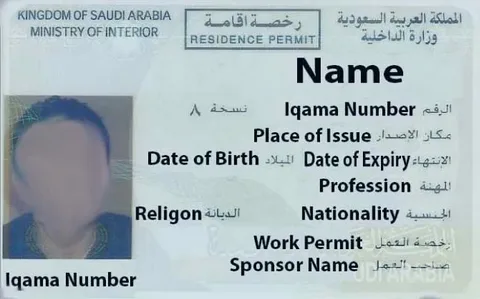
The Iqama (Arabic for "residence") is the mandatory legal identification and residence permit issued by the Saudi government to all foreign nationals living in the country. It is a physical card that functions as both a residency status document and a work authorization. In contrast, a work visa is a temporary sticker or digital authorization issued by a Saudi embassy abroad.
Here is a sample of an Iqama:
Without a valid Iqama, you cannot legally perform essential daily activities for long-term residency. This includes opening a bank account, registering for a mobile phone line, signing a housing rental contract, enrolling children in school, or accessing public healthcare services.
Understanding the Sponsorship (Kafala) System
For foreigners relocating to Saudi for work, your employer is central to your Iqama processing. Under the Saudi Labor Law, employers are responsible for initiating, paying for, and completing the Iqama issuance process within 90 days of your arrival.
Your employer must also be qualified and be eligible to hire foreigners in Saudi Arabia. They must secure a Maktab Amal levy or Expat levy from the Ministry of Human Resources and Social Development (MHRSD). It verifies the company has the legal quota and financial standing to hire a non-Saudi worker.
Before the Iqama card is issued, several non-negotiable requirements must be met:
- Valid employment contract and professional registration (if applicable): As the employee, you must have a valid contract attested and registered in the government system (Qiwa). Professionals (e.g., engineers, doctors) must also have their educational degrees attested and professional body registrations verified.
- Mandatory comprehensive medical examination (post-arrival): Upon arrival, you must undergo a full medical check-up at a Ministry of Health-approved center to confirm fitness for work and absence of communicable diseases.
- Approved health insurance coverage throughout the duration: Valid, comprehensive health insurance must be secured by the employer for you and your dependents (if applicable) before the Iqama can be issued or renewed.
The Different Types of Iqama in Saudi Arabia
To accommodate the diverse nature of foreign residency, Saudi Arabia offers various Iqama classifications. Understanding your specific type is crucial as it determines your rights, legal restrictions, and financial obligations in the Kingdom.
A. Standard Work Iqama
A standard work Iqama is granted to the vast majority of foreign professionals and laborers sponsored by a Saudi company or establishment. This category includes skilled professionals, management roles, and technical workers, essentially covering any expatriate hired under the traditional sponsorship model.
Standard Work Iqamas are generally issued for a period of one year, although two-year renewals are common for long-term employees. The government allows renewals to be processed for shorter, quarterly durations (3, 6, or 9 months) to offer financial flexibility in managing the mandatory government levies.
Your Iqama is linked to your employment contract. If your contract ends or is terminated, your residency status will be affected. You would need to transfer the work sponsorship or obtain a Final Exit Visa.
B. Premium Residency (The "Green Card" Alternative)
This program offers independence from traditional sponsorship for qualified individuals, primarily high-net-worth investors, innovators, and highly skilled professionals. There are two main types:
| Permanent Premium Residency (Unrestricted) | Renewable Premium Residency (Annual) |
|---|---|
| Requires a substantial one-time fee payment (SAR 800,000), granting permanent residency status without the need for annual renewal. Provides absolute security and long-term planning capability for the holder and their family, only requiring compliance with general laws. | Requires an annual fee payment (SAR 100,000), granting the same benefits but requiring annual renewal. Provides a more flexible, subscription-based approach to the premium benefits. Suitable for those who prefer to keep their long-term commitment flexible. |
Premium residency holders gain unparalleled autonomy in the Kingdom compared to standard Iqama holders. Specific privileges include:
- The right to work for any public or private sector entity without being subject to the traditional employment transfer rules.
- The authority to establish and operate businesses, including sole proprietorships, and manage them directly without the requirement of a Saudi partner (kafeel).
- The legal right to own residential, commercial, and industrial property in most areas of the Kingdom (excluding Makkah and Madinah, which have specialized rules).
- The ability to sponsor immediate family members (parents, spouses, and children) directly, without the limitations of minimum salary requirements imposed on standard Iqama holders.
- The freedom to enter and exit the Kingdom at will, without requiring a separate Exit/Re-Entry Visa for every trip.
C. Dependent/Family Iqama
Dependent/ Family Iqama is used for sponsoring family members primarily your spouse or children below 18 years of age. This permit grants your dependents legal residency. This enables your family members access crucial facilities like private and international schools and essential medical services under the family's health insurance policy. The family's residency status remains entirely tethered to the main Iqama holder's employment.
Your family members are strictly prohibited from seeking or accepting any form of employment in Saudi Arabia. Should a dependent wish to work, they must first secure a job offer from an eligible Saudi employer, undergo a change of status, and successfully obtain their own individual Work Iqama and Work Permit.
D. Investor and Specialized Iqama Types
An Investor or Business Iqama are issued to individuals who have either established or invested in a commercial entity in Saudi Arabia. With this permit, you are allowed to reside in Saudi Arabia to manage your investments and company operations. The process is typically facilitated through the Ministry of Investment (MISA) and requires you to meet specific capital or operational benchmarks.
Unlike the Standard Work Iqama, the Investor Iqama is tied to the success and compliance of the registered commercial entity rather than an employment contract with a third-party sponsor. This type grants the holder a degree of autonomy necessary for business management.
E. Iqama for students
This category is issued to foreign students who have been officially accepted and enrolled in approved Saudi universities, colleges, or educational institutions. The student's residency is directly sponsored by the educational institution itself, which handles the necessary paperwork and renewal processes.
The validity of the Student Iqama is tied to the duration of the study program, requiring continuous academic attendance and compliance with university rules. Like dependent holders, students under this status are generally not authorized to work while residing in Saudi Arabia.
The Step-by-Step Application and Issuance Process
Processing an Iqama has three-phases spanning from the initial job offer to confirming your residency status.
Phase 1: Pre-Arrival (Employment Visa)
Your employer must first submit a Work Visa request to the MHRSD under the Ministry of Foreign Affairs (MOFA) and generate a unique visa authorization number. Once approved, you must submit all your credentials to the Saudi embassy or consulate within your home country. This involves attesting necessary documents (degrees, certificates, criminal checks). You will then be issued a physical or digital Employment Visa. This is a stamp or a document necessary to board a plane and enter the country.
Phase 2: Post-Arrival and Activation
Upon arrival, your initial entry is logged by the Jawasat (General Directorate of Passports), This formally activates the 90-day countdown period within which the employer must finalize the Iqama issuance process through the Muqeem portal. They would need to do the following:
- Submit all required digital documentation.
- Ensure the Work Permit Levy (Maktab Amal fee) and basic Iqama fee are paid via the SADAD system.
- Confirm your health insurance coverage.
You must complete a mandatory medical check-up in a Ministry of Health-approved facility. The results are electronically submitted directly to the government system. Only upon receiving a 'Medically Fit' status confirmation can your employer proceed with the final stages of the Iqama application.
Phase 3: Finalization
To finalize your Iqama, you need to submit your biometrics at the designated Jawasat center or through specific airport channels for national ID databases. Once all mandatory fees (Iqama, Work Permit Levy, Dependent Levy) have been confirmed as paid and all medical and biometric checks are cleared, the Jawasat grants final approval and prints the physical Iqama card.
While the physical card is the official proof, the Iqama status is instantaneously updated digitally. The employee can and should immediately verify their legal status, validity date, and job title using the Absher Individuals platform (the main government portal for residents) or, less commonly, through the Muqeem portal used by employers. This digital record serves as the primary proof for many online services and financial transactions.
To streamline the Iqama process, Emerhub provides comprehensive relocation services tailored for you. We can coordinate medical exams, biometrics, and portal submissions via Absher or Muqeem. We handle ongoing compliance needs such as Iqama issuance, renewals, and related documentation through partnerships with authorities like the Ministry of Investment (MISA).
Start your journey in Saudi Arabia with Emerhub’s visa and relocation services. Fill out the form below for a free consultation with our local compliance experts!
Frequently asked questions
How long does it typically take to receive the Iqama after arriving in Saudi Arabia?
Once you arrive in Saudi Arabia and complete the mandatory medical examination and biometric registration (fingerprinting/photos), the employer usually has a processing window. The entire process, from arrival to issuance, typically takes between 1 to 3 months, depending on the promptness of the employer and the efficiency of the government systems (Jawasat/Muqeem).
Is the Iqama the same as the Work Visa?
No. The Work Visa is a travel document issued by the Saudi embassy in your home country that grants you temporary entry to Saudi Arabia for the purpose of work. The Iqama is the physical residency ID card issued after you arrive, confirming your legal status as a resident worker in the country.
Can I transfer my Iqama (sponsorship) to a new employer?
Yes, this process is known as Naqal Kafala (Sponsorship Transfer). Under recent labor reforms (Job Mobility Initiative), employees who meet certain criteria may be able to transfer their sponsorship without their current employer's explicit consent, particularly if: The new employer initiates the transfer request through the Qiwa platform.
Can a dependent work in Saudi Arabia?
A dependent (spouse or child) holding a Dependent/Family Iqama cannot legally work. To gain employment, the dependent must successfully transition to an Employment Iqama, which requires securing a job offer from a sponsoring employer and converting their residency status.
Do I need a visa to leave and re-enter Saudi Arabia?
Your Iqama allows you to reside and work, but to travel outside the Kingdom and return, you must first obtain an Exit and Re-Entry Visa through the Muqeem or Absher platforms. Traveling without one will prevent you from re-entering and may lead to Iqama cancellation.