
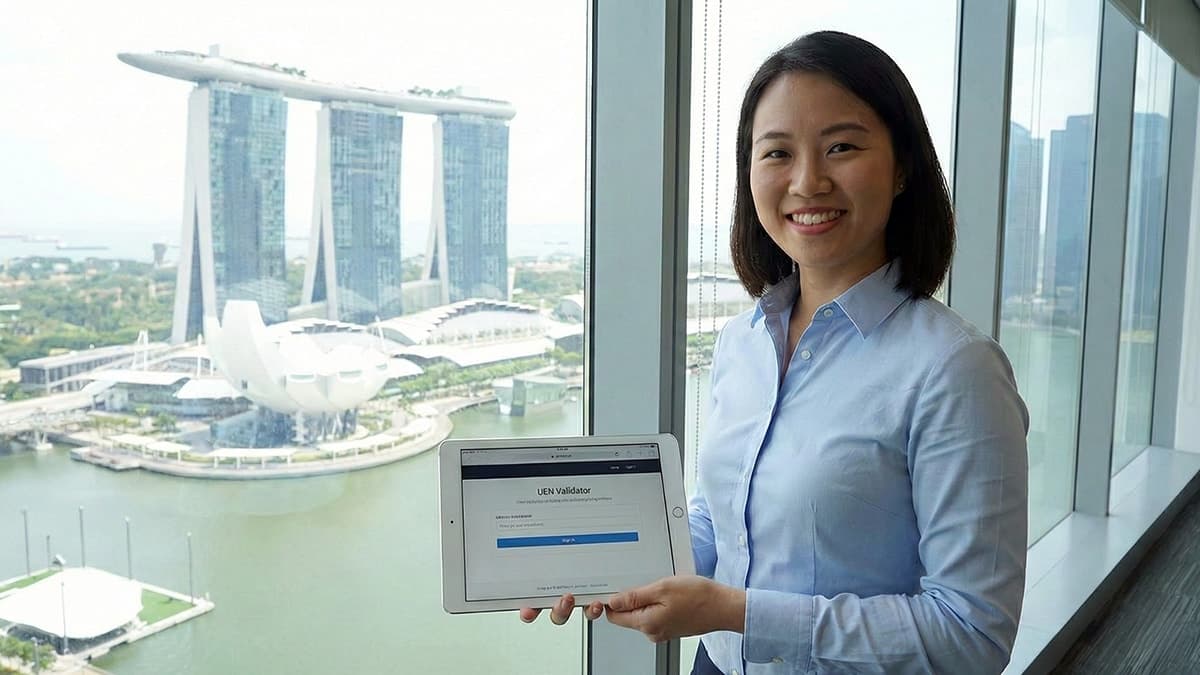
If you are doing business in Singapore, you will use the Unique Entity Number (UEN) constantly. It is the standard identification number for every registered entity in the country. This number is required for everything from tax filing to issuing invoices.
Since the government issues these numbers automatically upon registration, you don't need to worry about creating one. However, you need to ensure the UENs you receive from partners or suppliers are correct. A simple typo on an invoice can lead to administrative headaches later.
This guide provides a quick tool to validate UEN formats and explains how to read the different number structures.
Free UEN Format Validator
Use this widget to check if a UEN follows the correct Singaporean format. If the structure is valid, the tool provides a direct link to SSICdata.com to learn more about the company.
Why Check a UEN?
Verifying a UEN is a standard part of due diligence when onboarding a new vendor or client.
The primary reason to check is accuracy. UENs use a checksum formula in which the final letter is calculated from the preceding digits. If a supplier accidentally swaps two digits or makes a typo on an invoice, the UEN becomes invalid. Catching this early prevents issues with GST reporting or payment processing.
Secondly, it confirms legitimacy. Ensuring the UEN belongs to the company name on the contract confirms you are dealing with a registered Singapore entity.
Understanding the UEN Formats
You can often identify the type of entity you are working with just by looking at the UEN structure.
In 2009, the Singapore government unified the identification system. Previously, companies used different numbers for different agencies. Today, there are three main formats you will encounter:
1. Local Companies (Pte Ltd)
This is the most common format for private limited companies.
- Format:
YYYYnnnnnC - Example:
202512345K - Insight: The first four digits represent the year of incorporation. A company with a UEN starting with
2025is a newly registered entity.
2. Businesses (Sole Proprietorships & Partnerships)
This format is typically seen in businesses registered before the 2009 change, or traditional sole proprietorships.
- Format:
nnnnnnnnC - Example:
53123456A - Insight: These are often established businesses that retained their original Registry of Companies number after the 2009 unification.
3. Other Entities ("New" UENs)
Entities like Limited Liability Partnerships (LLP) and Foreign Company branches use a descriptive alphanumeric format.
- Format:
TyyPQnnnnC - Example:
T19LL1234G - Insight: The code tells you the entity type.
LLstands for LLP, whileFCindicates a Foreign Company.
Can You Choose Your UEN?
Generally, the system auto-generates a UEN for you upon registration. It is purely random.
However, for companies that value specific number patterns (for branding or Feng Shui), ACRA offers a Special UEN (SUN) service. By paying an additional fee during incorporation, you can select a number from a reserved list.
- Tier 1 ($3,000): Premium numbers with consecutive identical digits (e.g.,
8888) or ending in '8'. - Tier 2 ($1,000): Numbers with repetitive patterns (e.g.,
121212) or ending in triple digits (e.g.,777).
This is entirely optional. A standard, randomly assigned UEN functions exactly the same way for all legal and business purposes.
Getting Your Own UEN
You do not need to apply for a UEN separately. It is issued automatically when you register your legal entity with ACRA.
If you are setting up a company in Singapore, Emerhub can handle the incorporation process for you. We ensure your entity is structured correctly, compliant with local regulations, and properly registered so you can start business immediately.
Contact our consultants by filling out the form below to discuss your company registration needs.