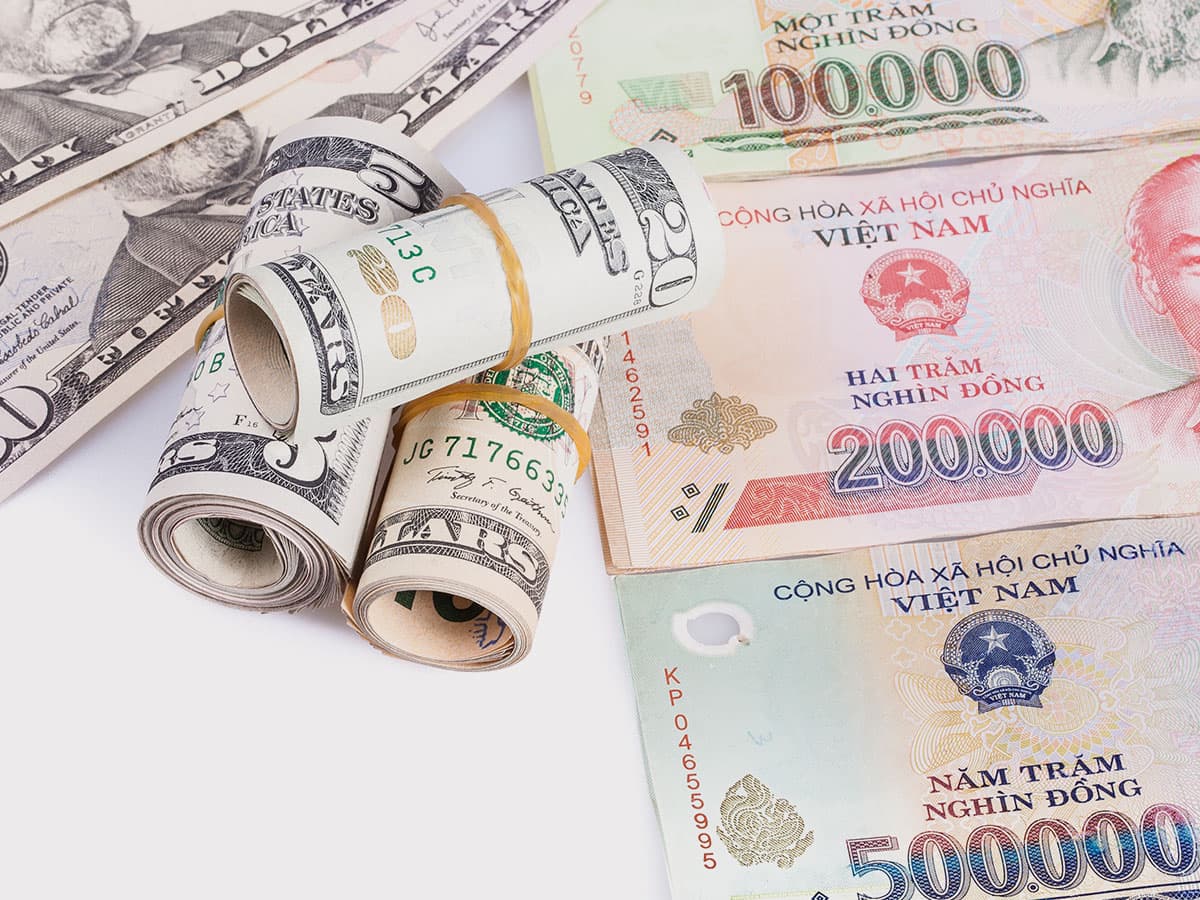
A general understanding is that taking money out of Vietnam is difficult.
In reality, it is not that complicated if you are familiar with the possibilities and have the relevant paperwork prepared. For this reason, we have put together the following article to present you the 5 ways of taking money out of a company registered in Vietnam.
#1 Dividend payments
Dividends are paid to owners out of the profit available after the deduction of the corporate income tax, other expenses, and previous losses if there are any.
Investors will receive dividend payments according to the percentage of their capital contribution.
Dividends are subject to personal income tax (PIT) which rates depend on how many owners the company has.
| One Owner | Dividend Tax Rate |
|---|---|
| Corporate investor (e.g parent company), either domestic or foreign | 0% |
| Foreign or resident individual investor | 0% |
| Two or More Owners | Tax Rate |
|---|---|
| Resident | 5% |
| Foreign | 5% |
| Corporate investor | 0% |
Dividends are paid once a year after the annual report has been approved.
If the low dividend tax rates seem too good to be true, remember that you can pay dividends after you have paid all applicable taxes such as corporate income tax.
The bank will require relevant documents explaining the reason for the transfer before they make any payments.
If you are using Emerhub’s
then all you need to do is just sign the papers and wait for the dividend payment to be transferred to your bank account.
#2 Service agreements
Banks in Vietnam require a written explanation why you want to transfer money out of the country. This is the reason people think that taking money out of Vietnam is difficult.
All international payments must be made at the bank. Make sure to bring all the relevant documents with you. Without them, the bank will simply refuse to make the payment.
Acceptable documents are, for example:
- service agreements
- sales contracts
- trade agreements
Sometimes the bank may also ask for an additional document, such as an invoice. Note that service agreements are also subject to value-added tax at a rate of 10%.
#3 Loan from the parent company
There can be several expenses before the capital contribution that, nevertheless, need to be covered. Where to get resources for these costs?
These expenses are most commonly covered by the parent company or the founder. This type of funding can be recorded as a loan. It also enables you to access foreign funds without losing any money.
You will need an authorization from the parent company to cover the expenses that occur before the capital contribution. You can take the loan for construction, renovation, leasing, etc.
The key is to register the loan from the parent company as an obligation which the company must repay to the investors. Terms are stipulated in a loan agreement.
The outstanding loan can be a method of reducing the corporate income tax when your revenue is less than the loan obligation. However, if your revenue is greater than your obligations, you still need to pay the corporate income tax.
Giving loan is beneficial to the investor as well since taking back the loan will bear less tax than paying out dividends.
#4 Salary payments
Another way to take money out of Vietnam is by paying salaries from your company registered in Vietnam. Often the investors are, for example, directors or board members of the company as well. This allows them to receive a salary.
Salaries are paid based on the payslips that are issued by the accountant.
In Vietnam, salaries are subject to Personal Income Tax (PIT). Different rates of PIT apply to residents and non-residents. A resident is someone who:
- spends 183 or more days in Vietnam in a total period of 12 months
- has a temporary/permanent residence permit
- has their address registered with the police
For residents, the tax is progressive and varying from
5% to 35%
.
| Monthly Taxable Income for Residents* | Tax Rate |
|---|---|
| Up to 5,000,000 VND | 5% |
| 5 to 10,000,000 VND | 10% |
| 10 to 18,000,000 VND | 15% |
| 18 to 32,000,000 VND | 20% |
| 32 to 52,000,000 VND | 25% |
| 52 to 80,000,000 VND | 30% |
| Over 80,000,000 VND | 35% |
*
Exchange rate at the time this article is published: 1 USD=22,760 VND
Individuals who do not meet the residency requirements mentioned above are regarded as non-residents. They are taxed at a
flat rate of 20%
.
Paying salaries might not be the most tax-efficient way to get money from the company. However, it can be done regularly as opposed to dividend payments, for example.
In addition, foresight and tax planning can optimize your tax obligations. Emerhub provides
all the necessary bookkeeping services
and our accountants are happy to help.
#5 Claiming expenses
You can also claim compensation for your business-related activities.
Examples of expenses you can claim compensation for:
- Travel expenses (flights, accommodation)
- Entertainment expenses (restaurant bills, costs of entertaining the client, events etc.)
- Equipment (laptops, phones)
- Phone bills
Expenses that cannot be compensated:
- Housing (unless you rent an entire apartment on behalf of your company and get a VAT invoice)
- Gym membership
- Other personal expenses for individual use
Closing thoughts
Taking money out of a company in Vietnam is not difficult if you know the possible ways. Preparation and relevant documentation play essential roles in doing so.
Our experienced accountants are glad to help you on this matter. Get in touch with our consultants by filling in the form below or go to our tax consulting in Vietnam page.