
-

Andi Refandi
Andi serves as a Senior Account Executive on Emerhub’s global team.
Indonesia’s liveaboard sector has grown from a niche diving market into a significant segment of the country’s tourism economy. In Labuan Bajo, the gateway to Komodo National Park, demand for boat-based stays now rival traditional luxury hotel occupancy. It recorded approximately 432,000 visitors in 2025, a 30% increase from the previous year.
Raja Ampat continues to command premium charter rates, with luxury Phinisi vessels booking out one to two years in advance during peak season.
Many well-positioned liveaboard operations charge USD 2,500 to 10,000 per night depending on vessel quality and destination, with strong repeat bookings from the international diving community.
If you are an investor looking to enter the liveaboard market in Indonesia, this guide covers the regulatory framework, the business models that work, and the practical steps to get started.
4 Liveaboard Business Models to Start in 2026
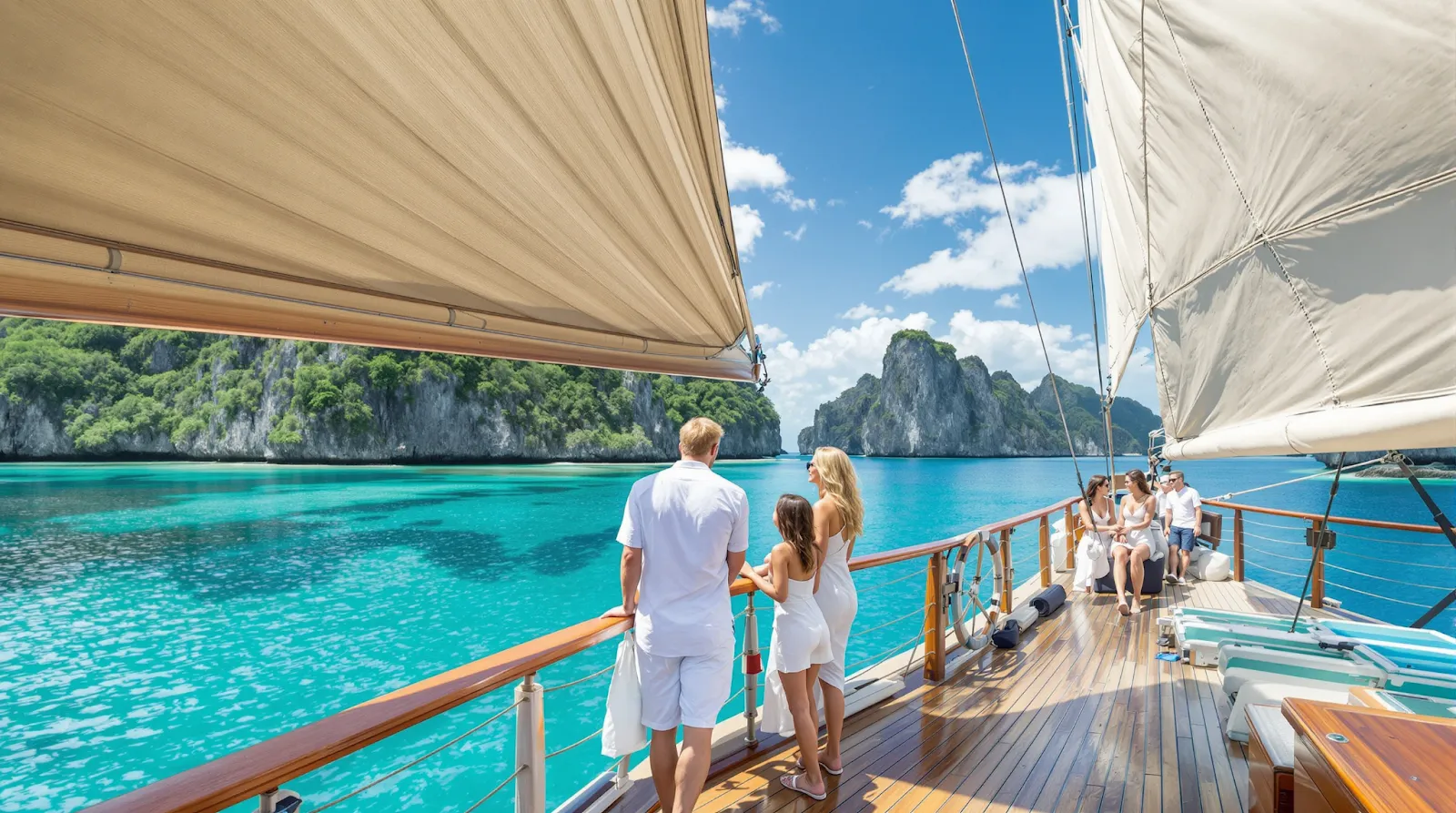
Liveaboards are floating hotels that travel between Indonesia’s most remote and desirable sites. Guests typically book three to ten-day expeditions that include accommodation, meals, and activities like scuba diving as part of an all-inclusive package. In popular destinations like Labuan Bajo, these voyages often include staple water sport activities such as snorkeling, canoeing, and island-hopping.
The business model differs from traditional hospitality in that your asset moves, allowing you to follow seasonal demand and access locations that land-based resorts cannot reach.
Four primary models define the market today:
| Business Model | Recommended Vessels | Primary Focus & Features |
|---|---|---|
| Luxury Private Charters | Custom Phinisi & Superyachts | High-spec “floating villas” designed for total privacy. Features include bespoke itineraries, Michelin-standard private chefs, onboard spas, and a dedicated personal service team for HNWIs. |
| Smaller private charter | Custom Phinisi | Traditional wooden schooners, primarily hand-built in Bira (Kampung Phinisi), Bulukumba in South Sulawesi. A popular and scalable entry point for investors targeting non-luxury and mid-range charter segments. Custom Phinisi with Bira (known as KAMPUNG PHINIS), Bulukumba, Sulawesi Selatan, as the main construction site, brings the most attraction for FDI (non-luxury) scale |
| Scuba & Diving Expeditions | Technical Liveaboards (High-GT Phinisi) | Technical liveaboards optimized for serious divers represent the largest segment of the market. These vessels feature high-capacity compressors, Nitrox systems, dedicated dive decks, and tender boats for reef access. Raja Ampat and Komodo are primary destinations. |
| Private Day-Trip Charters | Leisure Yachts & Catamarans | High-speed, luxury-fitted platforms for short-duration coastal excursions. Ideal for weddings, corporate retreats, and sunset cruises centered around Bali or Labuan Bajo. |
| Wellness & Retreat Charters | Boutique Phinisi with Yoga Decks | Specialized vessels featuring yoga decks and holistic treatment rooms. Designed for meditation retreats and wellness workshops, offered as full buyouts or shared cabin trips. |
Where to Invest: Top Locations Across Indonesia for Liveaboard Ventures
Positioning your vessels strategically is essential to maintain year-round occupancy. Most operators follow an East–West rotation, shifting their fleets across the archipelago to align with seasonal weather patterns and peak tourism windows. Charters typically run with 7 to 10-day itineraries, either as round-trips or one-way voyages between key hubs.
From May to October, the focus is on the Bali–Komodo corridor, where calm seas and strong tourist demand support consistent activity. When the season shifts in November, many vessels reposition east toward Raja Ampat for its prime sailing window.
You can market seasonal repositioning journeys as exclusive “crossing trips” through the Banda Sea. These expeditions traverse remote island chains rarely visited by standard tourism routes, allowing you to monetize the transit between regions.
1. Bali and the Gili Islands
You can establish your operations in Bali to leverage its position as Indonesia’s most sophisticated maritime logistics center. Repeatedly voted “The World’s Best Island” by leading travel publications, Bali provides the infrastructure required for high-end provisioning, international-standard maintenance, and seamless guest transfers.
The center of this growth is the Bali Maritime Tourism Hub (BMTH) at Benoa, which features the Indonesia’s first dedicated international-standard cruise and yacht terminal. This multi-billion IDR National Strategic Project provides specialized berths for superyachts up to 90 meters and deep-water access that simplifies the docking of high-GT liveaboards.
For your business, the BMTH acts as a “one-stop shop” for customs, immigration, and bunkering, significantly reducing turnaround times between charters. This allows you to reliably target the premium wedding and day-trip markets before repositioning east for the expedition season.
2. Labuan Bajo (Komodo National Park)
Position your fleet in Labuan Bajo to capture the high-growth adventure segment. Located approximately 270 nautical miles east of Bali, this hub serves as the primary base for Komodo National Park expeditions from May to October. During this window, the region’s dry season provides the calmest seas and best visibility for diving and leisure charters.
Recent upgrades to the Komodo International Airport also support direct international logistics, allowing you to run turnaround operations without returning to Bali. However, operating in Komodo also requires careful environmental compliance.
Local authorities enforce strict visitor management rules within the national park, including limits on anchoring and designated mooring points. Operators must also account for park entrance fees and conservation charges that apply to both guests and vessels.
3. Raja Ampat (Southwest Papua)
Reposition your fleet to Raja Ampat from November to April to offset the rainy season in Western Indonesia. This region commands the highest daily charter rates in the country, largely due to its remoteness and preserved natural beauty.
Operating here requires precise logistical planning, as high-end supplies frequently require air-freight from Jakarta or Sorong. Compliance with the Raja Ampat Mooring System (RAMS) is mandatory, and anchoring is prohibited in protected zones like the Fam Islands.
4. The Banda Sea and Wakatobi
The Banda Sea and Wakatobi are active corridors during the seasonal migration between Labuan Bajo and Raja Ampat. The primary windows for these crossings are September–November and March–May, when sea conditions are more favorable for long-range navigation.
Rather than viewing repositioning as a sunk cost, operators often market these voyages as “off-the-beaten-path” expeditions for experienced divers and photographers. In Wakatobi, there is a specific demand for vessels that can accommodate research teams or technical photography workshops.
A Spotlight on Phinisi Charters

The Phinisi is Indonesia’s traditional two-masted sailing vessel, built by Bugis and Makassar craftsmen in South Sulawesi (primarily within the Bulukumba Regency). These vessels are hand-built from ironwood and teak using techniques passed down through generations. Master builders (panrita lopi) work without standardized blueprints, creating bespoke hulls tailored to the commissioner’s specifications.
For foreign investors, commissioning a local Phinisi build is often more economical than importing a foreign-built yacht. You avoid prohibitive import duties and benefit from skilled local craftsmanship. A well-appointed 20 to 25-meter vessel typically costs IDR 7 to 8 billion (approximately USD 450,000 to 500,000), with construction taking 12 to 24 months depending on complexity.
The cultural authenticity of a Phinisi also justifies premium charter rates. These vessels carry UNESCO-recognized heritage value that generic yacht designs cannot match. For the international market, a traditional Phinisi is part of the Indonesian experience itself.
Mandatory Permits and Requirements for Liveboard Ventures in Indonesia
To operate legally, you must navigate specific regulations under Law No. 6/2024 and PP No. 28/2025. These detail the following key operational permits and requirements you will need to secure in order to establish your liveaboard business anywhere in Indonesia.
Emerhub prepares all mandatory documentation and helps ensure you meet the following regulatory requirements:
- The 49/51 Nationality Rule: Under the latest shipping regulations, foreign ownership in a domestic shipping company (PT PMA) is capped at 49%. You must partner with a qualified Indonesian legal entity to hold the remaining 51%. This partner can be a state-owned Enterprise (BUMN), Regional-Owned Enterprise (BUMD) or a Domestic Investment Company (PT PMDN).
- Legal Entity Requirement: Both shareholders must be legal entities. Note that individual shareholding is no longer permitted for shipping PT PMAs.
- Minimum Vessel, Size: Effective October 2025, PP No. 28/2025 mandates that the minimum vessel size for foreign-owned (PT PMA) maritime operations must be greater than GT 175.
- Essential Maritime Licenses:
- SIUPAL (Sea Transportation Business License): The primary license to operate as a shipping company in Indonesia.
- SIOPSUS (Special Sea Transportation License): Authorizes the vessel to function as a specialized leisure platform. Essential to provide liveaboard services.
- SIUPAR (Tourism Business License): Commercial permit required to legally provide tourism services such as diving, snorkelling, and surfing expeditions.
- Indonesian Flag Registration: All PT PMA vessels must fly the Indonesian flag and comply with domestic safety and manning standards.
- 100% Indonesian Crew: All crew members on your PT PMA vessels must be Indonesian citizens.
We can also help you navigate local partnership requirements. Our experts can evaluate your situation and recommend a compliant structure tailored to the liveaboard sector. Schedule a consultation with our local team today.
Step-by-Step Process to Establish a Liveaboard Business in Indonesia
Setting up a maritime PT PMA requires close coordination between Kemenhub (Ministry of Transportation) and Kemenparekraf (Ministry of Tourism). Emerhub manages every stage of this process, handling all administrative and regulatory steps on your behalf.
Here’s how we can establish your legal presence and secure your liveaboard vessel:
Step 1: PT PMA Company Registration
Establishing a legal presence is the mandatory first step. You must incorporate a joint venture company with a local partner, typically using the KBLI 50113 (Domestic Sea Transportation for Tourism). Bear in mind that recent 2025 KBLI updates may impact this selection, and Emerhub will verify the current alignment for your specific venture.
To establish your PT PMA, you will need to commit to an investment realization plan of at least IDR 10 billion (approx. USD 640, 000), with a minimum paid-up capital of IDR 2.5 billion. The process culminates in obtaining your Business Identification Number (NIB) and Taxpayer ID (NPWP), both of which are required to legally own maritime assets.
Investment Tip: Expenditures on vessel construction and specialized maritime equipment may contribute directly toward your IDR 10 billion investment realization requirement. This means the mandated investment capital may be funnelled directly into your asset, instead of sitting as idle cash.
Step 2: Vessel Selection and Strategic Acquisition
Next, finalize your choice of vessel to match your target market. Each asset type requires a specific legal approach for procurement and flag registration:
- Phinisi: Traditional hand-built schooners crafted by panrita lopi master builders. Commissioning a new build requires a detailed construction contract with milestone payments. These vessels require specialized hull inspections to secure a Surat Laut (Sea Letter).
- Yacht: Strategic for the luxury market. When purchasing an existing yacht, a comprehensive survey and sea trial are mandatory before executing the title transfer. This is to ensure compliance with Indonesian maritime safety standards.
- Liveaboard/Diving Boat: Designed for niche expeditions. These require additional deck space for air compressors and must meet specific Kemenhub (Ministry of Transportation) safety standards for commercial operations before they can be registered for charter.
The formal transfer of ownership is legalized through an Akta Jual Beli (AJB/Bill of Sale) executed before an Indonesian notary. For new builds, the contract must include a delivery schedule and sea trial clauses. This allows you to secure the Grosse Akta (Ship’s Title Deed), serving as the ultimate proof of ownership under the Indonesian flag.
Step 3: Finalize Operating Licenses (SIUPAL/SIOPSUS/SIUPAR)
Selecting the correct KBLI in the OSS-RBA system will automatically trigger the requirement for specialized operational permits. You will need to secure the following permits to activate your business license:
- SIUPAL (Sea Transportation Business License): The foundational permit required to operate a shipping business in Indonesia.
- SIOPSUS (Special Sea Transportation License): Required for vessels engaged in liveaboard activities and specialized services such as scientific research or unique industrial charters.
- SIUPAR (Tourism Business License): Mandatory for legally marketing and selling all-inclusive leisure packages, including diving and multi-day expeditions, in compliance with tourism ministry standards.
Step 4: Secure Maritime Insurance
The final prerequisite is to prove a comprehensive insurance coverage to obtain your SPB (Port Clearance) from the Syahbandar (Harbor Master). Emerhub can connect you with trusted providers to secure the following coverage:
- Hull & Machinery (H&M): Covers physical damage to the vessel’s hull, machinery, and onboard equipment.
- Protection & Indemnity (P&I): Covers third-party liabilities and environmental damage. P&I is especially critical in regions such as Komodo and Raja Ampat, as it covers accidental damage to coral reef systems.
Expert Support to Set Up Your Liveaboard Venture in Indonesia
As your dedicated local partner, Emerhub manages the full spectrum of your company’s legal and administrative requirements. Our services ensure a smooth transition from setup to operation:
- Company & Operational Registration: We manage your PT PMA incorporation, tax ID (NPWP) registration, and maritime licenses through the OSS-RBA system.
- Payroll & Tax Compliance: Our team handles monthly payroll processing, social security (BPJS) contributions, and comprehensive corporate tax reporting to ensure local compliance.
- Ongoing Compliance Support: We manage mandatory LKPM (Investment Activity Report) filings and the validity of your permits so you remain audit-ready at all times.
- On-Ground Logistics: With a dedicated team, we provide real-time support for Syahbandar inspections and port clearances across major maritime hubs.
Emerhub offers end-to-end support to set up your liveaboard business across Indonesia. Let us know your plans via the form below, and our advisors will reach out with tailored insights.
Frequently Asked Questions About Liveaboard Business Setups in Indonesia
Under Law No. 6/2024 on Shipping, domestic sea transportation for tourism is restricted to a maximum of 49% foreign ownership. To operate a PT PMA in this sector, you must enter into a joint venture with a qualified Indonesian legal entity that holds at least 51% of the company’s shares.
Emerhub can coordinate this arrangement and arrange for a compliant partnership that protects your interests. Reach out through the form below for a detailed breakdown.
Foreign investors typically secure their interests through a dual-entity structure. This arrangement allows you to define control and profit-sharing ratios through a Shareholder Agreement (SHA):
– maintaining a PT PMA for international marketing and guest relations, while
– partnering with a 100% local company PT PMDN (local company) to hold the 51% maritime asset ownership.
Emerhub can act as your local partner. We can provide a transparent arrangement that protects your ownership while ensuring the business remains fully compliant with local participation requirements.
Current maritime regulations for Indonesian-flagged (PT PMA) vessels require that 100% of your crew to be Indonesian citizens. While you may employ foreign staff in management, marketing, or as specialized dive instructors (subject to separate work permits), the operational crew, including the Captain and engineers, must be local citizens.
The combined process for PT PMA incorporation and securing the necessary SIUPAL, SIOPSUS, and SIUPAR licenses typically spans 3 to 6 months.
Bear in mind however, this timeline depends on the accuracy of your documentation and the readiness of your vessel for flag registration. Your custom vessel construction (such as a Phinisi build) may also add 12 to 24 months to your overall launch schedule.
