
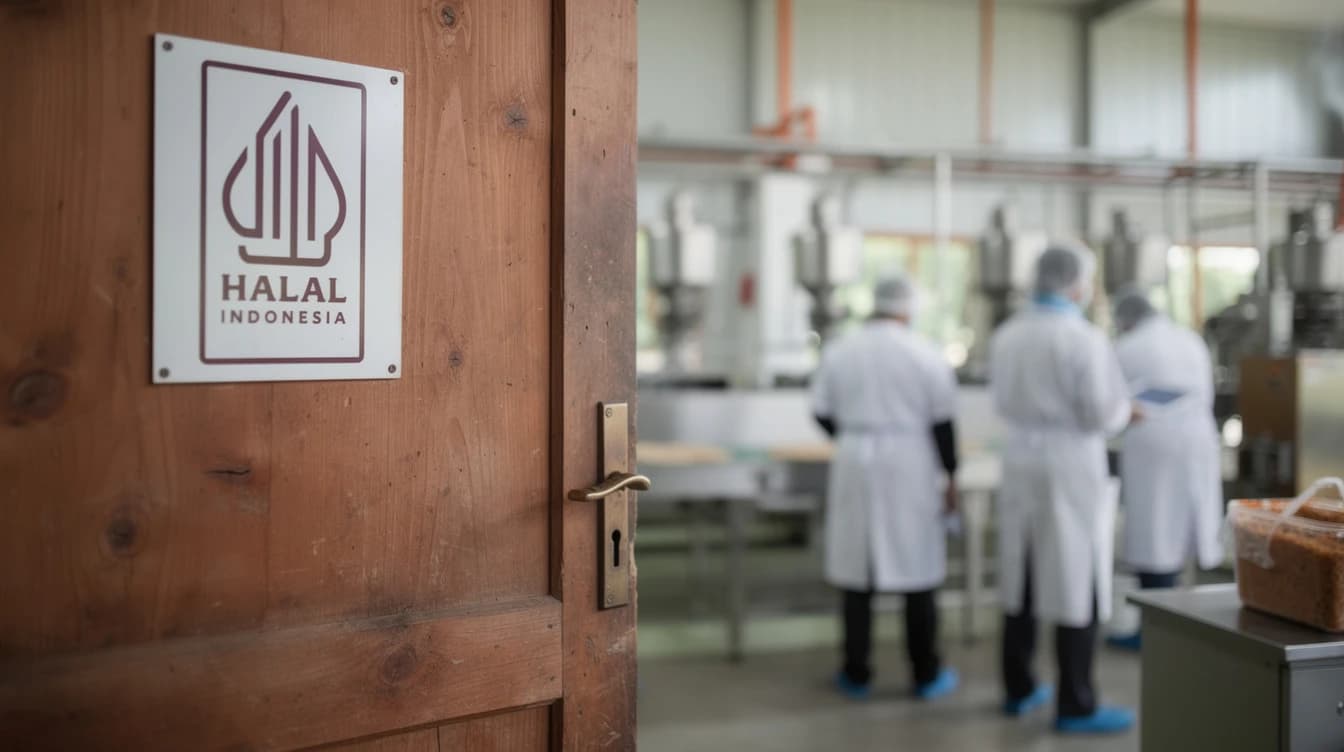
If you run an FMCG, cosmetics, or pharmaceutical business that sells into Indonesia, you face a fixed deadline. Food and beverages have required mandatory halal certification since October 2024. Cosmetics and traditional medicines join the list in October 2026. Pharmaceuticals and medical devices that contact the body follow in October 2029.
The three-phase rollout: when does your category hit?
| Phase | Products | Mandatory since |
|---|---|---|
| 1 | Food, beverages, food packaging, meat processing, slaughterhouses, hospitality (HORECA) | 17 October 2024 |
| 2 | Cosmetics, traditional medicines, certain household chemicals that contact the body | 17 October 2026 |
| 3 | Pharmaceuticals, medical devices that contact the body | 17 October 2029 |
Phase 1 already runs live. Food and beverage products on Indonesian shelves today should carry an active halal certificate or a formal non-halal declaration. If your Phase 2 cosmetics or Phase 3 pharma brand intends to be in the Indonesian market through 2026 and 2029, your supply-chain documentation work should already be in motion. The audit traces ingredients back to their source, and that work takes months, not weeks.
The market in numbers
The certification flywheel has already turned hard. The data below frames the size of the market your products enter and the speed at which competitors have moved.
5.57 million
Halal-certified products in Indonesia as of November 2024, issued under UU JPH. Source: BPJPH via Databoks.
1.55 million
Business actors holding at least one BPJPH halal certificate as of November 2024. Source: BPJPH.
92
Mutual-recognition agreements between BPJPH and foreign halal bodies, across 24 countries (52 of them signed at H20 2024). Source: BPJPH.
The composition of the certified base tells you something important about who has moved first. Of the 1.55 million certified business actors, 96.7% are micro businesses that came in through the Sehati self-declaration program. Small businesses make up 2.9%, large businesses 0.3%, and medium-sized businesses 0.08% (Databoks, citing BPJPH). The majority of certified products today come from micro-scale producers who used the simplified track. Large foreign manufacturers entering the market now face a comparatively thin field of certified large-scale competitors and a regulator with active capacity to process the higher-complexity files.
Indonesian consumer demand for halal products
The compliance deadline matters because the underlying demand exists. Polling data from Populix (March 2023, n=1,014 Gen Z and Millennial Muslim consumers) shows the halal certificate sits inside the buying decision, not at the margin.
81% of Muslim consumers said they purchase halal-certified ready-to-eat food and beverages in the Populix survey.
39% of respondents said they knew which personal-care and beauty ingredients qualify as halal, indicating an awareness gap that brands can close through clear labelling.
The shelf does not yet reflect the demand. A supermarket-side survey of premium retailers cited by the US Department of Commerce found that up to 25% of products on premium-supermarket shelves still did not meet Indonesia's halal certification and labelling requirements at the time of survey. That gap closes as enforcement moves through the categories. The brands that certify before competitors do not just clear compliance; they pick up shelf positioning that uncertified peers cannot match.
Three ways into the Indonesian halal market
Foreign brands enter Indonesia in three operational shapes. Each one carries a different relationship to halal compliance, a different timeline, and a different cost profile.
Option 1: Local manufacturing through a PT PMA
You incorporate an Indonesian PT PMA, register the right KBLI codes for your manufacturing activity, and operate a factory inside the country. Your halal certificate then covers your physical facility, your production processes, and your ingredient supply chain. The certificate sits in your PT PMA's name and applies to SKUs that come off that factory floor.
This route makes the most sense when you expect long-term volume in Indonesia and want full control over production, when your margins make local labour and material costs work, or when you face regulatory or tariff reasons to manufacture domestically.
Option 2: Toll manufacturing with an Indonesian partner
An Indonesian contract manufacturer produces your brand under a private-label or co-packing arrangement. The contract manufacturer's halal certificate covers your SKUs, as long as the agreed ingredient list matches what the LPH audited and your production runs on a line within the certificate's scope. Toll manufacturing saves significant time, because you piggyback on certification work the partner has already done.
The trade-off: your halal compliance now depends on the contract manufacturer's continued certification. If they lapse, you lapse. Contract language and audit-rights clauses matter more than they would in other markets.
Option 3: Import the finished product through a local distributor
You manufacture abroad and ship finished goods into Indonesia under your distributor's import licence. Two halal-compliance paths apply. You can either present a Foreign Halal Certificate (SHLN) issued by a halal certification body in your country of origin that BPJPH accepts under a mutual-recognition agreement, or you can certify the imported product locally through the standard BPJPH process. Our guide to foreign halal certificate registration covers the SHLN route in detail.
Compliance path by product category
Food and beverages (deadline passed)
If your business touches food in Indonesia, the deadline already hit in October 2024. That covers food and beverages, food packaging, processed meat, slaughterhouses, and HORECA operations (restaurants, hotels, cafés). The sequence for a new brand entry runs:
- Set up the PT PMA and register KBLI codes that match your manufacturing or import activity.
- Get BPOM registration: MD for domestic production, ML for imported finished goods. One number per SKU.
- Apply to BPJPH through the SIHALAL portal. BPJPH routes the application to an LPH for the on-site audit.
- Receive the MUI fatwa, then the BPJPH halal certificate.
Many foreign brands already operating on Indonesian shelves now find themselves in the catch-up phase, retrofitting halal compliance for an existing SKU list rather than building it from scratch. For BPOM-specific food mechanics, our processed-food BPOM guide walks through the MD and ML routes.
Cosmetics and traditional medicines (October 2026 deadline)
Most personal-care and beauty brands fall into this phase, along with traditional medicines and herbal supplements. BPOM uses notification (not full registration) for most cosmetics, which moves faster than the food regime, but halal certification still runs as a separate process on its own timeline.
If you intend to stay in the Indonesian market past October 2026, you should already be moving through the BPJPH process. The audit window stretches to several months when ingredient sourcing involves multiple international suppliers, and ingredients that fail the halal audit need substitute formulations, which themselves require fresh BPOM notifications. Starting late forces hard choices late.
If your formula uses ingredients that clearly fall outside halal (alcohol-based fragrances, pork-derived components, certain enzymes), the law gives you a third option: register the product as non-halal rather than seek certification. Indonesian regulators allow the sale but require visible non-halal labelling on the shelf. There is no fourth option of selling unlabelled.
Pharmaceuticals and medical devices (October 2029 deadline)
Phase 3 carries the most operational complexity. The audit traces every active pharmaceutical ingredient and every excipient back through the supply chain, including imported APIs. Global pharma majors have started restructuring API supply contracts now in preparation for the 2029 deadline. Lead time runs the longest of the three phases because substitution decisions for active ingredients touch product efficacy, clinical data, and BPOM re-registration, not just a halal-compliance checkbox.
The medical-device rule applies to devices that contact the body. Imaging hardware, lab equipment, and devices that never touch a patient fall outside the halal certification scope.
Five traps that catch foreign manufacturers
- Treating halal certification as a post-launch checkbox. The certificate needs to sit in your file before products legally circulate inside the relevant phase. Securing distribution first and chasing certification afterwards leaves shipments stuck in warehouses.
- Missing the BPOM linkage. Halal certification does not replace BPOM registration. The two processes run on separate timelines under different agencies, and your shipments need both before retail will take them.
- Under-budgeting for multi-SKU manufacturers. The LPH audit fee scales with product complexity and SKU count, not with company headcount. A cosmetics brand with 80 SKUs pays a meaningfully different fee than a 5-SKU brand. Build the budget bottom-up from your actual SKU list.
- Choosing an LPH without checking specialisation. Some LPHs excel at food and struggle with cosmetics. Some specialise in pharmaceuticals. A category mismatch between your product and the LPH's expertise drags the audit by months.
- Assuming hospitality sits outside the rules. Restaurants, hotels, and cafés that serve food in Indonesia fall under Phase 1. They either certify halal or formally declare non-halal status. Operating without either does not comply.
Scope your path with a 30-minute strategy call
Picking between PT PMA, toll manufacturing, and import depends on your SKU count, your existing supply chain, your timeline pressure, and whether your brand already holds halal certification in another market. If you would like to walk through the options with a consultant who has guided foreign FMCG, cosmetics, and pharma brands through this decision, book a strategy call with our Indonesia team. The first conversation typically covers the structural fit, the rough timeline, and the dependencies that will drive your launch sequencing.
The regulatory chain in 2026
The Indonesian halal regime layers several regulations on top of each other. Reading only the foundational law leaves you working from outdated rules.
| Regulation | Role | Status |
|---|---|---|
| UU 33/2014 (UU JPH) | Foundational Halal Product Assurance Law. Sets up the certification regime, names BPJPH as the issuing authority, and creates the mandatory-certification obligation. | In force, amended |
| UU 11/2020 (Cipta Kerja / Job Creation Law) | First major amendment to UU 33/2014. Creates the SME self-declaration track, simplifies the BPJPH renewal process, and waives application fees for micro and small enterprises. | Superseded by UU 6/2023 |
| Perppu 2/2022 and UU 6/2023 | Re-enact and consolidate the Cipta Kerja amendments into permanent law. The SME self-declaration track and renewal-by-statement provisions now sit in UU 6/2023. | In force |
| PP 31/2019 | First implementing regulation under UU 33/2014. | Repealed |
| PP 39/2021 | Second implementing regulation, issued after the Cipta Kerja amendments. | Replaced by PP 42/2024 |
| PP 42/2024 | Current implementing regulation. Introduces the Halal Product Assurance System (SJPH), tightens production-line separation between halal and non-halal products, expands the self-declaration track for low-risk SMEs, and moves applications onto the SIHALAL digital portal. | In force |
What PP 42/2024 changed in operational terms
The current implementing regulation differs from PP 39/2021 in five practical ways that affect day-to-day compliance:
- SJPH becomes a continuing obligation. PP 42/2024 frames the Halal Product Assurance System as something certified businesses must continuously implement, not a one-off audit. Certified facilities receive a consistency assessment every four years. The compliance function carries through the certificate's life rather than ending at issuance.
- Production-line separation tightens. The regulation expands the rules around physical and operational separation between halal and non-halal production. Lines, equipment, storage, and personnel flow all need documentation that an LPH can verify on-site. Shared facilities that previously passed audit under PP 39/2021 may need procedural updates to clear PP 42/2024.
- SME self-declaration broadens. Low-risk products from qualifying micro and small enterprises can certify through the Sehati self-declaration program rather than the full LPH audit. Turnaround drops to around 30 days. The threshold typically sits at annual revenue at or below IDR 500 million, with additional product-risk criteria. Foreign-owned PT PMAs do not qualify, but local toll manufacturers operating at this scale can.
- SIHALAL becomes the default channel. Application, document submission, and status monitoring all run through the BPJPH SIHALAL portal. Document requirements stay broadly similar to PP 39/2021; the submission channel moves online.
- Renewal-by-statement formalises. Where production process, ingredient composition, and supply chain have not changed, BPJPH can renew the certificate on the basis of a business statement rather than a full re-audit. UU 6/2023 carries the legal basis; PP 42/2024 sets out the procedure.
BPOM and BPJPH: the parallel-track mechanics
Two agencies sit between your product and the Indonesian shelf, and neither replaces the other. BPOM (Badan Pengawas Obat dan Makanan) issues the product registration that confirms the product can legally sell in Indonesia. BPJPH (Badan Penyelenggara Jaminan Produk Halal) issues the halal certificate that confirms sharia compliance.
Different product categories take different BPOM identifiers. Domestic processed food carries an MD number. Imported food carries an ML number. Cosmetics use NA or NK numbers depending on the notification path. Pharmaceuticals carry NIE numbers. Our complete guide to BPOM registration covers the category split in depth.
Sequencing matters. A foreign manufacturer that treats halal as a follow-on after BPOM finishes typically adds three to six months to the launch timeline. Running the two timelines in parallel reduces the runway. The trade-off: parallel running raises the risk that an ingredient substitution forced by the halal audit invalidates a BPOM submission already in progress, and the team has to re-file. The compliance team's job is balancing those two risks against the launch date.
The Foreign Halal Certificate (SHLN) pathway in detail
A brand manufactured outside Indonesia has a second route besides certifying locally. A halal certificate from an LHLN (an overseas halal certification body) that holds a mutual-recognition agreement with BPJPH can carry weight in Indonesia under the SHLN framework.
Recognition runs bilaterally and BPJPH does not accept every foreign halal body. BPJPH maintains a list of mutually recognised LHLNs that gets updated periodically as new MoUs sign and existing ones renew. Check the current list rather than relying on past acceptances. If your home-market certifier holds current recognition, the SHLN path moves faster than starting a local LPH audit. If your home-market certifier does not, certifying locally through BPJPH usually runs as the more direct route.
Technical pitfalls worth planning for
- Reading the 2014 law in isolation. The original UU 33/2014 text predates the SME self-declaration track, the renewal-by-statement provision, and SJPH's continuous-compliance requirement. Work from PP 42/2024 and UU 6/2023 alongside UU 33/2014, not the foundational text alone.
- Banking on a previously-recognised LHLN. Mutual recognition lists change. A halal body that BPJPH accepted in 2022 may not appear on the current list. Confirm recognition status against the live BPJPH list before relying on an SHLN-based filing.
- Ignoring SJPH continuity requirements. Under PP 42/2024 the certificate is not a one-and-done. The internal halal-assurance system needs documented operation throughout the four-year cycle, not just before the next audit. Compliance teams that treat certification as a project rather than a function find themselves rebuilding documentation at renewal time.
- Mis-mapping the SHLN documentation flow. SHLN paperwork sits with BPJPH but the underlying audit happens overseas. The Indonesian distributor's import licence still needs to align with the SHLN-covered SKU list, which in turn must align with what the home-market LHLN certified. Three documents, three jurisdictions, one common SKU schema. Mistakes here force re-filing.
Engage Emerhub for the end-to-end filing
When your compliance team needs a partner who can coordinate the BPJPH, LPH, BPOM, and underlying PT PMA workstreams against a deadline, Emerhub steps in as the in-country execution arm. We file the BPJPH application, coordinate the LPH audit, run the BPOM submissions in parallel, and keep the ingredient-documentation pack consistent across all three. Reach out to scope an engagement and we will scope the workplan against your launch date and existing certifications.
Frequently asked questions
When did halal certification become mandatory in Indonesia?
UU 33/2014 phases mandatory halal certification across three product groups. Food and beverages became mandatory on 17 October 2024 after a five-year transition. Cosmetics, traditional medicines, and certain household chemicals become mandatory on 17 October 2026. Pharmaceuticals and medical devices that contact the body follow on 17 October 2029. Operating in any phase past its deadline without certification (or a formal non-halal declaration where allowed) exposes the brand to administrative sanctions including distribution restrictions and product withdrawal.
Which regulations should I read to understand the current halal rules?
Three core texts together. UU 33/2014 remains the foundational law and establishes BPJPH as the issuing authority. UU 6/2023 (which made the Cipta Kerja amendments permanent after UU 11/2020 and Perppu 2/2022) carries the SME self-declaration track and renewal-by-statement provisions. PP 42/2024 is the current implementing regulation, replacing PP 39/2021 and PP 31/2019, and adds the Halal Product Assurance System (SJPH), tighter production-line separation rules, and applications routed through the SIHALAL digital portal. Reading only the original 2014 law gives a materially out-of-date picture.
Does halal certification replace BPOM registration?
No. BPOM and BPJPH run in parallel and you need both. BPOM (Badan Pengawas Obat dan Makanan) issues the product registration that confirms the product is safe to sell in Indonesia. BPJPH (Badan Penyelenggara Jaminan Produk Halal) issues the halal certificate that confirms compliance with sharia requirements. The two timelines run side by side, and shipments cannot legally circulate without both. Foreign manufacturers who treat halal as a follow-on to BPOM usually add three to six months to their launch timeline.
Can a foreign brand use a halal certificate issued in its home country?
Sometimes. BPJPH maintains a list of LHLNs (overseas halal certification bodies) that hold mutual-recognition agreements with Indonesia. A certificate issued by a recognised LHLN can carry weight in Indonesia under the SHLN (Sertifikat Halal Luar Negeri) framework, with some additional documentation. Not every foreign halal body sits on the recognised list, and BPJPH updates the list periodically as new MoUs sign. For brands with no existing home-country certificate, certifying locally through BPJPH is usually the more direct route.
How much does halal certification cost for a foreign manufacturer?
Three cost components apply. The BPJPH application fee is nominal at IDR 0 to 500K depending on business scale. The LPH audit fee is the main cost driver and varies by company size and product complexity, typically IDR 3M to 15M for SMEs and IDR 25M to 100M or more for larger manufacturers with multiple SKUs. The MUI Fatwa Commission fee is approximately IDR 350K per product. A small SME budget lands around IDR 5M total. A medium manufacturer with a broad SKU range can reach IDR 50M to 150M. BPJPH requires renewal every four years at roughly equivalent fees.
What if my product uses haram ingredients like alcohol or pork derivatives?
UU JPH allows products that clearly use haram ingredients (alcohol-based fragrances, pork-derived gelatin or enzymes, dog-derived ingredients) to register as non-halal rather than seek certification. The product is legal to sell but must carry visible non-halal labelling on shelves. There is no third option of selling unlabelled. Brands that prefer to remain on the halal track usually pursue reformulation, substituting plant-derived gelatin for porcine gelatin, for instance, then certifying the new formula.
How long does the BPJPH halal certification process take end-to-end?
The statutory window for BPJPH to issue or reject after a complete application and LPH audit report is 21 working days. Real-world end-to-end timing runs two to four months including company document preparation, LPH audit scheduling and execution, and MUI fatwa review. Faster tracks exist for SMEs in the Sehati self-declaration program, which can finish in about 30 days. Slower tracks apply to products requiring complex ingredient tracing, such as multi-stage food processing or pharmaceuticals with imported active ingredients, where the supply-chain documentation work can extend the audit by months.
Can I toll-manufacture in Indonesia and rely on the contract manufacturer's halal certificate?
Yes, this is a viable path. If the contract manufacturer holds a current BPJPH halal certificate for the production line and the agreed ingredient list matches what the LPH originally audited, your SKUs can fall under their certificate. Any deviation in ingredients, suppliers, or production-line scope triggers a re-audit. The toll-manufacturing agreement and the manufacturer's BPJPH file document the arrangement, not separately at BPJPH. Toll manufacturing saves significant time for brands that do not intend to operate their own facility in Indonesia, but it ties your halal compliance to the contract manufacturer's continued certification.