
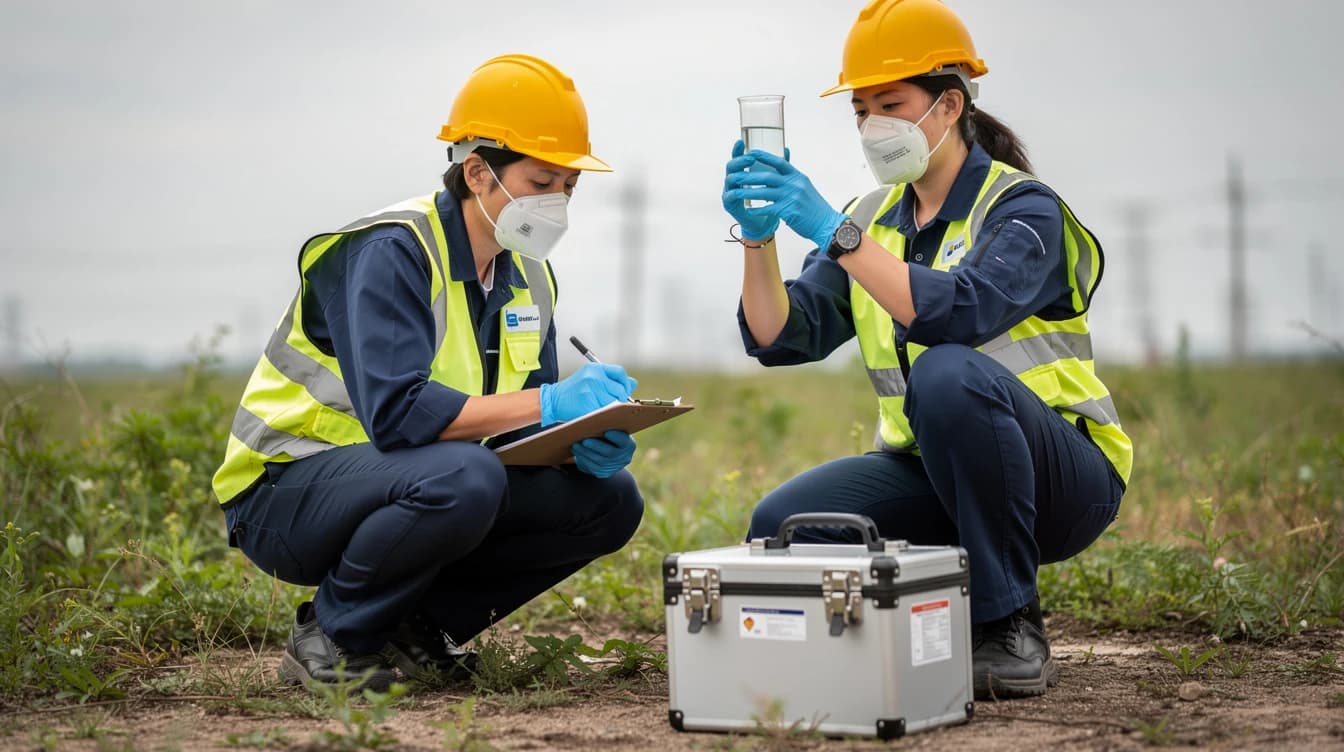
Every commercial project operating in Indonesia must secure an official Persetujuan Lingkungan (Environmental Approval) before launching construction or operations. This approval is non-negotiable and mandated under Law No. 32 of 2009 (UU PPLH) as revised by the Job Creation Law.
For large-scale and high-risk businesses, you will either need an AMDAL (comprehensive study) or a UKL-UPL (standardized management plan). SPPL is reserved for small and micro businesses with minimal impact. It does not apply to manufacturing plants, mining operations, large infrastructure, or any project with meaningful land, waste, or resource footprint.
This guide focuses on AMDAL vs UKL-UPL. We will also cover how these two Environmental Approvals differ and the application process.
How the OSS-RBA System Determines Your Approval Category
OSS-RBA assigns your tier automatically, based on the data you enter at registration. When you select your KBLI code (Klasifikasi Baku Lapangan Usaha Indonesia), the system runs a screening process called penapisan. It checks that code against the business list in Permen LHK 4/2021.
That screening checks your business sector and the scale of your planned activity, such as production capacity, land area, or building size. It also checks your location, including whether you sit near a protected area. Based on that screening, OSS-RBA tells you which of the three environmental documents you need before it will issue your NIB.
Submitting a UKL-UPL when an AMDAL is legally required constitutes regulatory misrepresentation. Under MoE/BPLH Regulation No. 6 of 2026, this triggers immediate administrative sanctions, project halts, or NIB cancellation.
What is AMDAL?
AMDAL is the most demanding Environmental Approval tier. Article 5 of PP 22/2021 requires it for business plans that fall under a few categories, including:
- Change the form or contour of the land or environment
- Exploit natural resources (renewable or non-renewable)
- May cause pollution, environmental damage, or degradation of natural resources
- Generate significant social, cultural, or artificial environmental impacts
- Affect conservation areas or cultural heritage protection
- Introduce new species of plants, animals, or microorganisms
- Involve high-risk activities or new technologies with large environmental footprints
- Impact national defense or security
Projects located directly within or adjacent to designated protected zones or conservation areas are automatically flagged for an AMDAL, even if the physical scale of operations falls below standard capacity thresholds.
TUK-LH Replaces Komisi Penilai AMDAL (KPA): This shift was set up under PP 22/2021 and detailed in Permen LHK 18/2021. However, it is still transitioning and some provinces may still refer to KPA as TUK-LH. If your project is in a region still transitioning, you can confirm with our consultants to know which body currently handles your AMDAL review.
Who can Obtain an AMDAL?
Under PP 22/2021, AMDAL documents must be prepared by a formally certified team holding an AMDAL Competency Certificate (KTPA/ATPA). The team must include:
- At least one certified team leader
- A minimum of two certified team members
- All holding valid competency certificates issued under PP 22/2021 standards
- The consulting firm (if used) must also be registered with the Ministry of Environment (Kementerian Lingkungan Hidup- KLH)
How to Obtain an AMDAL
The current AMDAL approval workflow (as of 2025–2026) runs through the Amdalnet platform integrated with OSS:
- Screening and terms of reference (KA-ANDAL): Your AMDAL-certified team prepares a Kerangka Acuan (KA-ANDAL), the terms of reference that scope what the study will cover. This stage includes early field surveys and a public consultation with affected communities which is a legal requirement under UU PPLH's public participation provisions.
- Impact study (ANDAL) and management plan (RKL-RPL): Your team produces the full ANDAL (Analisis Dampak Lingkungan). Alongside it comes an Environmental Management Plan (Rencana Pengelolaan Lingkungan - RKL) and an Environmental Monitoring Plan (Rencana Pemantauan Lingkungan - RPL).
- Review by the TUK: The relevant commission reviews the documents, at national, provincial, or district level depending on your project's scale. Regulation sets a maximum review window of 75 working days once your documents are declared complete. That window does not count time spent on revisions the commission requests.
- Environmental Approval (Persetujuan Lingkungan) is issued: Once the commission signs off, the authorized government body issues your Persetujuan Lingkungan. That approval feeds back into OSS-RBA and unlocks your effective NIB.
It usually takes about 3-6 months to process an AMDAL in practice from end to end including baseline environmental sampling, public consultations, and document revisions. Depending on the size and the complexity of the project or if there are any public objections, it can run longer.
Check for AMDAL Kawasan: If your business sits in an established industrial estate that already holds an area-wide AMDAL Kawasan, you may only need a UKL-UPL. This can cut both cost and timeline. Coverage varies by estate, so check with the estate management and your local DLH before assuming it applies to you. Emerhub can verify whether your chosen industrial estate already holds an AMDAL Kawasan before you finalize your site selection.
Emerhub can manage the KA-ANDAL drafting, public consultation logistics, and Tim Uji Kelayakan liaison on your behalf.
What is UKL-UPL?
UKL-UPL is Indonesia’s middle-tier environmental approval. Article 6 of PP 22/2021 assigns it to businesses of a medium scale that do not trigger a significant impact threshold but are also too large to qualify as an MSME. It serves as the environmental prerequisite when a full AMDAL is not required.
For example, a mid-sized hotel, a manufacturing plant with manageable waste output, or a hospital below the bed-capacity threshold need a UKL-UPL instead of a full AMDAL.
How to Obtain UKL-UPL?
Because there is no full impact study or formal feasibility panel, UKL-UPL moves faster than AMDAL. The actual time depends on how quickly your regional DLH processes the queue and whether your documentation is complete on first submission.
- Complete the standard UKL-UPL form: Unlike AMDAL, UKL-UPL uses a standardized format rather than a bespoke study, which is what makes it faster to prepare.
- Submit through Amdalnet: The applicant or consultant submits the completed UKL-UPL form and technical standards (Pertek) via the Amdalnet portal. The relevant environmental authority (KLH or regional DLH) verifies the submission administratively and technically.
- Receive your Persetujuan Lingkungan: Once the DLH is satisfied, it issues your Persetujuan Lingkungan, which again feeds into your OSS-RBA record.
Required Documents for Processing an Environmental Approval
Here’s what you need to obtain an Environmental Approval (for both AMDAL and UKL-UPL) in Indonesia:
- Company legal documents: deed of establishment, your base NIB, and business location details (address, coordinates, land status).
- KBLI code and business scale data: production capacity, land area, building footprint, or workforce size, depending on what your sector's threshold measures.
- Spatial Plan Conformity: Approved Spatial Planning Conformity (PKKPR / Kesesuaian Kegiatan Pemanfaatan Ruang) covering project coordinates.
Base NIB: used to apply for AMDAL or UKL-UPL, not as proof you can already operate. It only becomes effective for operations once your Environmental Approval is granted.
AMDAL-specific Requirements
If you are required an AMDAL, you also need to submit the following documents on top of the listed above:
- Public Consultation Records: Formal minutes, media announcements, attendance logs, and documented public feedback from directly impacted communities.
- Baseline Sampling Data: Environmental baseline measurements (air, water, soil, noise, and biodiversity data) collected during the Kerangka Acuan (KA-ANDAL) phase.
- Certified Compiler Credentials: Verification of KTPA/ATPA competency certificates for the drafting team.
- Integrated Technical Approvals (Pertek): Pre-approved technical standards covering wastewater discharge limits (BMAL), air emission controls, or hazardous waste (B3) management as required under
Foreign-owned applicants should also expect to submit sworn Indonesian translations of any foreign-language supporting documents. DLH and TUK reviewers work from Indonesian-language files. Emerhub can coordinate certified translation alongside document preparation.
AMDAL vs UKL-UPL: A Side-by-side Comparison
Indonesia sorts environmental approval into tiers based on how significant a business's impact on the environment is expected to be. The classification comes from Article 1 of PP 22/2021. The accompanying list in Permen LHK 4/2021 names the specific business lines and activity thresholds that fall into each category.
| AMDAL (Environmental Impact Analysis) | UKL-UPL (Environmental Management and Monitoring Effort) | |
|---|---|---|
| Who needs it | Businesses with a significant environmental impact: large-scale projects, activities that reshape land or landscape, or anything sited in or bordering protected forest | Medium-scale businesses whose impact does not meet the AMDAL threshold, and that are not classified as micro or small enterprises |
| KBLI Business Scale | > 10 Hectare | 1 - 10 Hectare |
| Document Preparation | A certified AMDAL preparer (holding KTPA or ATPA certification) through a registered environmental service provider (LPJP) | Prepared by the business or an environmental consultant using standardized technical forms (Formulir UKL-UPL). While a full certified AMDAL team is not required, technical approvals (Persetujuan Teknis) for wastewater, emissions, or hazardous waste may still require certified specialists. |
| Regulatory Body | Tim Uji Kelayakan Lingkungan Hidup (TUK-LH), a technical feasibility team operating under the Lembaga Uji Kelayakan (LUK) | Evaluated by KLH or DLH based on authority delegated by the Minister, Governor, or Regent/Mayor per risk level. |
| Format | A bespoke impact study built around your specific project and site | A standardized government form |
Where Does an SPPL Fit?
SPPL is the lightest of all Persetujuan Lingkungan. Article 7 of PP 22/2021 reserves it for small and micro businesses with minor environmental impact. This includes home industries, small retail, and small food outlets.
Unlike AMDAL and UKL-UPL, SPPL is self-declaratory. The business owner fills it in through OSS as part of the same session that issues the NIB, with no certified preparer, no external review body, and no separate waiting period. It is not a track that applies to large-scale or high-risk operations.
Obtaining an Environmental Approval with Emerhub
Emerhub's Indonesia licensing team handles environmental screening and AMDAL or UKL-UPL preparation through our network of certified consultants. We also manage OSS-RBA submission and TUK-LH liaison as part of setting up your PT PMA or expanding an existing entity.
Rather than guessing your tier from the Permen LHK 4/2021 list, reach out to our team for a screening review. We base it on your actual KBLI code, site, and production scale, before you commit to a location or timeline.
If you are unsure about your risk classification or what Environmental Approval you need, reach out to our local experts for a free consultation.
Frequently asked questions
Do I choose between AMDAL, UKL-UPL, and SPPL myself?
OSS-RBA assigns your tier automatically, based on your KBLI code, business scale, and location, screened against the list in Permen LHK 4/2021. You cannot opt for a lighter document than the one the system assigns to your activity.
Can a foreign-owned PT PMA apply for UKL-UPL instead of AMDAL to save time?
Only if your actual activity and scale genuinely fall under the UKL-UPL threshold in Permen LHK 4/2021. Misrepresenting your scale to avoid AMDAL is a compliance risk. DLH and Tim Uji Kelayakan (TUK) can reject or reclassify an application that does not match the real project data.
How long does UKL-UPL take compared to AMDAL?
UKL-UPL generally takes a few weeks to about two months from submission to approval, since it uses a standardized form and a single DLH review. AMDAL typically takes three to six months, sometimes longer. It involves a dedicated impact study, public consultation, and review by the Tim Uji Kelayakan (TUK), which has a regulatory review cap of 75 working days on top of document preparation time.
Does SPPL mean my business has no environmental obligations?
SPPL is a self-declared commitment, not an exemption. You are still legally bound to manage and monitor your environmental impact as stated in your SPPL. Regulators can still inspect and sanction you if your actual operations diverge from what you declared.
What if my business is located in an industrial estate that already has AMDAL Kawasan?
You may only need a UKL-UPL for your specific unit instead of a full standalone AMDAL, since the estate-wide AMDAL Kawasan already covers the broader environmental impact assessment. Coverage varies by estate, so confirm this with the estate operator and your local DLH before assuming it applies to you.
Who is legally allowed to write/prepare my AMDAL?
Only individuals or teams holding a certified AMDAL competency certificate under Article 69 of UU PPLH, typically through a licensed environmental consultancy (LPJP). Preparing an AMDAL without that certification carries its own criminal penalty under Article 110 of UU PPLH. The penalty is up to three years in prison and a fine of up to IDR 3 billion.
Can my environmental approval be revoked after I start operating?
This can happen if your actual operations differ significantly from what your AMDAL, UKL-UPL, or SPPL describes, or if you fail to follow your own RKL-RPL monitoring plan. The issuing authority can suspend or revoke your Persetujuan Lingkungan, and by extension freeze your NIB, until you bring operations back into compliance.