
Southeast Asia’s digital nomad visas are a relatively new alternative to the standard tourist-visa runs. Malaysia introduced the DE Rantau Nomad Pass in 2022, followed by Indonesia’s E33G Remote Worker ITAS and Thailand’s DTV in 2024.
Each visa comes with significantly different requirements for income, length of stay, tax residency and dependants. This guide compares the Thailand DTV visa, Malaysia DE Rantau Nomad Pass, and Indonesia Remote Worker Visa to help you choose the best fit.
Overview of Digital Nomad Visas in Thailand, Malaysia, and Indonesia
Thailand, Malaysia, and Indonesia allow eligible foreigners to live locally while working for overseas employers or clients. You can also enter and leave the country during the visa’s validity period, provided you continue to meet its entry and stay conditions.
However, the catch is the same across all three. None of them gives you the right to take on local employment or earn local income. Below is a breakdown of their key features and requirements.
| Category | Destination Thailand Visa (DTV) | DE Rantau Nomad Pass | E33G Remote Worker ITAS |
|---|---|---|---|
| Maximum duration | 180 days per entry, extendable once (5-year total visa) | 12 months, renewable once (2 years max) | 12 months, renewable online |
| Financial and income requirements | THB 500,000 (~USD 14,500) in liquid savingsNo fixed monthly income threshold | Tech: USD 24,000 per yearNon-tech: USD 60,000 per yearProven through payslips and contracts | Annual income of USD 60,000 per year/ USD 5,000 per monthForeign employment contract required |
| Tax residency | Not automatic;depends mainly on days spent in Thailand,180 days or more can make you a Thai tax resident | Not automatic; depends mainly on days spent in Malaysia,182 days or more can make you a Malaysian tax resident | Automatic upon visa issuance |
| Local-work restrictions | No locally sourced income allowed | No locally sourced income allowed | No locally sourced income allowed |
| Dependents | Spouse and legally dependent children under 20 | Spouse and dependents, subject to an additional fee | Spouse and children through the E31 dependent residence permit |
| Local bank account | Subject to bank requirements | Subject to bank requirements | Allowed |
Choosing the right visa starts with matching the route to your income, work arrangement, and intended length of stay. Emerhub’s local agents can assess your eligibility and manage the visa application process on your behalf.
Thailand’s Destination Thailand Visa (DTV)
The Thailand DTV visa is the most flexible option for freelancers, consultants, and business owners whose income doesn’t arrive as a fixed monthly salary. You only need to show THB 500,000 (~USD 14,500) in savings, and there is no stated annual income threshold.
However, the government tightened the application rules for all travelers on 31 August 2026. You cannot apply unless you are applying from a country where you hold nationality or permanent residence. You must also include an official criminal record clearance certificate with your paperwork.
Additionally, the five-year validity also does not mean you can live in Thailand continuously for five years. You can stay for up to 180 days per entry and extend once for a further 180 days. Once you spend 180 days or more in Thailand in a calendar year, you become a Thai tax resident.
You’ll then have to pay personal income tax at progressive rates of 0% to 35% on taxable income. Foreign income earned from 1 January 2024 onward also becomes accessible when you remit it to Thailand, whether you transfer it in the same year or later.
The DTV offers more freedom to structure a longer stay, but it is not a tax-free route. Therefore, it is advisable to review your income history and remittance plans before you extend your stay or move funds into Thailand.
Malaysia’s DE Rantau Nomad Pass
If you work in tech or other digital fields, the Malaysia DE Rantau Nomad Pass is the most accessible option. Tech applicants only need to meet an annual income of at least USD 24,000. Non-tech professionals can also apply, but the threshold rises to USD 60,000 a year.
You can apply as a freelancer, independent contractor, or remote employee, provided you can document your income and active work arrangements. The pass is initially valid for up to 12 months and can be renewed once, giving you up to two years in Malaysia.
However, the pass doesn’t exempt you from Malaysian tax obligations. Under Public Ruling No. 2/2026, any salary you earn for work performed while physically inside Malaysia is legally treated as local employment income. As a result, you owe local taxes even if a foreign employer pays you into an overseas bank account.
Malaysia does offer a short-term tax exemption if you work in the country for 60 days or fewer in a year. Crucially, it is not a broad exemption for your standard remote salary, nor does it apply automatically. You’ll have to claim it on a tax return, and it rarely covers a typical long-term DE Rantau stay.
Instead, your total days in the country determine how tax authorities bill your standard earnings. If you stay between 61 and 181 days, you must pay a flat 30% non-resident tax rate. Once your stay reaches 182 days or more in a calendar year, you become an official tax resident, which unlocks personal tax reliefs and lowers your rates to a progressive 0% to 30% scale
Indonesia’s E33G Remote Worker ITAS
The E33G Remote Worker ITAS is the clearest option for a salaried employee moving to Indonesia for the long haul. You need an employment contract with a company established outside Indonesia and an annual income of at least USD 60,000.
That makes it a clear fit if you have one overseas employer and predictable earnings. It is less suitable if you freelance, run your own business, or cannot provide a conventional employment contract. The permit is valid for one year and can be renewed annually, allowing you to build a longer-term life in Bali or elsewhere in Indonesia.
The key limitation is your tax obligations. Our tax guide for digital nomads in Bali explains that E33G holders become Indonesian tax residents from arrival because the KITAS shows an intention to reside. This means you will need to register for an NPWP tax number and file an annual return.
In all three countries, once you become a tax resident, you must register with the tax office and adhere to reporting obligations. If that income has already been taxed in your home country, double tax agreements or foreign tax credits can reduce or remove the second charge, but only if you are eligible.
Choosing Where to Live and Work Remotely: Thailand, Malaysia, or Bali?
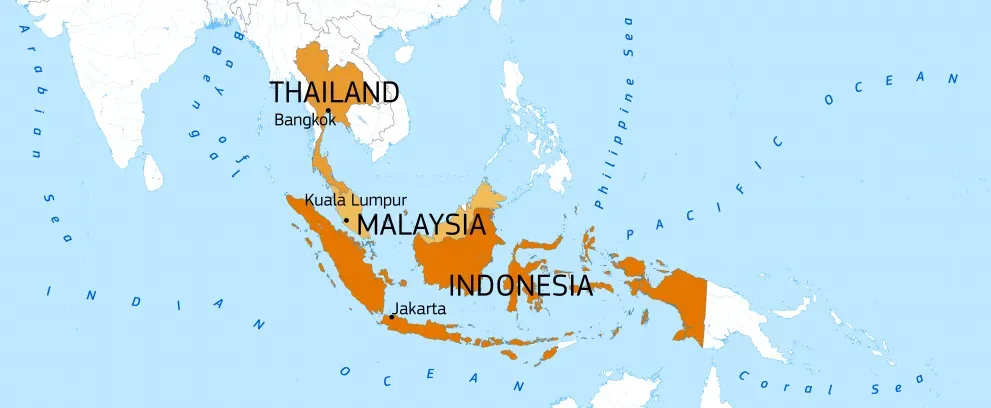
Southeast Asia’s leading nomad hubs sit within a few hours of one another, yet each offers a distinct way of life.
Thailand gives you the broadest range: Bangkok for city access, Chiang Mai for lower-cost living, and Phuket for a coastal base. Malaysia is the practical all-rounder, and while Bali offers an ideal tropical island lifestyle, it also comes with the price tag to match.
The visas discussed above may decide where you can stay. Your budget, healthcare needs, and family routine, however, decide where you will want to live.
Cost of Living and Housing Expectations
Housing is the biggest variable in your monthly budget. The table below shows the average cost of living for single remote workers vs families per month, alongside typical rental costs.
| Destination | Single (monthly) | Family (monthly) | Rent, prime areas |
|---|---|---|---|
| Thailand (Bangkok / Chiang Mai) | USD 1,200–2,200 | USD 3,500–5,500 | Bangkok one-bedroom condo: USD 600–1,100. Chiang Mai: about 30% less |
| Malaysia (Kuala Lumpur / Penang) | USD 1,300–2,100 | USD 3,200–5,000 | Two- to three-bedroom condo in Mont Kiara, Bangsar, Penang: USD 800–1,400. |
| Bali (Canggu / Ubud / Pererenan) | USD 1,800–3,200 | USD 4,500–7,500 | Villa in prime hubs, USD 1,800–3,500+ |
Our local experts report three key patterns in how remote workers and families budget across these destinations:
- Thailand lets you trade city access in Bangkok for a lower-cost northern base. Life in Chiang Mai cuts your monthly spending by about 30%. You still enjoy city infrastructure but nestled within a cool, mountainous enclave.
- Malaysia makes the strongest case if you’re looking for premium infrastructure for every dollar. Both Kuala Lumpur and Penang are established expat hubs offering reliable urban services at rents below comparable accommodation in Bangkok or Indonesia.
- Bali charges a premium for its most in-demand lifestyle hubs. Private villas in Canggu, Berawa, and Pererenan can cost as much as a larger family home in Kuala Lumpur.
Wellness and Healthcare Infrastructure
All three destinations offer private healthcare, but their capacity for specialist and emergency treatment differs significantly. Thailand is home to established hospital networks and a strong medical-tourism sector. Malaysia offers comparable infrastructure, particularly in Kuala Lumpur and Penang, where English is widely used by medical professionals and support staff. This makes consultations, diagnosis, and follow-up care more straightforward for foreigners. Bali stands out for daily wellness, from fitness studios and yoga retreats to recovery centers. However, residents often have to travel to Singapore or Malaysia for specialist or emergency care. This makes international insurance with evacuation coverage especially crucial.
International Schools and Family Life
An international school can be excellent on paper and still be the wrong choice for your family. The right choice shapes everything from your morning commute to how easily your children settle into a new environment.
Thailand provides the broadest selection of international schools. However, Malaysia offers a smoother day-to-day routine, especially in Kuala Lumpur’s established expat neighborhoods. Bali, on the other hand, draws families who value progressive, eco-focused curricula and are prepared for more difficult commutes.
| Country | Family hubs | Tuition per child, yearly | Curricula | School and Daily Life |
|---|---|---|---|---|
| Thailand | Bangkok, Chiang Mai, Phuket | USD 12,000–28,000 | IB, British A-Levels, American | Large, modern campuses with extensive facilities. Bangkok traffic is the trade-off; Chiang Mai and Phuket move at a more relaxed pace. |
| Malaysia | Mont Kiara and Bangsar in Kuala Lumpur; Penang | USD 8,000–20,000 | British IGCSE/A-Levels, IB, American | Established, academically focused British and IB schools, including GIS and Alice Smith. Walkable expat areas and integrated amenities make family logistics the simplest. |
| Bali, Indonesia | Sanur, Canggu, Ubud | USD 10,000–22,000 | IB, Australian, Green School curriculum | Eco-centric, progressive campuses, including Green School and Canggu Community School. Scooter-dominated traffic around Canggu and Ubud makes commute especially challenging. |
Which Digital Nomad Visa Should You Choose?
Ultimately, the right choice depends on how you earn, how long you plan to stay, and the kind of lifestyle you are looking for. So, which of these digital nomad visas should you choose?
- Thailand’s DTV: Your income is irregular, but you can prove THB 500,000 (~USD 14,500) in savings. Unlike the other two visas, it does not set a fixed annual income threshold. This makes it the most flexible choice for freelancers, consultants, and founders who want to spend time across Thailand rather than commit to one location.
- Malaysia’s DE Rantau Nomad Pass: You can document stable income and want an English-friendly base. The annual threshold is USD 24,000 for eligible tech professionals and USD 60,000 for non-tech applicants. It is a strong fit for couples and families who want established schools, private healthcare, and easier day-to-day logistics.
- Indonesia’s E33G Remote Worker ITAS: You are employed by an overseas company, earn at least USD 60,000 a year, and plan to stay in Bali or elsewhere in Indonesia for the longer term. However, the visa requires a conventional foreign employment contract and creates Indonesian tax-residency obligations from arrival. This makes it less suitable for freelancers or business owners with irregular income.
Plan Your Move to Southeast Asia With Emerhub
If you are unsure which digital nomad visa in Southeast Asia suits your situation, schedule a free consultation with Emerhub. Our local advisors in Thailand, Malaysia, and Indonesia stay current with regulations and practical issues that can affect your application.
We can verify which visa fits your work arrangement and prepare the documents needed to support your application. For Thailand’s DTV, we review your financial records and overseas-work evidence, then confirm that you apply through the correct Thai mission. For Malaysia’s DE Rantau Pass and Indonesia’s E33G, we’ll guide you through the relevant requirements and manage the submission on your behalf.
Fill out the form below, and we’ll put you in touch with our local experts.
Frequently asked questions
Which digital nomad visa has the lowest income requirement?
Thailand’s DTV has no fixed annual income threshold. Instead, applicants must show THB 500,000, or about USD 14,500, in liquid savings. Malaysia’s lower USD 24,000 annual threshold is available only to eligible applicants in the tech and digital category, while Indonesia’s E33G requires an annual income of at least USD 60,000.
Can I bring my spouse and children on the Thailand DTV, DE Rantau Pass, or E33G?
All three routes allow dependents, but the process and requirements differ. While Thailand allows a spouse and legally dependent children under 20, Malaysia allows spouses and dependents for an additional fee. Indonesia allows spouses and children to apply for an E31 dependent residence permit.
Can I work for local clients on a digital nomad visa?
Each visa is designed for remote work tied to overseas employers or clients, not local employment or locally sourced income. If you want to take on local clients or employment, you should consider work permits such as Malaysia’s Employment Pass (EP), Indonesia’s Work KITAS, or Thailand’s Non-Immigrant B Visa. Emerhub can help you secure these under an Employer of Record (EOR) arrangement. Reach out through the form below to discuss how this can work to your advantage.
Who qualifies for Malaysia’s lower DE Rantau income threshold?
The lower USD 24,000 threshold applies to applicants in MDEC’s tech and digital category. This includes roles in software, cloud services, cybersecurity, AI, data, UX and UI design, digital marketing, and content creation. You can also apply as a freelancer, independent contractor, or remote employee. However, your work must fall within an eligible field, and you must prove an annual income above USD 24,000.
Does holding a digital nomad visa make me a tax resident?
Thailand generally treats you as a tax resident after 180 days in a calendar year, while Malaysia uses a 182-day threshold. In Indonesia, however, the E33G is treated as creating Indonesian tax residency from arrival. You will need to register locally and file annual tax returns.