

Did you know that Malaysia is emerging as Southeast Asia’s most active IPO market? In the first half of 2025 alone, 32 new listings on Bursa Malaysia raised 66% of the region's total proceeds, driving a 165% surge in market capitalization.
Behind this momentum is Bursa’s unique three-board listing structure (Main, ACE, and LEAP), which gives companies different entry points depending on their size, maturity, and growth story. This guide walks you through how IPOs in Malaysia work, what makes each listing route distinct, and the key requirements foreign-owned companies should prepare for.
What is an Initial Public Offering (IPO) in Malaysia?
An IPO is the process of a private company offering its shares to the public for the first time, with those shares then traded on a stock exchange. In Malaysia, that exchange is Bursa Malaysia.
For any business, IPO marks a significant transition from a privately-owned business to a publicly-listed entity, bringing with it a new level of transparency and accountability to shareholders, regulators, and the market at large.
As a foreign-owned company, you have two fundamental options for how your company lists on the exchange. This determines the type of listing you pursue:
- Primary Listing: Bursa Malaysia serves as your company's main public exchange. This is the most common route for both local and foreign-owned companies. To be eligible, you must either incorporate your company as a public entity in Malaysia or choose a foreign jurisdiction with corporate laws and regulations that are at least equivalent to Malaysia's
- Secondary Listing: For companies already publicly listed on a recognized exchange in their home country (e.g., SGX, HKEX) and seeking an additional listing on Bursa Malaysia. This option is only permitted on the Main Market and is a less common route.
From here, you'll then choose one of Bursa Malaysia's three market boards, each designed to fit a company's growth profile and stage of maturity.
- Main Market: The only board available for a secondary listing. It's a premier platform for established, mature companies, from global brands to major domestic players. To list here, you must meet rigorous financial benchmarks, such as a minimum aggregate after-tax profit of RM20 million over three to five years or a market capitalization of at least RM500 million.
- ACE Market: This is the cornerstone of IPO activity in Malaysia. Designed for high-growth and innovative companies that may not yet be profitable, it attracts a wide range of forward-thinking businesses, from tech startups to expanding construction firms. Admission is based on a suitability assessment by a licensed sponsor, who looks for strong growth prospects and a sound business plan.
- LEAP Market: Specifically for SMEs and only accessible to investors deemed ‘sophisticated’ or high-net-worth. It allows SMEs to raise public funds and enhance their credibility without meeting the Main Market’s profitability thresholds.
What It Means When a Company Chooses to Go Public in Malaysia
By mid-2025, Bursa Malaysia’s total market capitalisation had crossed RM1.9 trillion, placing it among Southeast Asia’s most active capital markets. This means your shares is essentially trading in a liquid, credible environment where investors are paying very close attention to. Here’s how this actually plays out in practice:
- Access to Capital and Growth: IPOs in Malaysia are a proven way to raise significant funds for your expansion. In 2024, Bursa IPOs raised more than RM7 billion, demonstrating a strong investor appetite and market liquidity.
- Enhanced Credibility: Being listed provides a level of public trust that is difficult to achieve as a private entity. A Bursa-listed company is viewed as compliant and reliable by regulators, banks, and other local stakeholders, which streamlines everything from securing credit facilities to obtaining government licenses.
- Regional Visibility: Through its flagship Invest Malaysia series, Bursa actively showcases listed companies to global institutional investors, policymakers, and fund managers overseeing trillions in assets. This means golden opportunities for cross-border investments, extensive media attention, and inclusion in key regional financial dialogues.
- An exit strategy for early investors: For venture funds and other early backers, an IPO provides a transparent, market-driven way to realize a return on their investment. This liquidity is a key part of the value proposition for venture capital and private equity firms.
Preparing for the Inherent Risks and Challenges
Despite the promising trajectories and advantages, however, going public undoubtedly comes with significant commitments that requires careful planning and a realistic outlook:
- Dilution of control: To ensure a liquid and well-distributed market, at least 10–25% of your company's shares must be held by the public, depending on your type of listing. This reduces the direct influence of the original owners, regardless of whether they are foreign or local.
- Heavier compliance load: You must meet a higher standard of scrutiny and accountability according to Malaysian Financial Reporting Standards (MFRS). This includes mandatory quarterly reporting, audited financials, event-driven disclosures.
- Cost of listing: IPOs involve substantial financial investment. A Main Market IPO typically costs RM5 million to RM10 million in professional fees, while an ACE Market IPO can range from RM2 million to RM5 million. These costs include advisory, underwriting, and regulatory fees.
- Pressure from the market: The market ties your company's valuation to highly volatile investor sentiments. Your management must prepare to answer to public shareholders and deliver consistent results, which is a major shift from private operations
Understanding Malaysia’s IPO Regulatory Framework
The Securities Commission Malaysia (SC) and Bursa Malaysia govern every IPO in Malaysia through a dual framework. While SC regulates the market under the Capital Markets and Services Act 2007, Bursa operates the exchange and enforces its own Listing Requirements. Together, they provide the oversight that makes Malaysia one of the region’s most transparent capital markets.
- Main Market: The SC is the primary regulator and the first hurdle. They are responsible for reviewing and approving your prospectus, vetting corporate governance standards, and ensuring you meet eligibility criteria. Bursa Malaysia then manages the admission and enforces ongoing listing requirements.
- ACE & LEAP Markets: For these markets, Bursa Malaysia acts as the single approving authority for listing, handling both the prospectus registration and the admission process.
Bear in mind, however, there’s also a third layer to consider for foreign-owned companies: securing sector-specific approvals. Financial institutions, energy players, and other regulated industries will need clearance from key bodies like Bank Negara Malaysia (BNM), the Energy Commission (Suruhanya Tenaga), or PETRONAS before the SC will sign off.
Bursa Malaysia’s Listing Requirements for IPOs in Malaysia
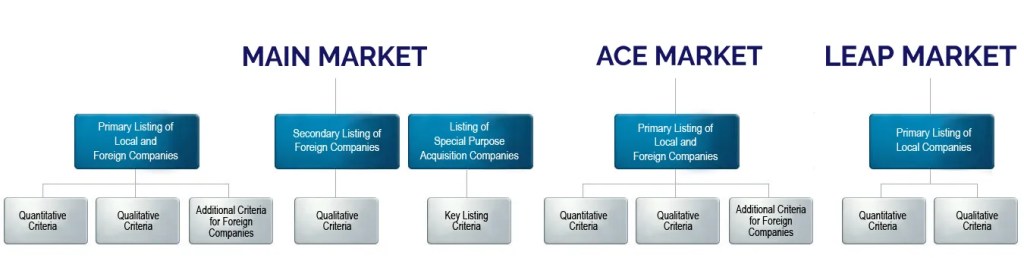
Bursa Malaysia’s baseline requirements ensure every listed company, whether local or foreign-owned, enters the market with adequate transparency and investor protection. While all markets share general obligations like corporate governance, each has very specific criteria for admission, which you can find them detailed in Bursa Malaysia’s official page here.
Below is a brief overview of the general requirements for each market:
| Market | Suitability Requirements | General Requirements |
|---|---|---|
| Main | Must meet one of three tests: - Profit Test: At least RM20 million aggregate after-tax profit over 3-5 years, with at least RM6 million in the most recent year. - Market Cap Test: A total market capitalization of at least RM500 million upon listing. | - Public Spread: The 25% public shares must be held by a minimum of 1,000 public shareholders. - Governance: Mandatory compliance with the Malaysian Code on Corporate Governance (MCCG). - Reporting: Quarterly and annual accounts prepared in line with MFRS. |
| ACE | - No minimum profit or market capitalization requirement. - Admission is based on a Suitability Assessment by a licensed Sponsor, who must be retained for at least three years after listing. | - Public Spread: The 25% public shares must be held by a minimum of 200 public shareholders. - Governance: Mandatory compliance with the MCCG. - Reporting: Quarterly and annual accounts prepared in line with MFRS. - Operating Track Record: Must have an identifiable core business. |
| LEAP | - No minimum profit or operating track record requirement. - Listing is based on a suitability assessment by an Approved Adviser. | - At least 10% of shares offered to only sophisticated investors. |
Sector-Specific Challenges and Opportunities for IPOs in Malaysia
| Industry | Key Challenges | Opportunities on Bursa Malaysia |
|---|---|---|
| Finance/ Banking/ Insurance | Additional approval from Bank Negara Malaysia; meet strict capital adequacy rules and ongoing prudential oversight. | Strong investor appetite for financial services, with banks often making up a large portion of Bursa’s blue-chip index. |
| Tech and E-commerce | Many firms lack profitability; ACE Market entry depends on sponsor suitability, requiring a strong business model and robust governance for an ACE Market listing. | - ACE IPOs dominated 2025 listings; SaaS, logistics, and e-commerce enablers attracted oversubscription. - Also fueled by the National Semiconductor Strategy and Bintang Semiconductor Impact fund to support high-tech Manufacturing and IR4.0 firms. |
| Manufacturing and Industrial Goods | Companies are asset-heavy and must demonstrate high efficiency, supply chain resilience, and strong ESG compliance. | - Firms that align with the “China Plus One” shift and the National Industrial Master Plan 2030 (focusing on automation and high-tech value manufacturing) are seeing strong investor interest. |
| Agriculture and Plantation | Subject to land ownership restrictions for foreign investors. Environmental, social, and governance (ESG) scrutiny is high. | - Palm oil and agri-tech IPOs remain attractive, with ESG-focused funds like the MSPO Impact Alliance backing traceability and sustainable plantation models. |
| Renewable Energy | Grid limitations and additional requirements from the Energy Commission (Suruhanjaya Ternaga). | - Malaysia’s National Energy Transition Roadmap (NETR) drives significant investment and a clear policy direction. - Bursa’s new Renewable Energy subsector actively boosts visibility for green IPOs. |
| Consumer Goods & Retail | - Market saturation; valuations tied to scalability, brand strength, and regional growth strategy. | - Consumer companies with ASEAN growth stories make prime candidates for oversubscribed IPOs.-I.e. Malaysia’s 99 Speedmart IPO in 2024 (RM1.5b raised, 121% debut jump), Eco-Shop’s 7% debut in 2025. |
Malaysia’s Initial Public Offering (IPO) Process: Step-by-Step
If you’re considering Malaysia as your listing destination, then the numbers speak for themselves: record-breaking IPOs, rising market caps, and growing foreign participation. For foreign-owned companies, the real challenge isn’t whether you can list, because you can.
The challenge lies in aligning your readiness with the right board, governance standards, and the overall market expectations. Here’s where you can start:
Phase 1. The Pre-IPO Readiness Assessment
Your IPO journey begins well before you file any paperwork. This stage is about proving your company is structurally, financially, and operationally ready to meet Bursa’s standards. Getting this right from the start reduces delays later in the process and, more importantly, builds confidence with regulators and investors alike.
The first step is to benchmark your company against the criteria for the Main, ACE, or LEAP board. At this point, you’ll also assemble your core IPO team– typically a Principal Adviser (licensed with the Securities Commission), lawyers, reporting accountants, and underwriters.
Next comes tidying up your shareholding, governance, and financial reporting to withstand regulatory and investor scrutiny. For foreign-owned businesses, this is particularly important: multi-jurisdictional ownership needs to be simplified, and your governance framework must align with Malaysian standards. Regulators will expect clear ownership structures, compliance with the Companies Act 2016, and transparent financial statements.
While your licensed advisers lead the IPO itself, corporate service providers like Emerhub can support this stage by aligning your company’s secretarial, compliance, and structuring needs. We’ll ensure your foundations are solid before you approach regulators.
Phase 2. Formal Submissions and Regulatory Approval
Once your company is structurally ready, the next milestone is formal submissions. At the heart of this phase is the prospectus– a detailed legal document that must be submitted to and approved by the SC and Bursa Malaysia. The submission process flows differently for each market:
- Main Market: The SC is your primary regulator. They’ll conduct a deep vetting process to approve your prospectus and verify your company's eligibility and governance standards. Once the SC grants its approval, Bursa Malaysia steps in to manage the official admission and enforce ongoing disclosures. This dual-regulatory approach also applies to companies seeking a secondary listing.
- ACE & LEAP Markets: The regulatory path here is more streamlined, as Bursa Malaysia acts as the single approving authority for your listing. They handle the entire process, including prospectus registration and managing your admission.
However, there’s an additional layer of clearance for regulated industries. For instance, financial institutions must secure approval from Bank Negara Malaysia, while power and energy companies answer to the Energy Commission. Oil & gas players often need PETRONAS sign-off. You'll have to obtain these sector-specific approvals before the SC or Bursa can proceed.
Note: Both the SC and Bursa are committed to a three-month review period for Main and ACE Market applications, provided all submissions are complete.
Phase 3. The Public Offering and Book-Building Process
With approvals secured, your IPO enters the market-facing stage. Here, the focus finally shifts from regulators to investors.
Your Principal Adviser or Sponsor, together with underwriters, will coordinate investor roadshows, analyst briefings, and media outreach. Institutional investors are generally courted first, followed by retail campaigns to build wider participation.
The final offer price is set through the book-building process– an exercise where prospective institutional and selected investors bid for portions of the Institutional Offering. Based on this feedback, your underwriters will construct an order book that reflects the true market appetite.
Phase 4. Public Offering and Listing Day
This is the culmination of your journey– the public launch of your company on Bursa Malaysia. The exchange coordinates the entire process, from the official gong-striking to the release of your shares on the trading system.
Trading usually begins immediately after the ceremony. Analysts, fund managers, and the media closely watch the first-hour price movement because it often sets the tone for investor sentiment. High-profile IPOs regularly make front-page headlines, while smaller listings may receive more targeted coverage.
Either way, listing day places your company in the spotlight, with investor confidence measured in real-time through your share price.
Phase 5. Post-IPO Listing Compliance and Obligations
The real impact of going public begins after listing day. From this point on, your company operates under constant market visibility, with every obligation you undertake determining whether you maintain investor trust and stock liquidity.
For instance, after listing, you must publish quarterly financial reports, annual audited accounts, and immediately disclose any material event (such as a change in leadership, major contracts, or acquisitions). If you miss deadlines, Bursa Malaysia can fine you RM200 per market day for delayed financial statements and up to RM1,000,000 per statement.
Moreover, independent directors, functioning board committees, and adherence to the Malaysian Code on Corporate Governance (MCCG) are mandatory. These structures reassure both regulators and investors that your company is managed responsibly.
Finally, sustaining liquidity and market confidence requires proactive communication. From analyst briefings to shareholder meetings, how you engage the market will shape long-term investor sentiments that go far beyond your listing day.
How Emerhub Supports Your IPO Journey
The Malaysian IPO process demands meticulous planning and a clear grasp of the regulatory framework governed by the Securities Commission and Bursa Malaysia. Navigating it without a misstep is crucial not just for a successful listing but to also avoid costly penalties.
This is where Emerhub can provide invaluable support. We provide end-to-end guidance to help your business move from a private entity to a public company, ensuring full compliance while positioning you for a strong market debut. Our core services include:
- Pre-IPO Readiness: Corporate structuring, incorporation, accounting, and audit preparation to ensure your governance meets Bursa’s standards.
- Regulatory and Compliance Advisory: Practical support in meeting SC, Bursa, and sector-specific requirements.
- IPO Professional Team Coordination: Assisting in assembling the right advisers and ensuring your submissions stay on track.
- Post-IPO Support: From compliance reporting, to maintain market trust after your listing.
Ready to go public in Malaysia? Schedule a complimentary consultation with our team to discover how we can guide you to a successful IPO.
Frequently asked questions
1. What are the key requirements for an IPO in Malaysia?
There is no single set of requirements, as they vary by market. Detailed requirements can be found on the official Bursa Malaysia site here. However, here’s a general overview of the three markets:
2. How long does the IPO process take in Malaysia?
The entire IPO journey, from initial preparation to listing day, typically takes 12 to 18 months. However, a key aspect of this is the regulatory approval timeline. The Securities Commission (SC) and Bursa Malaysia have a joint commitment to an expedited three-month approval period for a final decision on applications for both the Main and ACE markets, provided the submission is complete and all queries are answered promptly.
3. What are the costs involved in listing a company on Bursa Malaysia?
The total cost varies significantly based on the market and the size of the offering. Professional fees, which include advisory, underwriting, legal, and accounting services, are the largest component. For a Main Market listing, these fees can range from RM5 million to RM10 million. For ACE Market listing, on the other hand, the range is typically lower, ranging from RM2 million to RM5 million.
4. Can foreign-owned companies list on Bursa Malaysia?
Yes, foreign-owned companies can list on Bursa Malaysia. The most common route is a primary listing, where the company must either be incorporated in Malaysia or in a jurisdiction with corporate laws and regulations that are at least equivalent to Malaysia's. A less common option is a secondary listing, which is only permitted on the Main Market for companies that are already listed on a recognized foreign exchange.
5. How does an IPO compare to private fundraising options in Malaysia?
An IPO provides access to a much larger pool of capital from the public market, enhances a company's credibility, and offers an exit strategy for early investors. However, it comes with a heavier regulatory burden, higher costs, and a significant loss of control due to the requirement for a public shareholding spread. In contrast, private fundraising is typically faster and less expensive, but it may raise less capital and does not provide the same level of market visibility.