

If you are planning to bring electrical or electronic products to the Malaysian market, you will need to secure SIRIM certification. The Certificate of Approval (COA) is issued by the Energy Commission (Suruhanjaya Tenaga, or ST), while the ST-SIRIM label is supplied by SIRIM Berhad. Both must be in place before your product can be manufactured, imported, sold, or advertised in Malaysia.
SIRIM certification ensures that products meet Malaysian safety, quality, and energy performance standards. It is built on internationally recognized standards, comparable to Indonesia’s SNI Certificate, Singapore’s Safety Mark, and the U.S’s UL Listing.
This guide breaks down what you need to know about SIRIM certification for electrical and electronic products. We cover the regulatory framework, certification pathways, and the step-by-step application process.
What is SIRIM Certification in Malaysia?
SIRIM certification in Malaysia is a two-part process governed by the Energy Commission and executed by SIRIM Berhad. Together, they form the regulatory framework that authorizes electrical and electronic products to enter the Malaysian market legally.
- The Energy Commission (Suruhanjaya Tenaga, or ST) is the regulating authority. It operates under the Electricity Supply Act 1990 and the Electricity Regulations 1994. It issues the Certificate of Approval (COA) that legally authorizes you to manufacture, import, sell, display, or advertise a regulated product.
- SIRIM Berhad is the appointed testing and certification partner. Through its subsidiary SIRIM QAS International, it conducts the product testing and factory audits required by the Energy Commission. Then, it supplies the ST-SIRIM safety label (image below) that must be affixed to each approved unit.
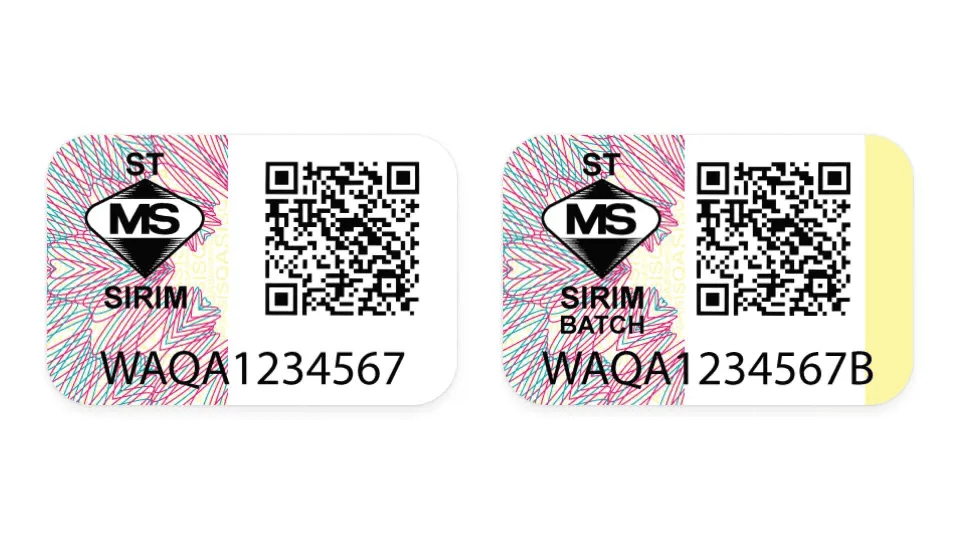
An electrical/electronic product is only legal for sale in Malaysia when both the active COA and the physical ST-SIRIM label are in place.
Who Needs to Apply for SIRIM Product Certification?
The requirement for compliance applies to any business entity involved in the supply chain of regulated electrical and electronic goods. You must secure this certification if you fall into any of the following categories:
- Importers: Local Malaysian companies bringing regulated electrical items into the country from overseas manufacturers.
- Manufacturers: Businesses producing regulated electrical equipment within Malaysia for local sale or export.
- Distributors and Retailers: Entities displaying, advertising, or selling regulated equipment to consumers, whether through traditional retail stores or online e-commerce platforms.
- Foreign Manufacturers: Overseas brands that want to sell their products in Malaysia. Because foreign companies cannot hold the certificate directly, they must work with a local representative to manage the process.
The certificate holder must be a local business entity registered with the Companies Commission of Malaysia, known as SSM. The applicant must also possess suitable premises, such as a registered office or warehouse, to store and distribute the certified goods. We delve into these requirements in the section below.
Key Regulatory Updates for SIRIM Certification in 2026
Malaysia continuously updates its standards to reflect modern technology and safety demands. You must account for these current standards during your product development and planning stages:
- Risk-Based Test Report Validity: The latest guidelines use a risk-based approach to determine if your test reports are acceptable. For high-risk electrical items, your safety test reports must be less than 5 years old from the date of the test. For low-risk items, older reports remain acceptable, provided the product design has not changed.
- Strict Prohibitions on EV Charger Models: To protect consumers and the national grid, the guidelines prohibit Mode 1 electric vehicle chargers. If you import EV charging equipment, you can only distribute Mode 2 and Mode 3 charging systems. These systems must be tested and certified against international standards like MS IEC 61851.
- Physical Label Placement on the Product Casing: You must place the ST-SIRIM safety label directly on the product itself. Applying the label to the outer retail packaging alone is no longer permitted. If your product arrives at customs with the label placed only on the cardboard box, the shipment may be detained.
- The Sabah Regulatory Shift: The Energy Commission of Sabah (ECoS) now manages all energy regulations and approvals within the state of Sabah. If you plan to distribute your products across the entire country, you must remember that a standard Peninsular Malaysia COA does not automatically extend to Sabah or Sarawak. You must secure separate state-level approvals for those territories.
Products That Require SIRIM Certification (ST COA) in Malaysia
The Energy Commission classifies electrical equipment into regulated and non-regulated categories. Regulated products generally include low-voltage consumer items that connect directly to the main electricity grid and do not require professional skills to operate.
The Commission regulates 34 distinct categories of electrical products. The table below lists the most common examples:
| Product Category | Specific Examples |
|---|---|
| Household Comfort & Care | Air conditioners, electric fans, vacuum cleaners, washing machines, hair dryers, hair straighteners, and electric irons |
| IT & Mobile Accessories | Laptop power adapters, mobile phone wall chargers, tablet chargers, desktop power supply units, and mains connection cables |
| Kitchen Appliances | Rice cookers, blenders, food processors, microwave ovens, refrigerators, slow cookers, and electric kettles |
| Audio-Visual Equipment | Televisions, high-fidelity audio systems, radios, and video players |
| Power Accessories | Domestic wall switches, socket outlets, multiway adapters, power chargers, and AC/DC power adapters |
| Lighting Products | LED lamps, fluorescent lamps, table lamps, standing floor lamps, and decorative festival string lights |
Energy Efficiency and the Star Rating Label
A portion of these categories also fall under Minimum Energy Performance Standards (MEPS), which apply to 10 product types:
- Refrigerators
- Air conditioners
- Televisions
- Domestic fans
- Lighting (including LED lamps)
- Washing machines
- Microwave ovens
- Rice cookers
- Freezers
- Electric ovens.
If your product falls under the MEPS scope, you must submit an energy performance testing report from an accredited laboratory. Once the Energy Commission approves the data, you must display the official 1-to-5 star energy rating label directly on your product alongside the safety mark.
Non-Regulated Products and Battery-Operated Devices
Devices that run entirely on USB power or internal dry-cell batteries do not require an ST COA. For example, a battery-powered wireless mouse or a low-voltage USB decorative fan is exempt from this safety certification.
This exemption extends to smartphones, tablets, and laptops because these mobile devices run on low-voltage internal DC batteries rather than connecting directly to the high-voltage AC mains grid.
However, a critical compliance requirement arises once these devices ship in a single retail package with an AC power adapter or a battery charger. While the laptop or smartphone itself is exempt from the ST COA, the accompanying wall charger plugs directly into a standard 230V outlet and remains highly regulated.
If you import a bundle containing both an exempt device and a regulated charger, customs will detain the entire shipment if the charger lacks a valid ST COA. To clear any ambiguity at the port of entry, you can apply for an ST Release Letter. This official document proves to customs officers that your specific primary item is exempt from safety certification, which prevents unnecessary shipping delays.
Overlapping Compliance for Specialty Devices
Some electrical items contain features that fall under the jurisdiction of multiple government agencies. If your product has hybrid features, you must clear additional compliance requirements before you can begin distribution:
- Smart and Connected Appliances: If your household appliance has wireless features like Wi-Fi, Bluetooth, or cellular connectivity, it is a communication device. In addition to your standard ST COA, you must obtain Type Approval through SIRIM QAS to secure the SIRIM-MCMC mark.
- Laptops, Tablets, and Smartphones: Because these devices connect to telecommunication and radio networks, they require mandatory MCMC Type Approval to secure the SIRIM-MCMC mark. This means that a smartphone or laptop bundle has a split compliance profile where the phone or laptop itself requires the wireless SIRIM-MCMC mark, while its accompanying power adapter must carry the physical ST-SIRIM safety label.
- Medical Electrical Devices: If you are importing medical lasers, electric wheelchairs, or specialized dental chairs, your product is a medical device. You must register these items with the Medical Device Authority (MDA) under the Medical Device Act 2012, which replaces the standard consumer COA process.
- Environmental and Refrigerant Rules: If you import air conditioners or commercial refrigerators, your equipment must comply with the Department of Environment (DOE) rules under the Environmental Quality Regulations 2020. You must prove that your cooling systems use approved, environmentally friendly refrigerants.
Emerhub can verify your product category and its specific import and certification routes. We can also serve as your license holder to import and distribute your products in Malaysia. Book a free consultation with our local experts here.
Pre-Requisites for Electrical Device Registration in Malaysia
1. Appointment of a Local Representative
The Energy Commission does not accept direct applications from foreign companies. To hold a certificate, you must have a local presence. As a foreign investor, you have two viable options to bring electrical products into Malaysia legally.
- Establish a Local Subsidiary: You can register a local Malaysian company, such as a Private Limited Company (Sdn Bhd). This company will register with the Energy Commission and hold the COA. This route gives you total control over your distribution, but it requires local registration, capital, and administrative overhead.
- Use a Local Importer of Record: You can partner with a service provider like Emerhub to act as your local Importer of Record in Malaysia. We register with the authorities, hold the COA on your behalf, clear your goods through customs, and manage your compliance. This way, you can enter the market without setting up a corporate entity.
2. Choosing Your Certification Pathway
You must select the testing pathway that matches your import frequency and shipment volumes:
- Batch Testing Scheme (BTS): This route, often called consignment testing, is ideal for trial shipments, seasonal imports, or low-volume shipments. SIRIM inspectors visit your local warehouse after the goods arrive, draw random samples from the batch, and test them in a local laboratory. You must repeat this process for every new shipment.
- Product Certification Scheme (PCS): This route is designed for high-volume, long-term importers or local manufacturers. It requires a comprehensive factory audit at your production facility, even if the plant is located outside Malaysia. Once SIRIM issues your Product Certification Licence, you do not need to test every incoming cargo batch. You can purchase your safety labels in bulk or print the safety mark directly onto your product casing.
3. Mandatory Documents for SIRIM Application
To avoid rejections during the review stage, you must prepare a complete technical and corporate dossier.
a. Corporate documents (from your local representative or subsidiary)
- The SSM company registration profile and corporate background documents
- A valid business license issued by the local municipal authority
- The lease or tenancy agreement for your local warehouse facility
- High-resolution photographs of your business premises showing the official company signboard
- A formal Letter of Authorization from the manufacturer appointing your local representative
- Signed declaration letter confirming:
- No distribution of the product before the COA and ST-SIRIM label are issued
- Responsibility for product quality and safety
- Compliance with ST-SIRIM labeling requirements
- Authenticity of all submitted documents
b. Technical documents (from the Manufacturer)
- A complete product safety test report from an accredited laboratory, such as an IECEE CB Scheme lab or an ILAC MRA signatory lab
- Full product specifications, user manuals in English or Bahasa Malaysia, and product brochures
- An official list of internal components, electrical circuit diagrams, and nameplate artwork
- For MEPS-regulated products, an accredited energy performance testing report
- A copy of the manufacturer’s ISO 9001 quality management system certificate, which is compulsory for the factory audit route
Step-by-Step Process for SIRIM Product Certification
Certifying your electrical or electronic products requires smooth coordination between the manufacturer, the local applicant, and the testing laboratories. Emerhub provides end-to-end support throughout this process, managing every technical and administrative phase on your behalf. Here’s an overview of the general process:
Step 1: Establish Your Local Representation
You must either set up your local Sdn Bhd or sign a representation agreement with a local importer of record. Your local entity will register on the e-DIK system, which is the official portal managed by the Energy Commission. This registration identifies your company as an authorized importer of electrical products.
This step issues your company a Certificate of Registration (CoR), which serves as your authorization to apply for product-specific COAs later.
At this stage, Emerhub can help you set up your local entity or act as your local representative to handle the product certification process on your behalf.
Step 2: Submit the Technical Dossier
Your representative will compile your corporate documents, product specifications, and safety test reports and upload them to the online e-Permit platform. The Energy Commission reviews these files to ensure your product complies with Malaysian Standards.
For example, all products intended for connection to a standard domestic wall socket must be fitted with a compatible Type G three-pin plug that complies with the MS 589 standard. If your product ships with a different plug type, your application will be rejected at this stage.
Step 3: Obtain the Provisional Approval and Ship Your Goods
Once the Energy Commission is satisfied with your documents, they will issue a provisional Certificate of Approval (CoA). This approval allows you to ship your products to Malaysia. When the shipment arrives at the port, customs will allow the cargo to pass into your licensed local warehouse, provided you have filed the necessary e-Permit declarations and linked them to your provisional approval.
Step 4: Complete Product Testing or Factory Audits
Once the goods are in Malaysia or ready for production, physical verification must take place:
- If you choose Batch Testing (BTS): Your representative will file a request on the SIRIM e-CEE portal. A SIRIM officer will visit your warehouse, select random samples from the imported cargo, and test them in their lab to verify safety compliance.
- If you choose Product Certification (PCS): SIRIM will conduct an audit of your manufacturing facility, inspect your quality control systems, and test sample units taken directly from your production line.
Step 5: Secure the Active COA and Apply Your Labels
Once your product passes the physical tests or the factory audit, the Energy Commission will release your final, active COA (valid for 12 months). You can now purchase your physical safety labels from SIRIM and manually apply them to each device in your warehouse.
If you hold a Product Certification Licence, you can print or mold the safety mark directly onto your product rating plate during production. Your goods are now ready for retail distribution.
How to Import SIRIM-Certified Products into Malaysia
Importing regulated electronics is very different from importing standard retail items. If you try to clear customs without the proper safety approvals, your shipment will be detained at the port.
To streamline this process, Emerhub acts as your local Importer of Record, managing the entire import process on your behalf. We handle everything from product registration and customs clearance to last-mile logistics, allowing you to bypass the complexities of setting up local licenses.
| Import Step | Standard Import Goods | SIRIM-Regulated Electrical Goods |
|---|---|---|
| Importer Requirements | Standard SSM company registration and customs import profile. | Active registration on e-DIK portal and a valid Certificate of Registration from the Energy Commission. |
| Port Entry Clearance | Standard customs declaration and tax invoice processing. | Custom declaration linked to a valid Certificate of Approval (COA) in the e-Permit system. |
| Post-Port Logistics | Immediate delivery to retail distribution centers. | Transport directly to a licensed local warehouse for consignment testing or label application. |
| Retail Readiness | Ready for sale immediately upon customs clearance. | Legal for sale only after physical ST-SIRIM safety labels are applied to each individual unit. |
| Product Examples | Wooden furniture, plain clothing, plastic kitchenware, or battery-operated devices without a wall charger | Electric kettles, hair dryers, household refrigerators, AC adapters, and LED light bulbs |
For a smooth process, your shipments must arrive with complete commercial invoices, packing lists, and bill of lading documents that perfectly match the technical names on your COA. Our local team coordinates directly with Malaysian Customs to ensure your cargo moves through the port of entry without inspection delays or demurrage charges.
Streamline Your SIRIM Certification and Product Compliance with Emerhub
Working through the Energy Commission’s approval process and SIRIM’s testing requirements takes local representation, complete technical documentation, and ongoing compliance. Emerhub supports foreign manufacturers and importers at every stage:
- Local Representation: We register as your appointed importer or agent with the Energy Commission, so you can enter the Malaysian market without setting up your own entity first.
- Application Management: Our team handles your e-DIK registration, e-Permit COA application, and document submission, coordinating directly with the Energy Commission.
- Testing Coordination: We liaise with SIRIM on consignment testing or factory audits, depending on the certification route that suits your shipment patterns.
- Renewal and Compliance Tracking: We monitor your COA validity and manage timely renewals, audit responses, and any updates required when product specifications change.
- Importer of Record Services: For foreign brands testing demand before full market entry, our Importer of Record service lets you ship products into Malaysia under our licenses while we manage the regulatory side.
Contact our compliance specialists today to secure your SIRIM approvals and launch your products in the Malaysian market. Schedule a free consultation via the form below.
Frequently asked questions
Do battery-operated devices require an ST COA?
An ST COA is only required for electrical products that connect directly to the main low-voltage power supply. Devices that run entirely on USB power or internal batteries do not require safety certification. However, if your battery-operated device includes an AC power adapter, that adapter must be tested and certified separately.
Can a foreign manufacturer own the ST COA directly?
The legal applicant and holder of the ST COA must be a company incorporated in Malaysia and registered with the Companies Commission of Malaysia (SSM). Foreign brands must either set up a local subsidiary or appoint a local importer of record like Emerhub to hold the certificate on their behalf.
If my product has a CE mark, do I still need a SIRIM certificate?
The CE mark is a self-declaration for the European market and is not recognized as a direct clearance document by Malaysian Customs. However, you can submit the accredited laboratory test reports used to obtain your CE mark to SIRIM. If those reports are less than five years old, SIRIM can use them to bypass local testing, saving you time and resources.
Are there separate certifications for telecom and smart appliances?
Standard electrical appliances only require the ST COA and the ST-SIRIM label. However, if your appliance includes wireless capabilities, such as smart refrigerators with Wi-Fi or Bluetooth speakers, it is a hybrid product. It will require both the ST COA for its electrical components and MCMC Type Approval for its wireless features, and you must display both safety marks.
What happens if my product fails the initial SIRIM laboratory testing?
If a product fails testing during the batch or factory audit route, you will receive a non-conformance report outlining the safety failures. You are typically allowed to rectify the specific issues (such as replacing non-compliant plugs or cords) and apply for a re-test. If the product fails a second time, the shipment must be returned to the country of origin or destroyed under customs supervision.