

If you plan to expand in Southeast Asia, Singapore and Labuan in Malaysia are some of the best locations to start a company. Both allow 100% foreign ownership and offer offshore-like benefits such as tax efficiency and flexible structuring. Both also operate within regulated frameworks that meet global compliance standards.
Singapore is the region's premium onshore jurisdiction. It ranks among the most credible places to register a foreign entity, backed by a deep treaty network and a regulatory reputation that international banks and business partners trust by default.
On the other hand, Labuan is a midshore jurisdiction sitting between a full onshore environment and a traditional offshore centre. Trading companies pay 3% tax on net profits. Holding companies pay 0%. Ownership stays private, and the compliance model is lighter by design.
The right choice comes down to your operational goals. Your tax position, compliance, and operations will look very different depending on which location you choose. This guide breaks down the essential trade-offs to help you decide which jurisdiction best aligns with your strategy.
Understanding Singapore and Labuan as Investor Hubs
Location and Market Access
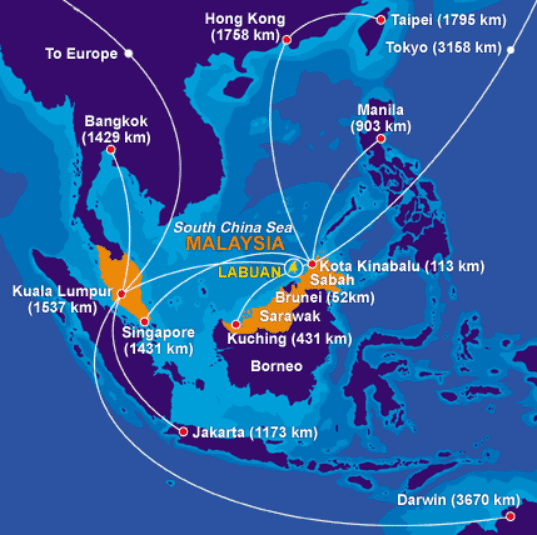
Singapore and Labuan are both located along Southeast Asia's busiest maritime corridors. But they serve very different purposes for foreign investors.
Singapore sits at the crossroads of the Malacca Strait and South China Sea, with direct access to ASEAN, China, India, and Australia. Changi Airport connects to over 150 cities. The port ranks among the top two globally by container throughput. The country's extensive FTA network covering the EU, the US, and the CPTPP is particularly beneficial for tariff-efficient supply chains.
Labuan is Asia's leading midshore financial centre, located off the coast of Sabah in East Malaysia. It was established as Malaysia's International Business and Financial Centre (IBFC) and regulated by a single authority, the Labuan FSA. The centre is specially designed for cross-border financial activity rather than physical trade. The FSA primarily licenses banks, insurers, fund managers, commodity traders, and digital financial service providers.
Infrastructure and Connectivity
Singapore essentially operates as a full-service commercial hub. It’s home to one of Asia's deepest banking ecosystems and a public company registry that builds trust with clients and investors. Government infrastructure supports everything from hiring to IP protection. The trade-off is higher costs across office space, compliance, and legal fees.
In comparison, Labuan offers a more specialised infrastructure. Over 60 licensed banks, including CIMB, Maybank, and Standard Chartered, maintain branches on the island.As Malaysia's only International Business and Financial Centre, it supports Shariah-compliant financial structures, captive insurance frameworks, family office vehicles, and private fund structures. The Global Incentives for Trading (GIFT) programme has also established it as a recognized base for international commodity trading alongside hubs like Singapore and Geneva.
Ownership details stay confidential with the FSA rather than sitting on a public registry. Running costs sit well below Singapore's.
Tip for Investors: Singapore is the clear choice for market-facing operations, especially if you’re targeting enterprise clients or external funding. Labuan is designed to support holding structures, treasury functions, and licensed financial activities with a more cost-efficient regulatory framework.
The Business Environment: Labuan vs Singapore
Both jurisdictions allow 100% foreign ownership with a single director and shareholder. However, day-one operating requirements diverge significantly from here. These differences shape your cost base, incorporation timeline, and how visible your ownership is to the public.
Taxation and Tariffs Comparison
Both Labuan and Singapore run low-tax environments, but their frameworks and access to international trade agreements differ significantly.
Labuan operates under the Labuan Business Activity Tax Act 1990 (LBATA), a separate regime from Malaysia's standard corporate tax code. Trading companies pay 3% on net audited profits. Non-trading companies pay 0% on qualifying passive income. There is no withholding tax, GST, or stamp duty on Labuan business activities.
Singapore uses a territorial system with a 17% headline rate. It bears no capital gains tax, and exemptions that bring the effective rate on the first SGD 100,000 down to roughly 4.25% for the first three years.
Here is a quick comparison of business taxes and trade access in both jurisdictions:
| Feature | Labuan | Singapore |
|---|---|---|
| Corporate Tax Rate | 3% on net profits (trading) / 0% (non-trading) | 17% flat (effective ~4.25% for startups) |
| Capital Gains Tax | None on Labuan business activities | None |
| Withholding Tax on Dividends | None for non-residents | None (one-tier system) |
| GST / SST | None | 9% GST |
| IP Income | 24% (standard Malaysian rate) | 17% (incentives available) |
| Double Taxation Agreements | Access to Malaysia's ~75 DTAs (some exclude Labuan) | 90+ DTAs, full access |
| Startup Tax Incentives | None comparable | SUTE: 75% exemption on first SGD 100,000 for 3 years |
For investors routing income through multiple jurisdictions or selling into markets that exclude Labuan from treaty benefits, Singapore's wider DTA coverage is more beneficial. For holding structures and regulated financial activities that stay within Labuan's tax regime, the 3% and 0% rates remain among the most competitive in Asia.
Important Note: Not every DTA Malaysia has signed extends to Labuan entities. Treaties with Australia, the UK, and Japan specifically exclude Labuan companies from treaty benefits. If you need treaty access to a specific jurisdiction, Emerhub advisors can review this for you.
Regulatory Environment and Setup Process
Both jurisdictions allow 100% foreign ownership with a single director and shareholder, and both offer fast incorporation. Bear in mind, however, bank account setups and sector licensing may stretch your operational timelines to between 3–4 weeks or longer, depending on your readiness.
Here is a comparison of setup requirements in Labuan and Singapore:
| Labuan (IBC) | Singapore (Pte Ltd) |
|---|---|
| Mandatory engagement of a Labuan trust company licensed by the FSA, which serves as the filing agent. | Mandatory engagement of an ACRA-registered Corporate Service Provider (CSP) to file incorporation on the company's behalf. Foreign companies and directors cannot file directly without a Singpass. |
| At least one resident director (typically provided by the trust company). | At least one resident director (Singapore citizen, permanent resident, or Employment Pass holder). Foreign shareholders without a qualifying nominee use a nominee director through their CSP. |
| Registered office in Labuan (provided by the trust company). | Registered local business address (cannot be a P.O. Box). |
| Minimum of 1 share in any foreign currency. | Minimum paid-up capital of SGD 1. |
| Company secretary role filled by the licensed trust company. | At least one company secretary resident in Singapore, appointed within 6 months of incorporation (typically provided by the CSP). |
Below is a quick overview of the company setup process:
| Labuan | Singapore |
|---|---|
| 1. Engage a Labuan trust company licensed by the Labuan FSA. | 1. Engage an ACRA-registered Corporate Service Provider. |
| 2. Prepare incorporation documents (Memorandum and Articles of Association, identification documents, beneficial ownership declarations). | 2. CSP runs KYC on directors and shareholders, then prepares incorporation documents (company constitution, Consent to Act forms, identification documents, company details). |
| 3. Trust company reserves the company name and submits the incorporation application to the Labuan FSA on your behalf. | 3. CSP reserves the company name through ACRA's BizFile+ portal and files the incorporation application on your behalf. |
| 4. Receive Certificate of Incorporation. | 4. Receive business profile and Unique Entity Number (UEN). |
| 5. Post-incorporation compliance: - maintain statutory registers- file annual returns within 30 days of the incorporation anniversary- submit tax returns by 31 March- prepare audited financials (trading companies),- meet economic substance thresholds annually. | 5. Post-incorporation compliance:- maintain statutory registers- hold annual general meetings- file annual returns with ACRA and tax submissions with IRAS- comply with audit requirements (exemptions apply for small companies). |
Two differences drive most of the friction:
- Labuan routes your compliance through a licensed trust company, which removes almost all of the administrative burden from your end.
- Singapore requires you to accept full public visibility of ownership. You also carry most of the ongoing compliance directly unless you choose to outsource your ongoing obligations.
If you’re looking to establish an entity in either jurisdiction, Emerhub can break down all the key considerations and manage the incorporation process for you. Schedule a free consultation with our advisors to learn more about our scope of support.
Government Incentives and Support for Businesses
Government support is a crucial factor when choosing where to set up, especially if you plan to scale, relocate key staff, or operate in a regulated sector. Here is a quick overview of incentives available in each jurisdiction:
| Focus | Labuan | Singapore |
|---|---|---|
| Main approach | Tax incentives through LBATA (3% on trading profits, 0% on holding income) rather than a grant ecosystem. | Broad ecosystem of grants and tax schemes through the EDB, including startup exemptions, pioneer incentives, and sector-specific programmes. |
| Commodity trading | GIFT programme: 3% tax rate for licensed commodity traders, tax exemptions on non-Malaysian director fees and trader income, stamp duty exemptions. | No equivalent programme. Traders taxed at 17%. EDB's Global Trader Programme may offer reduced rates on a case-by-case basis. |
| Islamic finance and digital | Full tax exemption for Islamic digital entities (2024–2028). Expanded to include (re)Takaful from 2025. | No equivalent exemption. Fintech support available through MAS innovation schemes. |
| Carbon and sustainability | Full tax exemption on qualifying carbon credit trading (2024–2028). Support for carbon project financing and tokenisation of credits. | No equivalent trading exemption. Green finance support available through MAS grant schemes. |
| Insurance and risk | MADANI Captive programme (2026 budget) designates Labuan as the home for national captive insurance. Captives taxed at 3%. | No equivalent captive programme. Insurers taxed at 17% under MAS regulation. |
| Relocation and talent | Labuan Employment Pass: two-year renewable work pass for directors and senior executives. | Employment Pass and Tech.Pass for senior hires and founders. Broader talent-attraction schemes. |
| IP and innovation | No specific IP incentives. Royalty income taxed at 24%. | IP Development Incentive offers concessionary rates (5%, 10%, or 15%) on qualifying IP income. R&D grant support available through Enterprise Innovation Scheme (EIS). |
| Regional headquarters | No direct grant support. Value comes from the 3% and 0% tax rates. | Regional and International Headquarters Awards offer reduced rates for companies basing operations in Singapore. |
Labuan's programmes essentially target financial services, commodity trading, and Islamic finance. If your business operates in one of these areas, Labuan offers tax benefits that Singapore does not match.
Singapore casts a wider net. Its incentives cover more industries and business stages, from startups to multinational headquarters. For businesses built around IP, R&D, or regional operations, Singapore has a stronger programme lineup.
Which Jurisdiction is Right for You?
The choice tends to come down to what you are building and where on the compliance spectrum your business naturally sits.
Choose Labuan if:
- You are setting up a holding company, treasury vehicle, family office, or fund structure where you want to leverage a 0% or 3% concessionary rate.
- Your business model can comfortably maintain the substance footprint (at least two local employees and RM 50,000 of annual local spend).
- You value corporate confidentiality and a flexible midshore framework over the prestige of a premium onshore brand.
- You want to relocate to Malaysia through the Labuan Employment Pass pathway.
Choose Singapore if:
- You are building an operational business that needs to hire locally, sell to enterprise clients, or raise institutional capital.
- You need access to more DTAs and one of the deepest FTA networks in Asia for tariff-efficient supply chains.
- You want a globally recognised base with top-tier banking, payment infrastructure, and access to credit.
- You plan to serve regional clients directly and want the credibility a Singapore entity carries with them.
Emerhub helps foreign investors establish and manage businesses across Southeast Asia. In Labuan, we handle the trust company engagement, Labuan FSA filings, substance planning, and ongoing compliance. In Singapore, we can act as your licensed CSP, managing your incorporation, corporate secretarial work, and annual filings with IRAS.
Our advisors can map out which jurisdiction best aligns with your goals and manage your company establishment. Let us know about your plans via the form below, and we’ll reach out with tailored insights.
Frequently asked questions
1. Is Labuan still considered an offshore jurisdiction?
Traditional offshore centres like the BVI and Cayman Islands charge zero corporate tax with minimal reporting. The trade-off is that banks and counterparties often treat entities from these jurisdictions with caution. Labuan sits in between. It charges low tax rather than zero tax, and requires companies to maintain real employees, local spending, and a physical office under the supervision of the Labuan FSA. These requirements brought it in line with OECD standards, which is why major regional banks operate Labuan branches and routinely bank Labuan companies. You give up zero-tax rates. But in return, you get seamless banking, stronger international recognition, and a framework that holds up under legal scrutiny.
2. Can a Labuan company do business within Malaysia?
Since 2019, Labuan companies have been permitted to transact in Malaysian Ringgit and with Malaysian residents. However, income derived from Malaysian business activities is typically subject to Malaysia's standard 24% tax rate rather than the 3% Labuan rate. If your primary business activity will be domestic Malaysian operations, a standard Malaysian company (Sdn Bhd) incorporated under the Companies Act 2016 may be a better fit.
3. Which jurisdiction is better for an investment holding company?
Both are popular for holding structures. Singapore is one of the most widely used holding company domiciles in Asia. Singapore is one of the most widely used holding company domiciles in Asia. Its broad DTA network gives access to over 90 treaty partners. Its public registry builds credibility with institutional investors and lenders. This makes it a natural choice for holding companies on an IPO track or raising external capital. Labuan is the stronger option when the priority is cost efficiency and privacy. Non-trading income is taxed at 0%. Ownership details stay confidential with the FSA, and running costs sit well below Singapore's. For family offices, treasury vehicles, and holding structures where the entity's only role is to hold equity, Labuan is the more practical fit.
4. Can I use a Labuan company for intellectual property (IP) holding?
Labuan companies can hold IP, but the tax treatment differs from other business activities. Following OECD pressure, Labuan revised its framework so that royalties and licensing revenue from patents, trademarks, and copyrights are now taxed at 24% under Malaysia’s Income Tax Act. This income does not qualify for the concessionary 3% Labuan rate. If IP holding is central to your model, Singapore is likely a better fit. It offers specialised incentives like the Intellectual Property Development Incentive and strong legal protections that make it a premier hub for IP commercialisation.