

Foreign investors often compare Singapore and Malaysia when planning to expand into Southeast Asia. The countries sit right next to each other, but in reality, they attract businesses with fundamentally different needs.
Singapore is known as the region’s most reliable free-trade market. It consistently ranks among the easiest places to launch and manage a foreign entity, with a regulatory environment that’s streamlined, and filings that are processed with incredible speed.
But what makes Malaysia a considerable alternative? For many foreign investors, it offers the kind of flexibility a city-state cannot. You get room to expand and support larger teams. Operating costs also stay significantly lower as you grow your footprint.
In this guide, we explain the practical differences between setting up a business in Singapore and Malaysia. We’ll cover how each location compares to help you assess which best aligns with your setup.
Understanding Singapore and Malaysia as Alternative Hubs
1. Location and Market Access
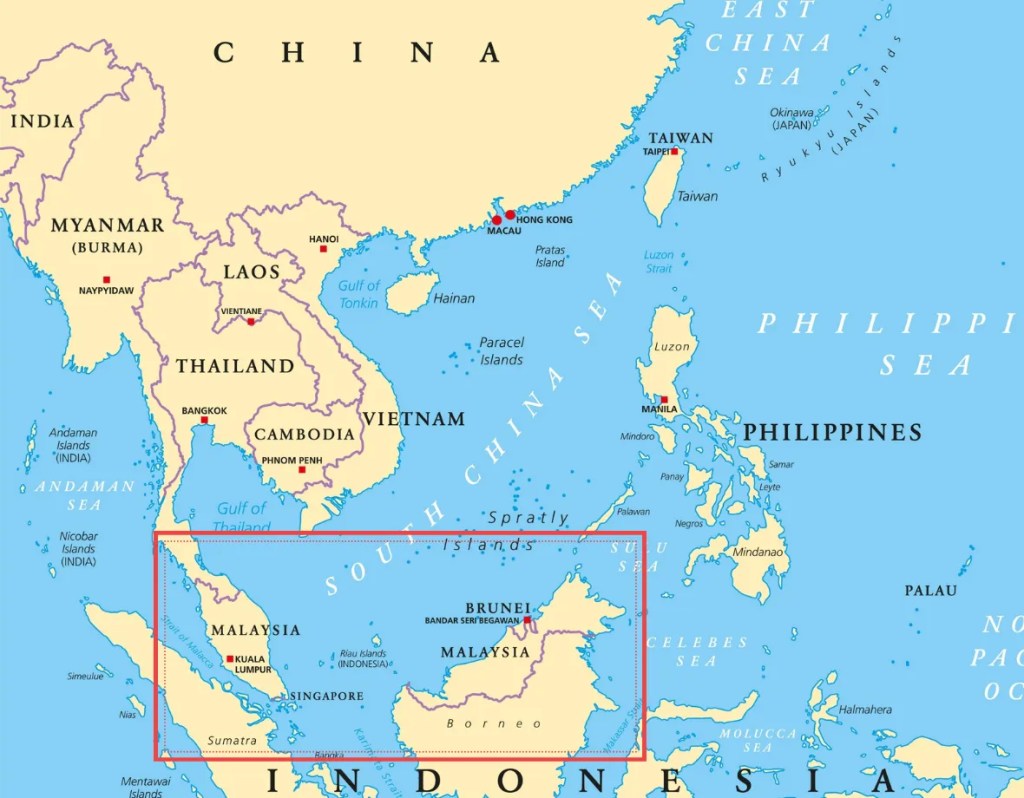
Singapore sits at the narrowest point of the Strait of Malacca, where most Asia–Europe vessels pass. This gives it the advantage of the world’s busiest transhipment port. Goods are moved at rapid speed between large vessels on their way to global destinations and secondary hubs in Australia, Indonesia, Vietnam, or even the US West Coast.
If your business relies on predictable, high-speed delivery cycles, Singapore stands out as a premium hub. We recommend Singapore to centralize activities such as:
- Time-sensitive regional fulfilment, like e-commerce or weekly inventory restocking.
- High-value shipments (medical, tech components) that demand nearly zero port dwell time.
- Coordinating complex, multi-country distribution from a single, reliable point.
On the other hand, Malaysia’s ports (like Port Klang and Tanjung Pelepas) operate primarily on origin and destination (O/D) cargo, meaning they are the beginning or end-point for Malaysian-produced goods. In short, businesses benefit the most when their focus is on local production, assembly, and long-term storage before export.
By centering your operations here, you gain immediate access to vast industrial land and a cost-efficient logistics network that directly supports industries requiring scale and competitive operational costs. For instance:
- Large-scale manufacturing (electronics, machinery, automotive).
- Consumer goods production and cold-storage distribution.
- Warehousing and regional fulfillment centers that require significant space.
- Businesses where long-term operational expenditure (OPEX) on land and competitive salaries are a key concern for expansion.
Tip: Many companies also adopt a twin-hub structure across Singapore and Malaysia. The Johor-Singapore Special Economic Zone makes this setup increasingly popular, allowing businesses to leverage Singapore’s Global Trade Gateway while tapping into Johor’s SEZ incentives and industrial capacity.
2. Political and Economic Stability
A stable political and economic environment plays a major role in obtaining long-term investor confidence. This is where Singapore and Malaysia offer significantly different environments.
If your business demands a stable, low-risk operating environment for long-term planning, Singapore is our primary recommendation. Its consistent governing system means business policies and regulations rarely shift between political cycles. This predictability minimizes sudden compliance burdens and is the foundation of its financial strength, making it the top destination in Asia for global wealth and treasury management.
This reliability grants your business two major benefits:
- Regulatory Certainty: Decisions by bodies like ACRA and MOM are highly predictable, backed by clear legislation. This minimizes administrative risk and allows for high confidence in long-term financial and operational projections.
- Offshore-like Benefits Onshore: Stems from Singapore's extensive network of 100+ Double Taxation Agreements (DTAs) and its policy of granting tax exemptions on specific foreign-sourced income (provided substance and taxation rules are met). This allows you to secure substantial tax efficiency and asset protection within its premier, globally respected onshore jurisdiction.
Conversely, Malaysia’s political environment is more dynamic. This means that while generous project-based incentives exist, policies and tax allowances can shift more often, requiring more active management and oversight. While Malaysia's network of 16 FTAs is strong for regional exports, its key advantage lies in its structure:
- Project-Based Incentives: High-value tax breaks and capital allowances (via MIDA) reward companies making large, long-term industrial investments.
- Dedicated Offshore Center: The Labuan IBFC acts as Malaysia's regulated offshore financial center, offering low tax for specialized trading and holding structures.
3. Infrastructure and Connectivity
In addition to political and economic stability, infrastructure is one of the clearest points of difference between Singapore and Malaysia. This directly shapes how efficiently your business can move goods, run operations, and expand across the region.
- Malaysia: Almost 500 times larger than Singapore, Malaysia has significantly more international airports, deep-sea ports, and far more industrial land if you’re planning for physical setups. Most of its economic activity is concentrated along the West Coast corridor, where extensive highway networks and modern industrial parks connect directly to major cities and ports. This region also hosts the majority of Malaysia's Free Trade Zones (FTZs) which maximize your export efficiency. This entire network makes it an excellent, cost-competitive base to manage internal logistics. You can quickly consolidate shipments from suppliers or efficiently distribute products from a central factory to retail points across the country.
- Singapore: Functions as a single, concentrated national hub. Its port terminals, airport, financial district, and tech parks sit within close proximity and run on a centralized smart digital network. All processing is handled electronically, from customs to company documents. This system is designed for maximum security and reliability, making it especially suitable if you plan to handle sensitive fund flows, where data security and connectivity are crucial. Because land is extremely limited, foreign investors typically lease high-specification properties for high-value activities (e.g. Innovative R&D and regional management).
The Business Environment: Malaysia vs. Singapore
Taxation and Tariffs Comparison
Both Singapore and Malaysia maintain competitive and business-friendly tax regimes to attract foreign investment. However, their approaches to corporate tax, GST/SST, and trade agreements significantly differ.
Singapore's main benefit is its low headline Corporate Tax rate of 17%, making your initial accounting and planning straightforward. It adopts a Goods and Services Tax (GST) of 9%. For your business, GST is a value-added tax that is generally recoverable for exporters and registered companies. This system prioritizes transparency and efficiency, often leading to better cash flow management.
Malaysia operates with a higher Corporate Tax rate of 24%, but its system is heavily driven by project-based incentives (via MIDA). The country uses a Sales and Service Tax (SST). Unlike Singapore's GST, the SST is generally not recoverable. This becomes a fixed expense that raises the effective operational cost of everything you purchase.
Here’s a comparison of business taxes in both Singapore and Malaysia:
| Tax Type | Singapore | Malaysia |
|---|---|---|
| Corporate Tax Rate | 17% (with exemptions for startups) | 24% |
| GST / SST | 9% GST on goods and services | Service Tax: 6% or 8%. Sales Tax: 5% or 10%. |
| Foreign Sourced Income | Favorable Exemptions– Generally exempted if remitted to SG, provided it was taxed overseas (> 15%). Ideal for holding companies. | Taxable– Taxed upon remittance into Malaysia, with limited exemptions for certain dividends/substance tests. |
| Tax Treaties (DTAs) | 100 DTAs + limited DTAs and EOI arrangements | 70+ agreements. (Strong regional focus) |
| Free Trade Agreements | 27 FTAs (Extensive network with EU, US, CPTPP, RCEP), broader tariff relief. | 16 FTAs (including CPTPP and RCEP), more selective tariff relief. |
If you are looking to reduce tariff impacts when trading with a wide range of global countries (such as the entire EU bloc, UK, Canada, and Australia), Singapore’s extensive FTA network provides more opportunities. Malaysia's FTA network is primarily useful if your primary market is Asia, particularly Southeast Asia (ASEAN), China, or Japan.
Emerhub experts can advise you on how each jurisdiction’s tax and treaty frameworks align with your specific trade or investment plans.
Regulatory Environment and Ease of Doing Business
Both Singapore and Malaysia make company incorporation relatively straightforward, with initial registration often completed in just a few days. However, as a foreign investor, you need to understand that the regulatory systems behind them differ vastly.
Singapore operates one of the most open market frameworks in Asia. You can legally incorporate with just S$1 in paid-up capital and retain 100% foreign ownership in almost every sector. Its entire process is managed through a single, streamlined digital system. This means you get your legal entity established and operational licenses processed significantly faster than in Malaysia.
Malaysia, in comparison, comes with more conditional requirements. While the initial registration is fast, foreign-owned companies often face a much higher practical minimum paid-up capital (ranging from RM 500,000 to RM 1 million) enforced by specific sectors. This is because Malaysia’s framework is layered, requiring you to secure multiple additional approvals and licenses from different government agencies after initial registration. This makes the period to achieve a full, compliant setup longer and requires more active management.
Here is a comparison of steps and requirements to set up a company in Malaysia and Singapore:
| Requirements | |
|---|---|
| Singapore (Pte. Ltd) | Malaysia (Sdn. Bhd.) |
| - At least one resident director (Singapore citizen, PR, or Employment Pass holder). - At least one shareholder. - At least one company secretary (resident status), appointed within 6 months. - Registered local address (cannot be a P.O. Box). - Minimum paid-up capital of SGD 1. | - At least one director who ordinarily resides in Malaysia. - At least one shareholder. - At least one company secretary (resident status), appointed within 30 days. - Registered business address in Malaysia. - Capital requirements: - Foreign-owned service sectors: RM 500,000 (~USD 120, 875) - Regulated sectors: RM 1 million (~USD 240, 000) |
| Company Setup Process | |
|---|---|
| Singapore | Malaysia |
| 1. Choose and approve a company name via ACRA’s online system. 2. Prepare all incorporation documents. 3. Submit application via BizFile+ or through a registered agent if you lack a Singpass. 4. Receive business profile and Unique Entity Number (UEN) (typically within 24 hours). 5. Post incorporation compliance: - Open a corporate bank account - Apply sector licences on GoBusiness (if applicable). - Register for GST (annual taxable turnover ≥ S$1m) or if opting in. - Comply with audit requirements (some exemptions apply for small companies). | 1. Choose and approve a company name through MyCoID (SSM). 2. Prepare incorporation documents. 3. Submit application via MyCoID or through a licensed agent. 4. Obtain Certificate of Incorporation from SSM (typically within 3–5 working days). 5. Apply for additional approvals from respective ministries if you operate in regulated sectors (e.g. F&B, wholesale/retail trade, manufacturing). 6. Post-incorporation compliance: - Open a corporate bank account in Malaysia. - Register for tax (LHDN) and Sales and Service Tax (SST) - Comply with ongoing tax and reporting requirements. |
Government Incentives and Support for Businesses
Government support plays a crucial role when expanding or setting up a new hub, especially if you plan to grow and innovate quickly. Below is a quick overview of government support and incentives for businesses in Singapore and Malaysia:
| Support Focus | Singapore | Malaysia |
|---|---|---|
| Overall Approach | Promotes innovation, R&D, and services. Incentives are often enhanced tax deductions and grants (sometimes cash payouts). | Focused on attracting large-scale physical investment (FAI) and job creation. Incentives are generally project-based income tax exemptions. |
| Core Incentives | - Regional HQ (RHQ) Schemes and DEI: Concessionary corporate tax rates (5%–15%) on qualifying regional income. - EIS/R&D Schemes offering enhanced deductions/grants. | - Global Services Hub (GS-Hub): Concessionary tax rates (0-10%) for service and trading activities. - Pioneer Status (PS) and Investment Tax Allowance (ITA) (income tax exemptions). |
| Foreign Investment Goals | To encourage companies to base their R&D, IP management, and regional coordination functions here. | To incentivize companies to commit to large physical operations, manufacturing capacity, and local hiring targets. |
Expert Support for Foreign Setups Across Southeast Asia
Both Singapore and Malaysia actively attract foreign investments of various scales, ranging from small-scale setups to major industrial operations. Choosing between either locations ultimately comes down to your intended activities and the sectors you operate in.
At Emerhub, we provide end-to-end company setup services, whether you are looking to establish in Singapore or Malaysia. This covers every step, from your initial consultation and registration to licensing and managing your ongoing compliance.
We specialize in helping foreign businesses expand their operations across Southeast Asia. With local expertise in emerging and a track record of over 4,000 established setups across the region, our experts are set to deliver proven solutions.
Ready to explore your options in Singapore or Malaysia? Fill out the form below to schedule a no-obligation discovery call with our experts today.
Frequently asked questions
1. Can a foreigner own 100% of a company in Singapore and Malaysia?
Full foreign ownership is generally allowed in both Singapore and Malaysia, but the framework in Singapore is far more open and straightforward. In Singapore, you can typically own 100% equity in almost all sectors without needing a local partner or government approval. It's a very clear-cut system. In Malaysia, full foreign ownership is also possible, but you'll encounter restrictions and extra requirements in certain sectors, like logistics, finance, or certain manufacturing activities. These often require approval from bodies like MIDA and local shareholding.
2. How long does it take to incorporate a company in Singapore vs Malaysia?
Singapore has one of the fastest systems globally. Registration with ACRA is often completed within 24 hours, while setting up a bank account and licenses may take 2–4 weeks, provided all your documents are in order. In Malaysia, approval from SSM typically takes up to 5 working days, but full setup (including tax, SOCSO, and business premise licences) can take 4–8 weeks. Regulated sectors such as finance, education, logistics, and manufacturing often require approvals from MITI, BNM, or MIDA, which can extend timelines between 3–6 months.
3. Which country is better for manufacturing or logistics– Singapore or Malaysia?
The better choice depends entirely on your operational needs and budget.
4. Can I base my headquarters in Singapore and operate from Malaysia?
This is a common and highly effective strategy for foreign companies expanding into Southeast Asia– especially with the emerging Johor-Singapore SEZ. Many businesses use Singapore as their regional headquarters for finance, legal compliance, and senior management. They leverage Singapore's stable tax environment and strong international reputation. Meanwhile, Malaysia serves as the operational base for manufacturing, logistics, or service delivery. This dual setup is especially beneficial because it allows you to access Singapore’s efficiency and global access while benefiting from Malaysia's lower operating costs and larger workforce for scalable operations.
5. Which country offers stronger intellectual property protection: Singapore or Malaysia?
Singapore is widely regarded as the safer jurisdiction for IP protection. Its legal framework is robust, adhering strictly to major international treaties, while its courts are highly specialized in commercial and IP disputes. Registering patents, trademarks, and copyrights through the Intellectual Property Office of Singapore (IPOS) is a globally respected standard. Malaysia's IP laws, while compliant with international standards, have historically faced challenges in enforcement. While the framework is strong, the judicial process can be slower. For technology companies whose primary assets are intangible (patents, software, trademarks), Singapore stands out as the better option.