

Buying property in Bali is a goal for a lot of foreigners. Some want a holiday home, others want a base to retire to, and many are looking at it as a long-term investment with rental income attached.
The Bali property market is open to foreigners and has been for years, but Indonesian property law works differently from what most international buyers are used to, so it pays to understand how it works before you start signing anything.
The good news is that the legal pathways for foreign ownership are well established. Leasehold, Hak Pakai, and a PT PMA holding HGB title are the three options that work for foreigners. And once you understand which one fits your situation, the rest of the process is manageable.
This guide walks through what foreigners can and cannot own in Bali, the three structures in detail, and step by step process.
Can Foreigners Buy Property in Bali?
Foreigners can legally buy property in Bali, but not in the same way they would in most Western countries. Under Article 21(1) of Indonesia's Basic Agrarian Law (Law No. 5 of 1960), only Indonesian citizens can have freehold title (Hak Milik). This is a constitutional principle that has been in place since independence and is not going to change.
What foreigners can do is acquire property through three legal options: leasehold agreements (Hak Sewa), Right to Use titles (Hak Pakai), and foreign-owned companies (PT PMA) holding land under Right to Build (Hak Guna Bangunan).
These are not workarounds or grey areas. Indonesian government has set up these pathways specifically for foreign ownership, and thousands of investors have used them successfully over the past two decades.
Let's take a look at each of these in detail.
The Three Ways Foreigners Hold Property in Bali
1. Leasehold (Hak Sewa) - Under Articles 44 and 45
Leasehold is the simplest and most common entry route for foreigners buying property in Bali. Under a leasehold structure, the Indonesian landowner retains the freehold title (Hak Milik), while you hold a contractual right to use the land or the building for a defined period.
Typically, lease terms in Bali run 25 to 30 years, with extension options negotiated into the contract from the start.
The primary reason why leasehold is attractive for most foreign buyers is that it does not require company setup or minimum investment. Under Article 45 of the Agrarian Law, you can have a leasehold villa in Bali with nothing more than a KITAS and a properly drafted contract.
This is why many foreigners who want a holiday home or a long-term lifestyle base without the complications of running a business, choose this option.
The catch, however, is that everything depends on the contract. Unlike HGB, a leasehold is not issued as a separate land certificate by BPN. Therefore, your legal position rests entirely on the leasehold contract and the integrity of the underlying Hak Milik certificate.
This is why nearly every leasehold dispute you read about online traces back to one of two situations.
The first is a casual contract handed over by a seller's agent, without proper notary review or title verification.
The second is taking over a leasehold from a previous lessee without involving the actual landowner in the transfer. Even if the original contract allows assignment, the landowner must be party to the transfer for it to be enforceable against them.
If the current holder just hands you the lease and disappears, you inherit their obligations without the landowner's consent, and any dispute down the line puts you in a weak position.
Key clauses every foreign lessee should secure
- Extension terms and renewal pricing formula: fixed, indexed, or at market rate
- Right of first refusal (pre-emptive right): obligates the landowner to offer any extension, or any sale of the underlying freehold, to you before any third party. This is the single most important protective clause in a Bali lease and must be drafted carefully to be enforceable.
- Right to assign or sublease: critical if you ever want to sell your leasehold interest to another foreigner before the term ends.
- Succession clause: what happens if the landowner dies, sells the freehold, or encumbers it with a mortgage. The lease must survive these events and bind any successor-in-title.
- Encumbrance and title warranties: the landowner warrants the Hak Milik is clean, unencumbered, and free of inheritance disputes, with indemnity if it isn't.
These points determine whether your investment holds its value 15 years from now.
Emerhub's property consultants handle the due diligence, title verification, and contract drafting end-to-end so that the lease you sign actually protects the position you think you're buying.
2. Hak Pakai (Right to Use)
Hak Pakai is a registered land title issued by the National Land Agency (BPN). It is the only structure under Indonesian law that lets a foreign individual hold property in their own name, on an official certificate.
This is what makes it different from leasehold. With leasehold, your protection lives inside a private contract. With Hak Pakai, your name sits on a title recorded by the government, which gives you a level of legal security that a lease agreement cannot match. It is probably the most misunderstood right available to foreigners in Indonesia, but also one of the most useful when it is set up correctly.
Hak Pakai also has a financial advantage. Under Article 25 of the Basic Agrarian Law and Government Regulation 18 of 2021, it can be used as collateral for a loan through a mortgage right (Hak Tanggungan). This means the property can be pledged to a bank, which is not possible under a simple leasehold.
The main requirement, however, is residency. To hold Hak Pakai, you must have a valid Indonesian stay permit, either a KITAS or a KITAP. This makes it the right structure for foreigners who actually live in Bali, plan to stay long-term, and want a secure title in their own name.
Under Government Regulation 18 of 2021, Hak Pakai can be held for up to 80 years through a three-stage process. You start with an initial term of 30 years. This is followed by a 20 year extension. After that, you can apply for a further 30 year renewal. For almost any personal use case, this is more than enough security.
Furthermore, articles 49 to 64 allow commercial use of Hak Pakai land when the commercial purpose is clearly stipulated in the underlying agreement with the state or the landowner.
What Hak Pakai cannot do on its own is operate a hotel or short-term rental business. Running a rental business requires a separate operating company (typically a PT PMA) with the correct KBLI classification and proper licenses.
3. PT PMA with Hak Guna Bangunan (Right to Build)
For investors who want to build a portfolio, run a rental business, or hold multiple properties, the PT PMA route is the strongest option. PT PMA is an Indonesian foreign-owned limited liability company and can hold HGB (Hak Guna Bangunan) over land.
One thing to understand here is that HGB does not transfer land ownership to the company. Under Article 35 of the Agrarian Law, it gives the holder the right to construct and own buildings on that land.
The maximum duration with HGB is 30 years initial term, extendable by 20 years under the Agrarian Law, with a further 30-year renewal available under Government Regulation 18 of 2021, bringing the total to 80 years.
What makes the PT PMA structure powerful is that it gives you full commercial flexibility.
You can hold multiple properties under a single company. And with the right KBLI and licenses, also operate those properties as Airbnb-style rentals in Bali or as a hospitality business.
One important clarification
Owning the property as a company asset and operating it as a hotel or short-term rental are two different activities under Indonesian regulation. The PT PMA needs the correct KBLI classification and operating license to legally run accommodation rentals.
Talk to Emerhub's property advisors to get the structure right from the start.
In the past, the PT PMA route used to be capital-intensive. Which is why most foreign buyers historically defaulted to leasehold. That changed in October 2025 when BKPM Regulation No. 5 of 2025 reduced the minimum paid-up capital for a PT PMA from IDR 10 billion to IDR 2.5 billion (approximately USD 150,000).
The total investment plan still needs to exceed IDR 10 billion per business activity and there is also a 12-month lock-up period on the deposited capital. However, this rarely affects property buyers because the capital is normally used for the property purchase itself, which qualifies as a permitted use.
Comparing the Three Structures Side by Side
| Leasehold (Hak Sewa) | Hak Pakai | PT PMA with HGB | |
|---|---|---|---|
| Who can use it | Foreigner with KITAS | Foreigners with KITAS or KITAP, Legal Entity, and Foreign Representative Office, NGO | Legal Entity |
| Title in your name | No, contractual right only | Yes, registered with BPN | Held by your PT PMA company |
| Maximum duration | Negotiated in contract (typically 25-30 years + extensions) | Up to 80 years (30 + 20 + 30) | Up to 80 years (30 + 20 + 30) |
| Indonesian residency required | Yes | Yes | No |
| Minimum capital | None | IDR 2.5 billion paid-up capital | |
| Short-term rentals (Airbnb) | Not permitted to self-operate. Subleasing to a licensed OTA operator is possible if the contract allows | Not permitted to self-operate. Subleasing to a licensed OTA operator is possible | Permitted with proper licenses |
| Hold multiple properties | Possible but each requires separate contract | Possible, each property held under a separate certificate | Yes, under single company |
| Transferrability | Depends; if not stipulated under the contract, cannot be transferred | Yes | Yes |
| Loan guarantee for Mortgage | No | Yes, if the conditions are met. (Registered at BPNAnd Transferable (can be sold/transferred)) | Yes |
| Setup time | 2-4 weeks | 4-8 weeks | 10 working days for PT PMA, then property purchase |
| Best for | Personal use, holiday homes | Long-term residents | Investors, rental operators |
Understanding Bali's Land Zones
Bali's zoning system uses color codes that are worth knowing if you are looking at properties:
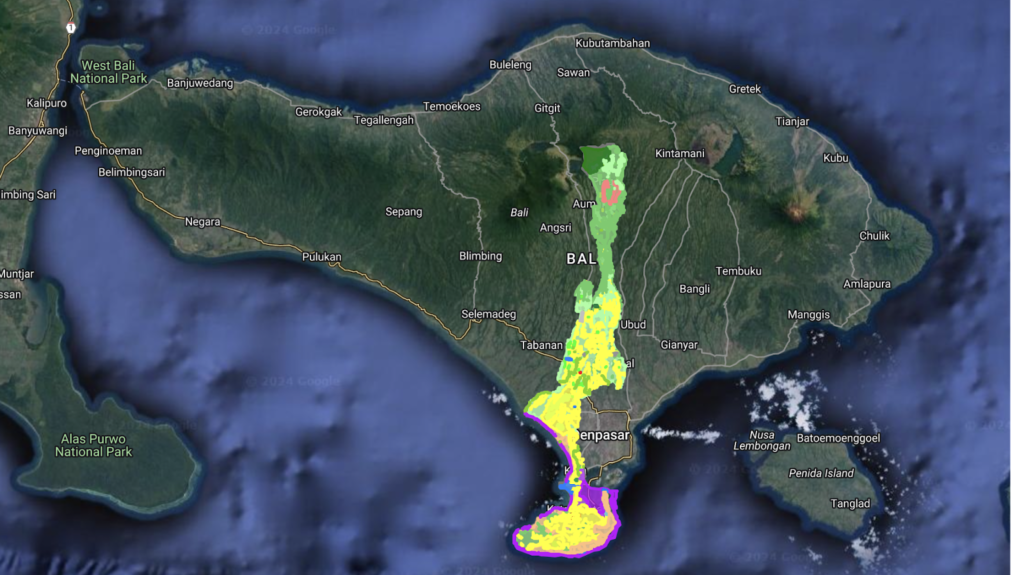
- Pink (Tourism) is the zone you want for any rental investment. Hotels, villas, and tourist accommodation are all permitted here. The main pink zone areas include Kuta, Seminyak, Canggu, Uluwatu, Jimbaran, and parts of Nusa Dua.
- Orange (Residential) covers areas zoned for private homes and apartments. Buildings here are for living in, not for running a tourist accommodation business. Common orange zone areas include parts of Denpasar, Kerobokan, and Pererenan.
- Red (Commercial) is for shops, restaurants, and offices. Found in Denpasar and central Seminyak.
- Yellow (Mixed) is primarily agricultural but can be converted for residential use under specific procedures.
- Green (Agricultural) is strictly for farming. Building tourism accommodation in a green zone is illegal, and the government is actively demolishing structures that violate this. The high-profile Parq Ubud case (a major lifestyle complex shut down for being built on protected rice fields) is a recent example.
Each regency in Bali has its zoning regulations, typically available on the regency's official websites. However, these zoning maps may not always be up-to-date. It's crucial to verify the current zoning rights directly with local authorities before proceeding with any property transactions.
Doing Due Diligence Before You Buy
Bali's property market has a long history of title disputes, zoning violations, and unpermitted construction. A beautiful villa means nothing if it sits on disputed land or in the wrong zone. Due diligence is where you either protect your investment or expose it.
The most important checks to make on any property:
- Verify the title. Ask for the original land certificate and have a qualified notary (PPAT) cross-check it at the local BPN office. Confirm the certificate number, the registered owner, the plot boundaries, and any expiry dates if it is HGB or Hak Pakai. Watch out for legacy certificates such as Girik, which became invalid for transfer purposes under recent regulations and cannot be legally transferred to a new owner.
- Check who has the right to sell. If the property belongs to a married couple, both spouses must sign. If the seller inherited the property, all heirs need to consent. Skipping this step is one of the most common reasons sales unravel after the buyer has already paid a deposit.
- Confirm the zoning. Verify the zoning directly with the local BPN office and through the OSS system, which now formally checks zoning conformity through KKPR (Kesesuaian Kegiatan Pemanfaatan Ruang). A property in the wrong zone is essentially uninvestable, regardless of how good the deal looks.
- Look for outstanding obligations. Check that the seller has paid all annual land and building tax (PBB), that there are no mortgages or liens against the property, and that there are no pending legal disputes attached to the title.
- Verify existing buildings have permits. If there are already structures on the land, confirm they have valid PBG (building permit) and SLF (safety certificate) documentation. Properties built without permits are at risk of demolition, and the government has been actively enforcing this. In July 2025, 48 illegal structures were demolished at Bingin Beach, and similar enforcement actions are ongoing. Buying a villa without valid permits means inheriting that risk.
- Get a fresh land survey. Boundary disputes are one of the most common sources of post-purchase litigation in Bali. A current survey by a licensed surveyor confirms that the physical boundaries match what is on the certificate.
This is the kind of work that takes time and local expertise to do properly. Emerhub helps foreign buyers navigate the full due diligence process, from title verification at BPN and zoning checks through OSS, to permit reviews, boundary surveys, and notary coordination. We make sure the property you are buying actually checks out before you commit, so your investment is secure from the start.
Refer to our guide on Property Due Diligence in Bali for more details.
Can I Buy Property Under an Indonesian's Name?
This question comes up often, usually because a buyer has been told they can sidestep the foreign ownership rules by having an Indonesian "nominee" hold the title for them. The short answer is no, and it is worth understanding why before anyone offers this to you.
Under Indonesian law, the person whose name is on the title is the legal owner. If you put a property in an Indonesian nominee's name, the nominee owns it. They can sell it, mortgage it, transfer it to a relative, or simply refuse to return it to you.
Any side agreement you sign with them is unenforceable in Indonesian courts, because the underlying arrangement violates the Agrarian Law. So if things go wrong, not only do you lose the property, you also cannot recover the money you paid.
And "things go wrong" happens more often than buyers expect.
In February 2026, Bali went further by formally criminalizing nominee land transfers under Perda 4/2026, adding criminal exposure for both the foreigner and the Indonesian nominee on top of the existing civil risks. Enforcement has been active, with the Indonesian government targeting nominee structures as part of a broader crackdown on foreign property ownership shortcuts.
If an agent, developer, or notary suggests a nominee arrangement, treat it as a red flag and walk away. The three legal structures above exist for exactly this reason, and any reputable advisor will guide you toward one of them.
The Steps to Buy Property in Bali
The buying process moves through four phases, regardless of which ownership structure you use. The exact actions inside each phase differ depending on whether you go with leasehold, Hak Pakai, or PT PMA, but the overall flow is the same. A typical purchase from start to finish takes between 6 and 12 weeks for most buyers, longer if you are setting up a PT PMA or applying for tourism business licensing.
Phase 1: Preparation
This is the work you do before you even start looking at properties seriously. It includes choosing the right ownership structure for your situation, lining up the legal and advisory support you will need, and (for PT PMA buyers) starting the company setup process.
If you are going the PT PMA route, this is when the IDR 2.5 billion paid-up capital is deposited and the company is incorporated. The setup takes around 10 working days.
For leasehold and Hak Pakai buyers, this phase is mostly about preparation and engaging the right advisors. Hak Pakai buyers also need their KITAS or KITAP in place before they can hold registered title.
Duration: 1-3 weeks (longer if PT PMA setup is involved)
Phase 2: Due Diligence
Once you have identified a property, the next step is to verify everything before committing. This is the same for all three structures and includes aspects such as title verification at BPN, zoning confirmation, permit and SLF checks for any existing buildings, a boundary survey, a tax status review, and confirmation that the seller has the legal right to sell.
Most buyers sign a preliminary agreement with a refundable deposit at the start of this phase, which locks in the price while the verification work happens. The deposit is returned if the due diligence reveals problems.
Duration: 2-4 weeks
Phase 3: Transfer
This is the formal acquisition. For PT PMA and Hak Pakai buyers, the Sale and Purchase Deed (Akta Jual Beli) is signed before a licensed PPAT notary, who handles the title transfer. Taxes are paid at signing which include 5% BPHTB for the buyer, notary fees of 1% to 2.5%, and 12% VAT if buying a new build from a developer.
The title is then registered at the BPN office under the PT PMA's name (for HGB) or your own name (for Hak Pakai).
For leasehold buyers, this phase looks different. There is no title transfer because the land continues to belong to the Indonesian landowner. Instead, the lease contract is drafted, reviewed, and signed before a notary, then registered with the relevant authorities. There is no BPHTB on leasehold transactions and no BPN title registration.
Typical duration: 1-2 weeks
Phase 4: Post-Purchase
For most buyers, the process effectively ends at Phase 3. You hold the property and you can start using it. A few situations require additional steps after the purchase:
- If you plan to build or renovate, you need to apply for a PBG building permit through the OSS system, and obtain the SLF safety certificate before occupancy.
- If you plan to operate the property as a short-term rental, you need to apply for tourism business licensing, which typically takes 6 to 12 months. This is a PT PMA-only path; leasehold and Hak Pakai do not permit short-term rentals.
- If you hold the property through a PT PMA, ongoing compliance applies: quarterly LKPM reports, annual financial filings, and corporate maintenance.
Duration: Variable, depending on what applies
What It Will Cost You
The costs of buying property in Bali depend heavily on which structure you use. Leasehold transactions are simpler and have fewer associated fees, while PT PMA purchases involve company setup costs and ongoing compliance on top of the property transaction itself. The table below shows what applies to each structure.
| Cost | Leasehold | Hak Pakai | PT PMA with HGB |
|---|---|---|---|
| Property price / lease premium | Negotiated with seller | Negotiated with seller | Negotiated with seller |
| BPHTB (Acquisition Tax) | Not applicable | 5% of property value | 5% of property value |
| Notary fees (PPAT) | 1% to 2.5% | 1% to 2.5% | 1% to 2.5% |
| VAT (new builds from developers) | Not applicable | 12% | 12% |
| PT PMA setup fees | Not applicable | Not applicable | USD 3,000 to USD 8,000 |
| Paid-up capital deposit | Not applicable | Not applicable | IDR 2.5 billion (becomes investment, not a fee) |
| Annual PBB (Land and Building Tax) | Sometimes covered by landowner | Yes, paid by holder | Yes, paid by company |
| Ongoing compliance | None | Minimal | Quarterly LKPM reports, annual filings, corporate maintenance |
| Building permits (PBG and SLF) | Varies by project | Varies by project | Varies by project |
A few notes on the table:
- The 5% BPHTB does not apply to leasehold because there is no transfer of title.
- The lease premium (the upfront payment for the lease) is negotiated directly with the Indonesian landowner and varies widely depending on location, property size, and lease duration.
- For PT PMA buyers, the IDR 2.5 billion paid-up capital is technically part of your investment rather than a cost, since the funds remain in the company and can be used for the property purchase itself or related business expenses after the 12-month lock-up period.
How Emerhub Can Help
Emerhub provides corporate advisory and entity management services for foreigners buying property in Bali. We handle PT PMA setup, conduct full due diligence on properties before purchase, coordinate with notaries and BPN for title verification and registration, and manage the OSS licensing process.
For investors planning rental operations, we also handle the tourism business licensing pathway and ongoing compliance after the property is in your name.
If you are evaluating a property in Bali or planning a future purchase, contact our team for a consultation.
We will walk you through the right ownership structure for your situation, and map out the realistic timeline and cost from the first viewing through to final registration.
Frequently asked questions
Can a foreigner own land in Bali?
No. Under Article 21 of the Agrarian Law, only Indonesian citizens can hold freehold title (Hak Milik). This rule has been in place since 1960 and is not going to change. Foreigners can acquire property through leasehold (Hak Sewa), Hak Pakai, or a PT PMA holding HGB, but not freehold.
What is the cheapest way for a foreigner to buy property in Bali?
Leasehold is usually the cheapest entry route. There is no acquisition tax (BPHTB), no company setup cost, no minimum capital, and the upfront payment goes mostly to the lease premium itself. The trade-off is that you hold a contractual right rather than a registered title, and the quality of the contract determines how protected your investment really is.
Can I operate an Airbnb or short-term rental as a foreigner in Bali?
If you have a PT PMA with the correct KBLI classification and a tourism business license, you can run a short-term rental business in Bali. However, you cannot legally self-operate a short-term rental under a leasehold or Hak Pakai structure. What you can do under leasehold or Hak Pakai is sublease to a licensed villa management company or OTA operator, who then runs the rental under their own license. That route generates rental income without the need to set up and run your own operating company.
Do I need to live in Indonesia to buy property in Bali?
It depends on the structure. For Hak Pakai and leasehold, you need to be residing in Indonesia, which in practice means holding a valid KITAS or KITAP. For a PT PMA with HGB, no personal residency is required, because the company holds the property, not you as an individual. This is one of the reasons investors who do not live in Bali typically go the PMA route.
I'm married to an Indonesian citizen. Can I inherit property from my spouse or their family?
Under Article 21(3) of the Agrarian Law, if you obtain freehold (Hak Milik) through inheritance or through communal marital property as a foreigner, you must relinquish that right within one year. If you do not, the right becomes invalid automatically and you lose it without compensation.