

For foreigners looking to establish a non-profit in Bali or anywhere in Indonesia, the required legal structure is a foundation, known locally as a Yayasan.
In this guide, we’ll walk through what a Yayasan is, the key requirements for foreign founders, how the setup process works, and what you need to know about taxes and ongoing compliance.
What is a Foundation (Yayasan) in Indonesia?
Under Indonesian law, a foundation (Yayasan) is a legal entity created by separating a portion of a founder's assets for a specific purpose. It is a non-membership entity, meaning it is not designed to generate profit for its founders or members.
Under Article 3 of Law No. 16/2001, a Yayasan must be established for a non-profit purpose within one of three main fields:
- Social: Can include activities related to education (like building schools or providing scholarships), healthcare (operating clinics), environmental protection, or the development of arts and culture.
- Religious: Activities directly related to a specific faith, such as building and maintaining places of worship, running religious educational programs, or publishing religious materials.
- Humanitarian: Involves providing aid and support to those in need. Examples include disaster relief efforts, operating orphanages or homes for the elderly, and providing assistance to vulnerable communities.
While a Yayasan can establish a business to generate income, the activities of that business must directly support the foundation's non-profit goals. This legal principle ensures the foundation’s assets are dedicated to public benefit.
If we look at the legal framework, a foundation is regulated primarily by:
- Law No. 16 of 2001 on Foundations (as amended by Law No. 28 of 2004)
- Government Regulation No. 63 of 2008 on the Implementation of the Law on Foundations
- Law No. 17 of 2013 on Societal Organizations (UU Ormas): relevant if you engage with foreign donors or conduct certain public activities.
The Structure of a Foundation in Indonesia
Under Articles 28–31 of Law No. 16 of 2001, Every Indonesian foundation is required to have a three-tiered organizational structure. Understanding the roles of each board is essential for good governance.
- The Board of Trustees (Pembina): This is the highest authority within the foundation. The Trustees are not involved in daily operations but hold the power to make all major strategic decisions. This includes amending the Articles of Association, appointing or dismissing members of the other boards, and approving the foundation's dissolution.
- The Board of Management (Pengurus): This board is responsible for the day-to-day management of the foundation. They are the ones who execute the foundation's programs and activities. This board is appointed for a five-year term and must have at least a Chairperson, a Secretary, and a Treasurer.
- The Board of Supervisors (Pengawas): This board's role is to supervise and provide advice to the Board of Management. They ensure the foundation's activities remain aligned with its mission and comply with the law.
Important: The same individual cannot hold positions on more than one board simultaneously. For example, a person cannot be both a Trustee and a Manager, or a Supervisor and a Trustee, etc., in the same foundation
Rules for Foreigners in a Yayasan
Foreigners are allowed to establish and participate in foundations in Indonesia, but there are specific rules and restrictions regarding their roles on the boards.
| Board Position | Rules for Foreigners |
|---|---|
| Founder | Foreign individuals and foreign entities can be founders. A passport copy is required for registration. |
| Board of Trustees (Pembina) | Foreigners are permitted to be trustees and do not need to reside in Indonesia. If they reside in Indonesia, they must hold a valid KITAS. |
| Management (Pengurus) | Foreigners can be members of the Management board. However, at least one member of this board (Chairperson, Secretary, or Treasurer) must be an Indonesian citizen. Any foreigner on this board must hold a valid work permit (IMTA) and stay permit (KITAS). |
| Supervisor (Pengawas) | Foreigners can be supervisors. If they reside in Indonesia, they must hold a valid KITAS. |
Initial Capital and Funding Requirements for a Foundation
One of the foundational requirements for establishing a Yayasan is the declaration of initial assets or capital. When you create a foundation, the founders must separate a portion of their personal assets into the foundation as its starting endowment.
The minimum initial assets required to establish a foundation depend on the founder's nationality. Please note that the requirements for foreigners are significantly higher and were increased by the 2013 Societal Organizations Law.
- Local Foundations (Indonesian founders): The minimum initial assets are Rp 10 million (approx. USD 616).
- Foreign-Founded Foundations (Foreign individual as founder): The minimum initial assets are Rp 1 billion (approx. USD 61,500).
- Foreign-Founded Foundations (Foreign entity as founder): The minimum initial assets are Rp 10 billion (approx. USD 615,000).
Important: Much of the guidance online is outdated and still cites the old, lower figure of Rp 100 million for foreign founders. As of the latest regulations, any new foundation established by a foreigner must meet the Rp 1 billion threshold.
After establishment, a Yayasan can receive funding from:
- Non-binding donations (hibah)
- Endowments (waqf)
- Grants and bequests
- Other lawful sources that align with your Articles
Foreign founders should note that any foreign grants or donations must be reported to the relevant ministry under Government Regulation No. 2/2013 on Grant Procedures.
Step by Step Process to Setup a Foundation in Indonesia
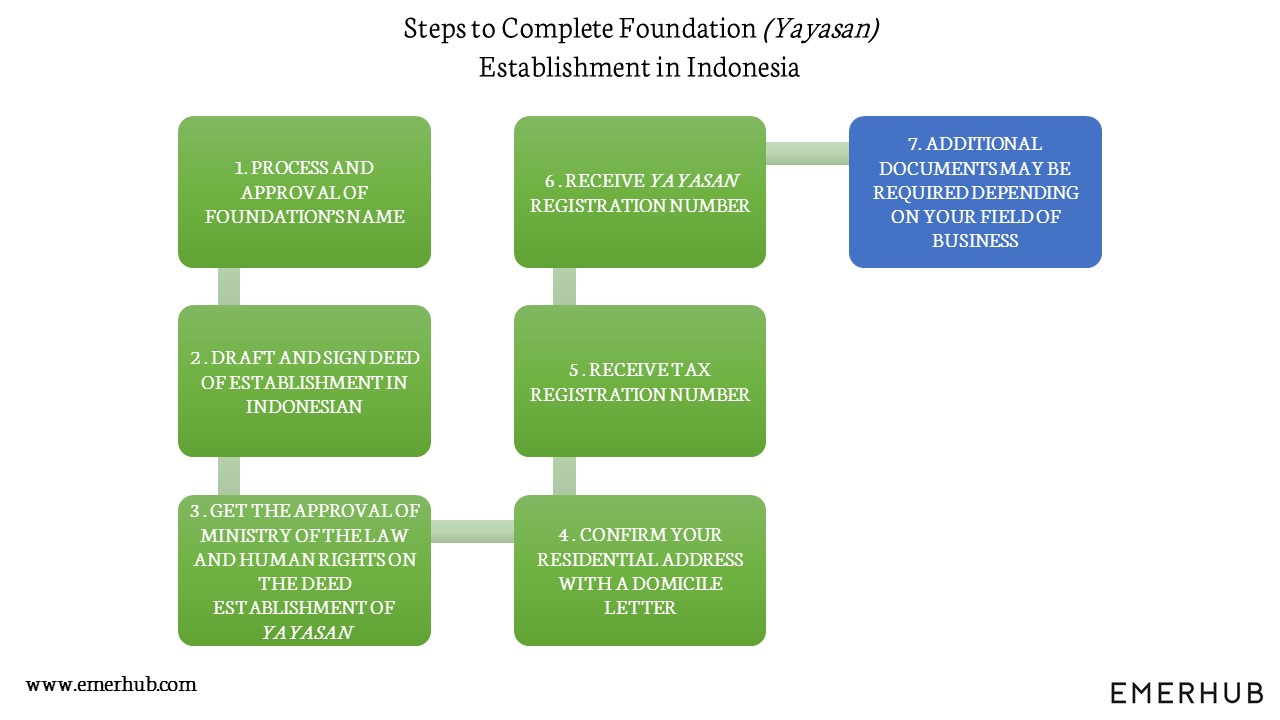
1. Define the purpose & Activities, and Appoint Board Members
Before you can register your foundation, one of the first steps is to define the purpose and activities. As mentioned earlier, a Yayasan can only operate in one of three areas: social, religious, or humanitarian. Depending on the area, you will also define your activities as MOLHR expects your stated purpose to match your actual planned activities.
Once you have defined your purpose and activities, you will need to appoint Trustees (Pembina), Trustees (Pembina), and Supervisors (Pengawas) as defined by law.
2. Naming Your Foundation
The name of your foundation must be preceded by the word "Yayasan". It cannot be a name that is already legally in use by another foundation or one that is contrary to public order or morality. If the foundation's assets originate from an endowment, the word "waqf" can be added after "Yayasan".
3. Notarial Deed of Establishment
The process begins by executing a Deed of Establishment (Akta Pendirian) before a local notary. This deed contains the foundation's Articles of Association, which outlines its purpose, initial assets, and board structures. The articles of Association must contain at least the following details:
- The foundation's name and domicile.
- Its aims, objectives, and the activities it will undertake to achieve them.
- The period of establishment.
- The amount of initial assets separated from the founder's personal wealth.
- The procedures for appointing, dismissing, and replacing members of all three boards (Trustees, Management, and Supervisors).
- The rights and obligations of each board.
- The procedures for holding official meetings.
- Provisions regarding amendments to the Articles of Association.
- Procedures for the merger or dissolution of the foundation and the use of any remaining assets.
4. Ministry of Foreign Affairs (MOFA) Recommendation
If your Yayasan has foreign founders or board members, you’ll need a recommendation from the Ministry of Foreign Affairs (MOFA). This requirement is set out in Government Regulation No. 59/2016 on Foreign Societal Organizations in Indonesia.
MOFA’s inter-ministerial permit team will vet your application to ensure your activities align with national interests.
5. Ministry of Law and Human Rights (MOLHR) Approval
Once the MOFA provides a positive recommendation, the next step is submission of the deed of establishment to the MOLHR for final approval. Upon approval, the foundation officially obtains legal entity status.
6: Post-Registration Requirements
After legalization, the foundation must obtain a Tax ID (NPWP), open a bank account, and register with social security agencies (BPJS) if it plans to hire staff. There are also tax obligations and several compliance requirements which we will cover in the next section.
Emerhub’s local experts handle this entire setup process on your behalf. We will help you prepare the necessary documents and submissions to ensure accuracy and completeness.
Tax Obligations of a Foundation in Indonesia
A common misconception about non-profits is that they are entirely tax-free.
Under Law No. 36 of 2008 on Income Tax, a foundation is a legal entity subject to Corporate Income Tax (PPh Badan) on the excess after all allowed deductible, but with important exemptions under Article 4(3) if the foundation income is used for specific purposes such as:
- donations, including zakat received by zakat collection bodies or zakat collection institutions
- Gift (hibah)Scholarship funds provided to eligible recipients.
- Income from educational or R&D activities if reinvested into the same programs within four years.
- Donations or grants, provided there is no business relationship between the donor and the foundation.
Beyond income tax, you also need to be aware of withholding tax obligations as a withholding Tax Agent:
| PPh 21 (Employee Withholding Tax) | You must withhold and remit income tax on staff salaries, with rates ranging from 5% to 35% depending on income level (Law No. 7 of 2021) |
|---|---|
| PPh 23 | A 2% withholding tax applies to certain service payments (e.g., consulting, engineering, internet services) |
| PPh 4(2) | A final tax on specific income types, such as 10% rental tax for land/buildings and 5% BPHTB for land/building transfers. |
| Value Added Tax (VAT/PPN) | If your foundation provides taxable goods or services and exceeds the annual turnover threshold, VAT registration is mandatory under Law No. 42 of 2009. |
Ongoing Compliance Requirements
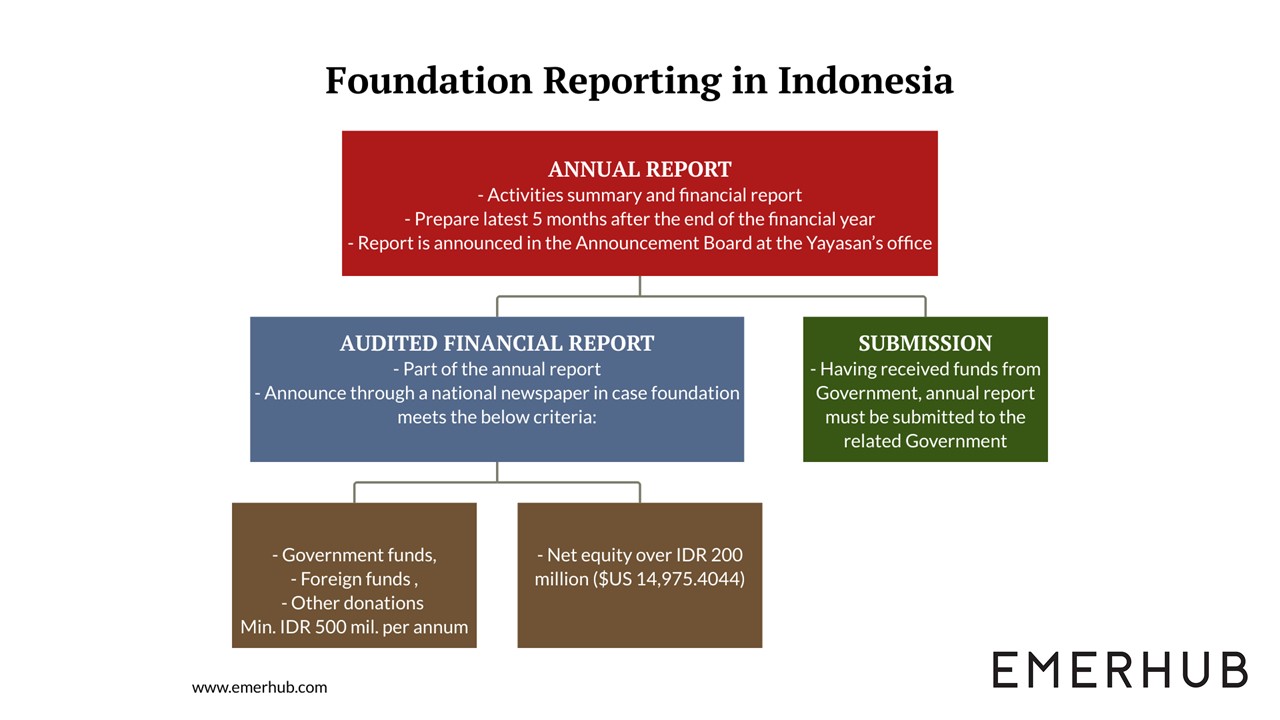
Indonesian Law No. 16 of 2001 on Foundations and Government Regulation No. 63 of 2008 sets clear expectations for reporting, transparency, and governance of foundations. Following are the ongoing compliance requirements that you must keep in mind:
- Annual Activity & Financial Reports: Under Article 52 of the Foundation Law, you must prepare an annual report in Bahasa Indonesia, detailing both your activities and your financial statements. This report should be available to stakeholders and, if required, the public.
- Transparency for Public Donations: If your Yayasan collects public funds, you need to publish your financial statements in media accessible to the public.
- Societal Organization (Ormas) Reporting: If your foundation is also registered under Law No. 17 of 2013 on Societal Organizations, you must submit periodic activity reports to the Ministry of Home Affairs.
- Tax Compliance: Beyond the annual corporate tax return (SPT Tahunan Badan), you must file monthly withholding tax and VAT reports if applicable.
- Changes in Structure or Statutes: Any amendment to your Articles of Association or changes in your board must be reported to the Ministry of Law & Human Rights. For foreign-linked foundations, you need to report these changes to the Ministry of Foreign Affairs as well.
- Permit Renewals: Certain operational permits (especially in education, healthcare, or foreign cooperation) may require periodic renewal, so it’s best to maintain a compliance calendar.
Can a Foundation in Indonesia Pay Salaries?
A common question we receive is whether a foundation can pay salaries to its board members. As per Government Regulation 63 of 2008, Article 5(1), members of the Board of Trustees and Board of Supervisors are considered volunteers and cannot receive a salary.
That said, members of the Board of Management can receive a salary, but only if they meet specific conditions such as:
- They are not founders of the foundation
- Are not related to the other boards
- Are managing the foundation on a full-time, day-to-day basis.
Setup Your Foundation in Indonesia as a Foreigner with Emerhub
Setting up a foundation in Indonesia involves a detailed legal process with strict requirements for foreign founders.
Emerhub’s role is to manage this entire legal and administrative setup for you. We handle the registration of your Yayasan, advise on the correct board structure, and manage all necessary visa and work permit applications for your foreign members, ensuring you are fully compliant.
Fill out the form below and get in touch with our consultants to discuss your plans for setting up a foundation in Indonesia.