
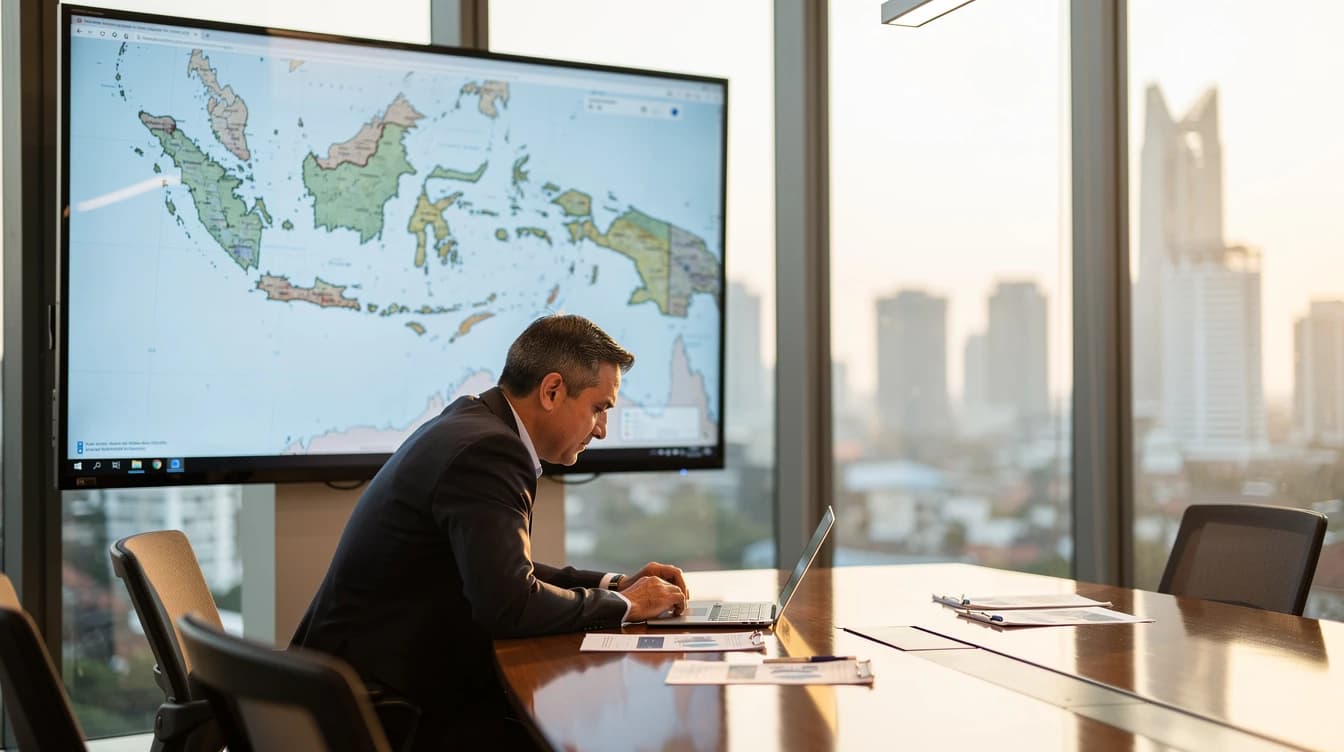
The Indonesian Rupiah has been under sustained pressure throughout 2025 and into 2026. As of early June 2026, the Rupiah opened at an all-time low of Rp18,050 against the US Dollar, crossing the key Rp18,000 threshold for the first time. This losing streak marks the currency;s 10 consecutive weeks of decline. Currently, the currency has shed more than 7% of its value this year alone.
For foreign investors already in Indonesia or thinking about entering, this is a moment worth paying close attention to. With the right legal setup, you can pay your operating costs in cheap Rupiah while billing clients in USD, EUR, or SGD. That gap between your cost currency and your revenue currency is where the opportunity sits.
This article breaks down the practical strategies for capturing that advantage, along with the legal vehicles you can use to act on them.
Strategy 1: Localize Costs, Globalize Revenue
The most fundamental move is to restructure your cost base so most of your operational spending is in Rupiah. This means:
- Running payroll in Indonesia rather than abroad
- Leasing local office or warehouse space instead of remote infrastructure in higher-cost markets
- Sourcing from domestic suppliers where feasible
- Building your operational team in-country
At the same time, your client contracts, invoicing, and revenue collection stay in USD, EUR, SGD, or AUD to maximize foreign exchange.
This is the exact playbook used during the 1998 Asian Financial Crisis when the Rupiah violently collapsed from Rp2,500 to over Rp16,000 per dollar. A concentrated group of export-focused businesses in palm oil, mining, and manufacturing captured enormous gains.
They paid workers, leases, and suppliers in depreciated Rupiah while collecting revenue in dollars. They then used their cash-rich positions to buy up prime real estate and industrial assets at up to 90% discounts. The window for that kind of positioning is cyclical. It opens, it closes, and the businesses that move during it build advantages that last for years.
Strategy 2: Build a Tech, BPO, or Employer of Record Operation
If you are running an agency, a SaaS startup, or a tech enterprise, your single largest line item is payroll. Right now, building your technical, creative, or customer success back-office in Indonesia is heavily discounted due to the weak local currency.
Indonesia has a large and growing pool of bilingual technical talent, including software engineers, UI/UX designers, data analysts, and growth marketers. The country's tech workforce has expanded steadily alongside its digital economy, and the quality of candidates at the mid-to-senior level is competitive with other regional talent markets.
Here’s a quick comparison of typical back-office roles comparing Indonesian rates against equivalent salaries in the West:
| Role | Previous rates in Indonesia (Rp14,000/USD) | Current Rates Indonesia (Rp18,000/USD) | US Market | UK Market |
|---|---|---|---|---|
| Mid-Senior Software Developer | $1,070 – $1,780/mo | $840 – $1,400/mo | $7,500 – $14,750/mo | $3,750 – $5,800/mo |
| UI/UX Designer | $900 – $1,500/mo | $700 – $1,170/mo | $7,000 – $11,200/mo | $3,300 – $5,200/mo |
| Growth Marketer | $700 – $1,200/mo | $550 – $940/mo | $6,200 – $9,700/mo | $2,900 – $4,500/mo |
| Customer Success Manager | $600 – $1,100/mo | $470 – $860/mo | $5,800 – $8,500/mo | $3,100 – $5,200/mo |
Indonesian salary figures are based on Rp10,000,000 – Rp25,000,000 per month for each role, converted at both exchange rates. US and UK figures reflect current mid-to-senior market benchmarks.
From this alone, you are looking at 80% to 90% in cost savings on equivalent roles compared to hiring in the US, and 60% to 75% compared to the UK.
To facilitate your expansion, you can establish a PT PMA (Perseroan Terbatas Penanaman Modal Asing), which is Indonesia's foreign-owned limited liability company. You register the PT PMA as a Business Process Outsourcing entity that employs the local team in full compliance with Indonesian labor law, while your global entity bills clients in foreign currency.
Alternatively, if you want to hire Indonesian talent for your existing international company without setting up a standalone entity immediately, you can use an existing Employer of Record service as an interim step. An Employer of Record is a third-party entity that legally employs your staff on your behalf. You can then transition into your own PT PMA once your headcount justifies it.
Strategy 3: Export-Oriented Manufacturing and Trade
Indonesia's currency weakness makes it a competitive sourcing and manufacturing base for goods destined for international markets. The key is choosing sectors where Indonesia has genuine supply-side strength and where the export pathway is commercially realistic.
Here are top 4 high-margin export sectors you can target:
- Processed Agricultural & Downstream Palm Products (Oleochemicals): Instead of exporting raw oil (which triggers high domestic export taxes), source high-value bioplastics, cosmetic bases, glycerin, and industrial oleochemicals in cheap IDR. You then export these items tariff-free across Asia via RCEP.
- Sustainable Apparel, Footwear, & Textiles: pay for the inventory in depreciated Rupiah, and clear custom borders into high-demand retail markets like Australia, Japan, and South Korea
- Bauxite, Copper, and Nickel Derivatives: Export companies are stepping in to source semi-processed minerals, anodes, and chemical compounds required for the global EV battery supply chain. You can buy from local smelters in IDR and sell to battery manufacturers in East Asia under zero-tariff lines.
- Premium Organic Commodities (Coffee, Cacao, Spices): Buy directly from local farmer cooperatives or processing hubs using high-purchasing-power dollars converted to IDR, white-label the premium packaging, and sell to boutique distributors in the US and Europe at massive luxury markups.
Like Strategy #2, you can also establish a PT PMA to tap into export-oriented marketing and trade. Sectors like textiles, oleochemicals, or processed commodities will generally require a PT PMA, since these activities involve direct production and trade within Indonesia.
You can also establish a Foreign Trade Representative Office (KPPA) if you simply need a local presence for sourcing, supplier relationship management, and market research, without conducting direct commercial transactions. It is a practical first step for foreign buyers sourcing premium commodities or textiles who are not yet ready to commit to a full PT PMA setup. Keep in mind that you can’t generate revenue in Indonesia through a KPPA or enter into sales contracts in your own name.
Strategy 4: Hospitality and Luxury Real Estate
The hospitality and real estate sectors benefit from the Rupiah weakness on two fronts simultaneously:
- Property Acquisition: property and construction costs are priced in Rupiah. If you are buying or developing a villa, boutique hotel, or co-working property in Bali, Lombok, or another high-demand tourism area, your capital goes further in dollar terms than it did two years ago.
- Benchmarked Revenue: Your nightly rates on Airbnb, Booking.com, or luxury travel networks are quoted in USD or EUR. Your guests are paying global prices for a product whose operational costs are settled in a depreciated local currency. That gap between revenue currency and cost currency is rental yield optimization in practice.
Your ongoing expenses, including property maintenance, staff payroll, local taxes, and utilities, are all settled in Rupiah while your income does not have to be.
Critical Regulatory Updates:
- Minister of Tourism Regulation No. 6/2025 now enforces stricter licensing standards for Airbnb and other booking sites. Online travel platforms are actively delisting properties that cannot provide proper licenses with their listing.
- Bali's OSS system no longer accepts new PT PMA registrations for low and medium-low risk KBLIs, including KBLI 55900, under a Bali province address. The current compliant path is to register your PT PMA in Jakarta, which can still hold KBLI 55900 and manage a Bali property through the same management agreement structure.
It is advisable to discuss your needs with our local experts. We guide you on the right setup and handle the process on your behalf.
Set Up Your Indonesian Entity Compliantly With Emerhub
Every strategy depends on having the right legal structure in place. Without it, you cannot legally hire, hold assets, invoice clients, or repatriate profits.
To help you start your own business in Indonesia, Emerhub’s experts can assist you through the process. We handle the full PT PMA registration process for foreign investors in Indonesia. This includes the initial document preparation and company name reservation, NPWP registration, Business License issuance, corporate bank account setup, and any sector-specific licenses your business activity requires. The entire process is managed end-to-end by our trusted experts in Indonesia.
Emerhub also supports ongoing compliance, including monthly and annual tax filings, LKPM investment realization reports to BKPM, and labor law compliance for your local workforce.
Reach out to our team to discuss your business plan and we will walk you through the right structure for your goals.
Frequently asked questions
Can a fully foreign-owned PT PMA operate in any business sector in Indonesia?
Not all sectors permit 100% foreign ownership. Indonesia's Positive Investment List, governed by Presidential Regulation No. 10 of 2021 (as amended by Presidential Regulation No. 49 of 2021) sets out which business activities are open, conditionally open, or closed to foreign investment. More than 200 sectors are now fully open to foreign investors. However, some sectors such as small-scale retail, primary healthcare clinics, and certain media activities require local partnership or have foreign ownership caps. Always confirm the KBLI code for your intended activity before proceeding with registration.
What is the minimum investment required to set up a PT PMA in Indonesia?
Under BKPM Regulation No. 5 of 2025, the minimum paid-up capital for a PT PMA is IDR 2.5 billion (approximately USD 150,000). This is the amount that must be deposited into your corporate bank account. The total investment plan commitment per business activity code remains above IDR 10 billion, which covers all investments including capital expenditure, operational costs, and assets over time. These are two separate figures and should not be confused.
Do I need an Indonesian shareholder or director to register a PT PMA?
There is no legal requirement for Indonesian citizenship among your shareholders, directors, or commissioners. A PT PMA can have an entirely foreign board. However, you must appoint at least one resident director who is physically based in Indonesia. That person can be an Indonesian citizen or a foreign national holding a valid KITAS.
Is the Employer of Record route a good alternative to registering a PT PMA?
An EOR is a practical interim option if you want to hire Indonesian talent quickly without going through the full PT PMA registration process. It allows you to bring people on legally and compliantly while you assess the market. The trade-off is that you do not directly own the entity, cannot register products or hold licenses in your own company's name, and are dependent on the EOR provider for compliance. For most serious business expansions, transitioning into a PT PMA as soon as the headcount or operations justify it is the recommended path.
What legal structure should I use if I only want to source and export products from Indonesia without running a full operation?
If your primary goal is sourcing and exporting, you have two practical options. A Foreign Trade Representative Office (KPPA) allows you to establish a local presence for sourcing and liaison purposes without the full capital requirements of a PT PMA, though it does not permit direct commercial activity or domestic revenue generation. If you plan to enter into purchase contracts, hold inventory, or manage a supply chain directly, a PT PMA under a trading or export company KBLI is the more appropriate structure. The right choice depends on the volume, complexity, and long-term scale of your intended operations.