Bali Closes Low-Risk and Medium-Low-Risk PMA Licensing in OSS
The Indonesia Investment Ministry has blocked new PMA company registrations in Bali for all business activities classified as low risk and medium-low risk.


The Indonesia Investment Ministry has blocked new PMA (foreign investment) company registrations in Bali Province for business activities classified as low risk and medium-low risk. The restriction is now live in the OSS system. Foreign investors attempting to register these KBLI codes in Bali will see a rejection notice: "Pengajuan Tidak Dapat Dilanjutkan" (Application Cannot Be Continued).
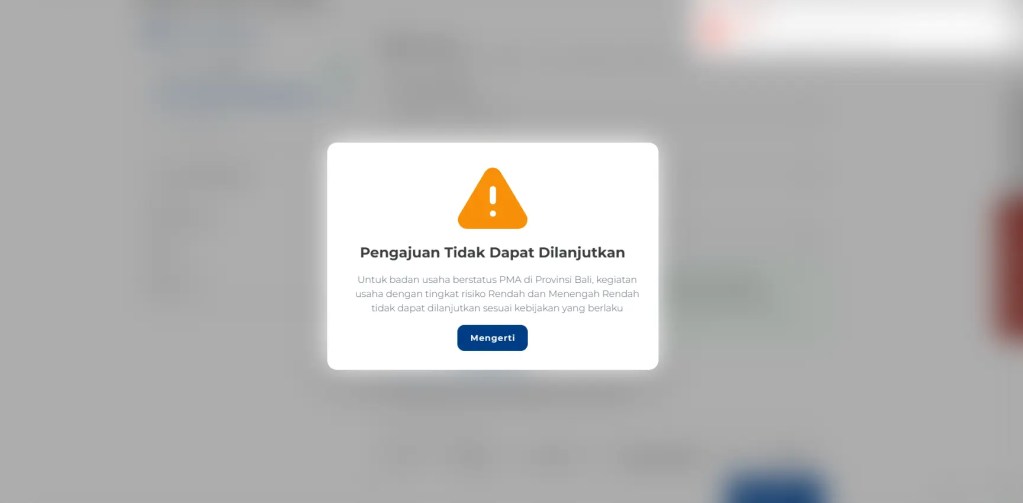
Bali is the first province in Indonesia to enforce this kind of regional restriction on foreign investment licensing.
Why Bali Requested the Closure
Governor Wayan Koster formally requested the closure in a letter to Minister of Investment Rosan Perkasa Roeslani on January 28, 2026 (Letter No. B.27.000/642/PM/DPMPTSP). The letter followed an MOU between the Bali Provincial Government and the Investment Ministry on investment control in the province.
The letter laid out three data points that drove the request:
Bali accounts for a disproportionate share of national PMA registrations. Between 2021 and 2025, 19,262 PMA entities were registered in the province, roughly 40% of all PMA NIBs (Business Identification Numbers) issued nationally. Those entities generated 55,458 projects, and 47.55% of them were low-risk projects that required nothing more than a NIB to operate. No standard certificate, no additional permits.
The most commonly registered KBLI codes for PMA in Bali tell the story. KBLI 68111 (self-owned or leased real estate) accounted for 72.1% of all national projects under that code. KBLI 70209 (other management consulting activities) accounted for 62.2% nationally. Both are low-risk classifications.
The Bali government's position is that these licensing schemes were being used as vehicles for foreign nationals to obtain residence permits without genuine business activity or meaningful investment realization.
Scope of the OSS Restriction
The OSS system now rejects new PMA applications for any business activity classified as low risk or medium-low risk in Bali Province. The block applies to every KBLI code in those two risk tiers.
To understand why this matters, it helps to know how Indonesia's risk-based licensing system (PBBR) works. Every business activity registered through OSS is assigned one of four risk tiers, and the tier determines what the company actually needs to operate:
| Risk Tier | Licensing Requirement |
|---|---|
| Low | NIB only. No further permits. Issued automatically. |
| Medium-Low | NIB plus a self-declared standard certificate. No government verification. |
| Medium-High | NIB plus a standard certificate verified by the relevant ministry. |
| High | NIB plus a full permit (Izin) requiring government approval before operations begin. |
Low-risk and medium-low-risk PMA registrations in Bali essentially meant a foreign investor could obtain a business identity and residence permit pathway with minimal documentation, no field verification, and no regulatory oversight beyond the NIB itself. That is the gap the Bali government asked the Investment Ministry to close.
The Governor's letter cited nine KBLI codes (under the 2020 classification) as the most abused categories that prompted the request:
| KBLI Code | Activity |
|---|---|
| 68111 | Self-owned or leased real estate |
| 70209 | Other management consulting activities |
| 77311 | Motorcycle rental without option to purchase |
| 77100 | Car, bus, truck, and similar vehicle rental |
| 79121 | Travel agency activities |
| 47711 | Retail trade in clothing |
| 47511 | Retail trade in textiles |
| 47249 | Other food retail trade |
| 47991 | Mobile retail trade in agricultural food commodities |
These codes share two characteristics. They all fall under the low-risk or medium-low-risk tier of Indonesia's risk-based licensing system. Meaning they require only a NIB to operate, with no standard certificate or further permits. Moreover, they are all concentrated in Bali at rates far above any other province. KBLI 68111 alone had 72.1% of its national project registrations located in Bali.
Currently, the implementation in OSS goes beyond these nine codes. Any low-risk or medium-low-risk KBLI selected for a PMA entity with a Bali Province address will trigger the rejection.
PMA Enforcement Actions in Bali During 2025-2026
Throughout 2025-2026, the Investment Ministry conducted enforcement actions in Bali. A total of 426 PMA businesses were investigated for licensing violations. Of those, 423 were sanctioned. Violations included fictitious companies, failure to meet basic licensing prerequisites like environmental approvals and building permits (PBG/SLF), operating in activities closed to foreign investment, and not meeting minimum investment thresholds.
In January 2026, the Investment Ministry also established a dedicated Investment Desk in Bali, a joint operational unit between central and provincial government designed to monitor and enforce PMA compliance going forward.
What This Means for Foreign Investors in Bali
Any new PT PMA registration in Bali Province with a primary business activity classified as low risk or medium-low risk will be rejected by OSS. The system-level block applies at the point of business activity selection during the NIB application process.
Accommodation and villa rental businesses are among the most directly affected. Several accommodation-related KBLI codes fall under the lower risk tiers, and these have been a popular registration category for foreign investors in Bali.
Investors who have already signed lease agreements or purchased property with the intention of registering a PMA for a villa or guesthouse operation under a low-risk KBLI will find the OSS path closed. The KBLI classification and risk tier should be confirmed before committing to any property or lease arrangement.
Existing PMA entities that already hold valid NIBs and licenses issued before the closure are not affected. Their licenses remain valid. However, they are facing immediate compliance exposure.
DPMPTSP Bali has indicated that active entities holding these restricted codes are being subjected to strict field inspections and audits.
Can You Register in Jakarta and Operate in Bali?
The short answer: only under very limited conditions. A PMA registered in Jakarta with no commercial activity in Bali can be structured this way. The most common scenario is a holding entity that owns assets in Bali but does not conduct operational business there. Running a restaurant, rental business, or retail operation out of Bali through a Jakarta-registered PMA would not satisfy this condition.
For most business models that involve active commercial operations in Bali, the Jakarta registration workaround does not apply.
Higher-Risk Activities Remain Open
The closure targets only the low-risk and medium-low-risk tiers. Business activities classified as medium-high risk or high risk in Bali are not affected. These categories require standard certificates or full permits and typically involve more substantial compliance requirements, which is precisely the point. The Bali government wants PMA activity in the province to carry genuine investment weight and regulatory oversight.
Check Your KBLI Risk Classification Before Incorporating
Foreign investors planning to set up in Bali should verify their intended KBLI codes against the current risk classification before beginning the incorporation process. If your planned activity falls in the low-risk or medium-low-risk tier, the OSS system will reject the application.
For activities that genuinely require a Bali presence and fall under higher risk tiers, the standard PMA incorporation process still applies. Emerhub's Indonesia team can confirm whether your specific KBLI codes are affected and advise on structuring options.
If you are already operating a PMA in Bali under one of the affected KBLI codes, your existing license remains valid. No action is required unless you plan corporate changes that would trigger a new OSS submission.
Emerhub handles company registration and licensing across Southeast Asia. For questions about Indonesia PMA incorporation or the Bali restriction, contact our team.
More news from Indonesia.
Adjacent regulatory shifts and government actions.
Affected by this in Indonesia?
A 30-minute call with the team that handles compliance in your market. We will talk through what this means for your structure and timeline.