Indonesia and EU Sign Landmark Trade and Investment Agreements, Target Early 2027 Implementation
Indonesia and the EU have signed their long-awaited trade and investment agreements, with lower import duties, wider market access for European investors, and provisional application targeted for early 2027.

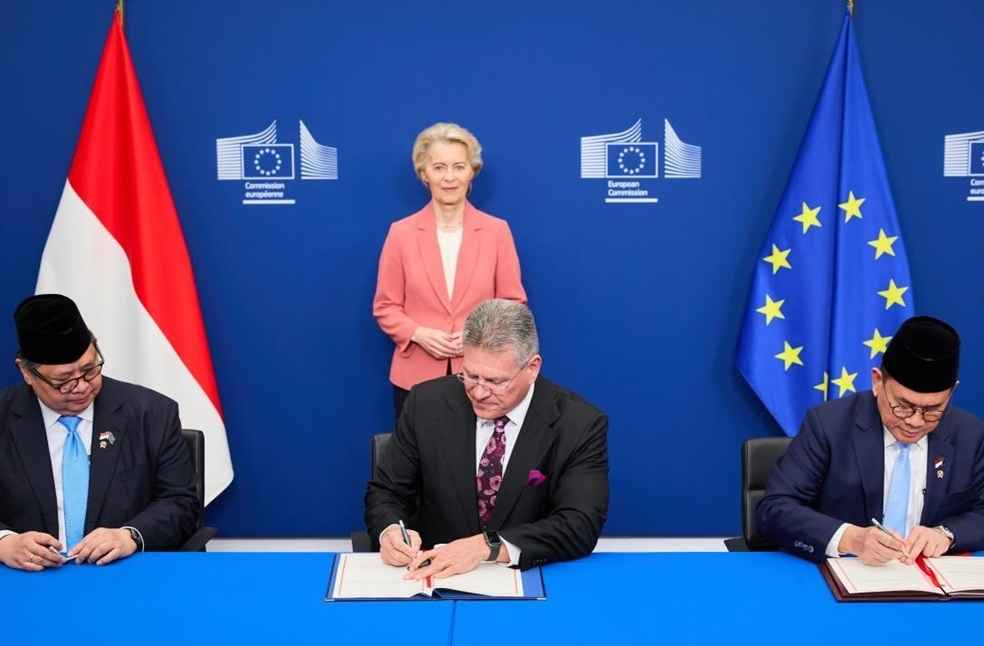
Indonesia and the European Union signed the Indonesia-EU Comprehensive Economic Partnership Agreement (IEU-CEPA) and a separate Investment Protection Agreement (IPA) in Brussels on November 21, 2026.
The agreements will reduce import duties, expand market access for European companies, ease certain investment restrictions, and provide stronger legal protection for investors on both sides.
Negotiations began in July 2016 and concluded in September 2025. Both parties are now targeting provisional application in early 2027, pending the completion of the necessary legal procedures.
The timeline is particularly important for Indonesian exporters. Indonesia will lose its preferential tariff treatment under the EU's Generalized Scheme of Preferences (GSP) on January 1, 2027. Both sides are working to avoid a gap in preferential market access.
Lower import duties for European goods entering Indonesia
According to the European Commission, Indonesia will eliminate duties on 98.5% of tariff lines for EU goods once the agreement is fully implemented. Approximately 80% of tariffs will be liberalized at the start of implementation, rising to 96% within five years.
The Commission estimates that the reductions will save European exporters approximately €650 million annually in customs duties.
Some of the largest reductions will apply to industrial and consumer goods that currently face high Indonesian import duties.
| Product category | Existing import duties | Changes under IEU-CEPA |
|---|---|---|
| Motor vehicles | Up to 50% | Eliminated, mostly within five years |
| Machinery and electrical equipment | Up to 15% | Mostly eliminated immediately, with remaining reductions over five years |
| Chemicals | Up to 25% | Mostly eliminated immediately, with remaining reductions over five years |
| Pharmaceuticals | Up to 15% | Mostly eliminated immediately, with remaining reductions over three years |
| Processed foods | Up to 30% | Many eliminated immediately, with others phased out |
| Dairy products | Up to 10% | Mostly eliminated immediately |
| Meat products | 5–20% | Mostly eliminated immediately |
European exporters of fruit, vegetables, and other agricultural products will also benefit from tariff reductions and more predictable food safety procedures.
The agreement addresses technical barriers to trade as well. Indonesia will accept vehicles certified under the applicable United Nations vehicle regulations used in the EU and gradually align its domestic vehicle regulations with these standards by 2033.
Provisions on conformity assessments will also help reduce duplicate testing and certification for certain industrial products.
However, businesses will still need to meet Indonesia's import licensing requirements, applicable product registration requirements, halal certification obligations, and national product standards.
Foreign ownership and market access for European companies
The IEU-CEPA provides European investors with greater certainty over foreign ownership and market access in Indonesia.
Under the agreement, Indonesia commits to allowing 100% European ownership in covered telecommunications and computer services activities. While Indonesia's existing investment regulations already permit full foreign ownership in many of these activities, the agreement makes market access a treaty commitment.
The services and investment chapter also establishes market access commitments across several other sectors, including:
- Financial services
- Postal and courier services
- Maritime transport
- Manufacturing
- Mining
- Renewable energy
In covered activities, European-owned businesses will benefit from commitments on equal treatment with Indonesian companies. The agreement also limits certain restrictions on the number of businesses operating in a sector and, for covered cross-border services, requirements to establish a local presence.
The extent of these commitments varies by business activity. European investors establishing a foreign-owned company (PT PMA) in Indonesia must still comply with applicable foreign ownership restrictions, minimum capital requirements, and sector-specific licensing regulations.
Changes to local content requirements
Another significant development for European manufacturers is Indonesia's commitment to restricting local content requirements, known as Tingkat Komponen Dalam Negeri (TKDN), in covered investment activities.
These commitments cover industries including:
- Pharmaceuticals and medicinal products
- Electronics and semiconductors
- Telecommunications equipment
- Batteries
- Automotive manufacturing and components
- Renewable energy
Local content requirements can influence where manufacturers source their components and raw materials. Reducing these restrictions could give European companies greater flexibility when establishing production facilities in Indonesia.
The commitments remain subject to the conditions and reservations specified in Indonesia's investment schedule.
Access to government contracts
European-owned companies established in Indonesia will benefit from non-discriminatory treatment when participating in public procurement covered by the agreement.
Indonesia also commits to publishing covered public tender opportunities through a single electronic portal, making it easier for businesses to identify government contracts.
Further negotiations on access to public procurement markets are scheduled to begin within five years of the CEPA entering into force.
Transferring European employees to Indonesia
The agreement establishes temporary entry and stay commitments for eligible European business professionals.
| Category | Length of stay |
|---|---|
| Intra-corporate transferees, including eligible managers and specialists | Up to three years |
| Eligible business visitors | Up to 90 days within any 12-month period |
These commitments provide greater predictability for European companies transferring employees to their Indonesian subsidiaries or sending staff to Indonesia for eligible business activities.
The agreement does not replace Indonesia's existing immigration and employment procedures. Companies transferring foreign employees will still need to obtain the applicable foreign worker approvals and work KITAS.
Preferential access to the EU market for Indonesian exports
According to Indonesia's Ministry of Trade, 90.4% of EU tariff lines for Indonesian goods will become duty-free when the relevant tariff commitments take effect.
Further tariff reductions will be phased in over three to 15 years, bringing the total coverage to more than 98%.
Industries expected to benefit include:
- Palm oil and its derivatives
- Rubber products
- Footwear
- Textiles and garments
- Fishery products
- Furniture
The agreement also introduces arrangements for duty-free quotas on Indonesian exports of crude palm oil and palm kernel oil in relation to Indonesia's export duties.
However, the EU will retain protections for sensitive agricultural products, including rice, sugar, eggs, fresh bananas, and ethanol. Other agricultural products will receive limited access through tariff-rate quotas.
For European companies considering Indonesia as a manufacturing base, the agreement creates opportunities on both sides of their supply chains. Companies could import European machinery and components at lower duties, manufacture products in Indonesia, and export qualifying finished goods to the EU at preferential tariff rates.
To qualify for these rates, products must meet the agreement's rules of origin and supporting documentation requirements. Goods manufactured in third countries and simply repackaged or resold in Indonesia will not automatically qualify for preferential treatment.
Stronger legal protection for European investments in Indonesia
Alongside the trade agreement, Indonesia and the EU signed a separate Investment Protection Agreement (IPA).
The IPA establishes legal protections for qualifying European investments in Indonesia and Indonesian investments in the EU.
These include protection against unfair treatment, denial of justice, and unlawful expropriation.
The agreement initially provides for state-to-state dispute settlement, with a voluntary mediation mechanism available for investors. It does not currently establish an arbitration mechanism through which individual investors can independently bring treaty claims against either government.
Both parties have committed to concluding negotiations on an investor-state dispute settlement mechanism within three years of the IPA entering into force.
The European Commission has proposed the IPA as an EU-only agreement, meaning that separate ratification by each EU member state is not required.
The agreement also provides long-term protection for existing investments. If either party terminates the IPA, qualifying investments made before termination will remain protected for a further 10 years.
When will the Indonesia-EU trade agreement take effect?
The Council of the European Union authorized the signing and provisional application of both agreements on November 18, 2026, three days before their formal signing in Brussels.
The agreements must now receive consent from the European Parliament before the Council can formally conclude them. Indonesia is completing its own domestic ratification procedures in parallel.
Both agreements allow for provisional application before formal entry into force, provided that the parties have completed and notified each other of the necessary internal procedures.
The Indonesian government is targeting January 1, 2027, for provisional application of the CEPA. The European Commission expects provisional application in early 2027.
As of November 25, 2026, neither agreement is in force, and the exact implementation date has not been confirmed.
Until provisional application begins, existing tariffs, investment regulations, and licensing requirements continue to apply.
Businesses planning imports, investments, or manufacturing operations for 2027 can already assess the published tariff schedules, rules of origin, and investment commitments to determine how the agreement could affect their operations.
Planning to expand your business to Indonesia?
The IEU-CEPA creates new opportunities for European companies looking to sell their products in Indonesia, establish local operations, or use the country as a manufacturing and export base.
Emerhub's local team can help you assess foreign ownership requirements, establish your Indonesian company, obtain business and import licenses, register your products, and arrange work permits for foreign employees.
Contact our Indonesia team to discuss your expansion plans and prepare your business for the new trade and investment framework.
More news from Indonesia.
Adjacent regulatory shifts and government actions.
Affected by this in Indonesia?
A 30-minute call with the team that handles compliance in your market. We will talk through what this means for your structure and timeline.