
Did you know that the Singapore government committed a massive S$37 billion to the RIE2030 plan to accelerate AI adoption and expand its talent pipeline? Singapore is actively shaping how AI businesses are built and scaled with new initiatives like “Champions of AI” programme and a dedicated governance framework for Agentic AI.
The Accounting and Corporate Regulatory Authority (ACRA) streamlines the incorporation process for companies. Starting an AI venture, however, comes with additional layers. You must meet evolving AI governance standards and comply with labour and tax requirements. You'll also have to carefully align your structure to remain eligible for government incentives.
This guide walks you through the process of setting up and scaling an AI company in Singapore. We’ll outline 2026 incentives, key requirements, and the steps to register your business seamlessly.
AI Company Incorporation Trends in Singapore (2021–2026)
Singapore is consistently ranked among the world's most AI-ready nations. The Oxford Insights Government AI Readiness Index places the city-state in the global top 10, with over 60% of the workforce already adopting AI tools in day-to-day work. The infrastructure, talent, and regulatory clarity are already in place. And this is the environment that has been drawing in founders from around the world since early 2021.
The numbers reflect this. The data below captures that the number of companies incorporating with "AI" in their registered name has climbed steadily. While monthly registrations averaged around 5 per month in 2021, the generative AI wave that swept through 2023 changed the pace entirely. By March 2026, that number had increased over 15-fold in just five years.
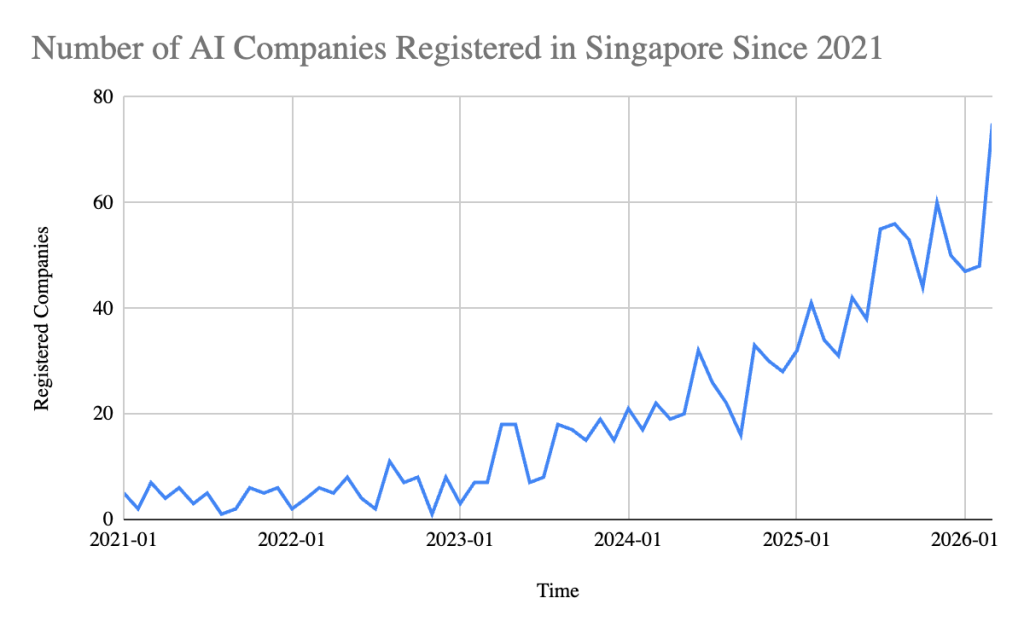
The chart above covers ACRA registration data via ssicdata.com.
Two key factors drove this growth:
- The launch of ChatGPT in late 2022 triggered a global rush to form AI-related businesses. Singapore's policy response followed quickly.
- Budget 2024 and Budget 2025 dedicated compute subsidies and expanded R&D tax deductions. This made it materially cheaper to build and train models on local infrastructure.
By the time Budget 2026 arrived, Singapore had assembled one of the most complete AI startup ecosystems in the region. They combined compute access, grant funding, and a clear governance framework, which gives both investors and enterprise buyers the confidence to deploy.
Understanding AI Governance for Companies in Singapore
Singapore’s AI governance spans national regulators, baseline data protection laws, and advisory frameworks that shape how AI systems are built and commercialized. At the center of this system are three key authorities:
- The Ministry of Digital Development and Information (MDDI): Formerly known as MCI, this ministry now oversees the overarching digital strategy through the newly formed National AI Council.
- The Infocomm Media Development Authority (IMDA): Develops national AI governance frameworks and testing tools such as the AI Verify Toolkit.
- The Personal Data Protection Commission (PDPC): Enforces data protection laws and regulates how personal data is used in AI systems.
- Sector regulators (MAS, HSA, LTA): Impose additional rules where AI is applied in regulated industries such as finance or healthcare.
Singapore’s approach emphasises demonstrable accountability. This means your company must be able to demonstrate, not just claim, that your AI systems are explainable, governed, and subject to human oversight where necessary.
Key Frameworks AI Companies Must Adhere in Singapore
To operate commercially, your AI systems should align with Singapore’s core governance stack. This combines legally enforceable obligations with widely adopted national frameworks:
- Personal Data Protection Act (PDPA): Singapore's primary data protection law governing how personal data is collected and used. For AI companies, this directly shapes your training data pipeline, specifically how datasets are sourced, processed, and retained. The PDPA mandates you to:
- Appoint a Data Protection Officer (DPO) to oversee compliance with AI frameworks.
- Conduct a Data Protection Impact Assessment (DPIA) where AI systems process local consumer data.
- Establish a lawful basis (such as consent or legitimate interests) when processing personal data.
- Appoint a Data Protection Officer (DPO) to oversee compliance with AI frameworks.
- Conduct a Data Protection Impact Assessment (DPIA) where AI systems process local consumer data.
- Establish a lawful basis (such as consent or legitimate interests) when processing personal data.
- Sectoral Regulations (MAS, HSA, LTA): Regulators in your specific industry sector, such as finance, healthcare, or transport, provide overriding legal authority. Approval is typically required before the commercial launch of your product, often involving a rigorous pre-market technical assessment or licensing application.
- Model AI Governance Framework for Agentic AI (2026): Published by IMDA, this is a voluntary "soft law" benchmark. Aligning with this framework is often a commercial prerequisite for government contracts or high-tier bank onboarding. Key focus areas include:
- Assess and Bound Risks: Restricting an agent's Action-Space based on the sensitivity of the task. For example, a customer service bot should be Sandboxed to only read from a database, while a wealth management agent may be granted "write" access only within predefined financial limits.
- Meaningful Human Accountability: Implementing Human-in-the-loop (HITL) checkpoints, where a human can override autonomous actions that carry high financial or safety risks.
- Technical Controls: Enforcing Least-Privilege access to APIs and databases. Includes implementing Tool-Calling Guardrails to prevent prompt injection attacks that can trick an agent into calling unauthorized external systems or exfiltrating sensitive model weights.
- Assess and Bound Risks: Restricting an agent's Action-Space based on the sensitivity of the task. For example, a customer service bot should be Sandboxed to only read from a database, while a wealth management agent may be granted "write" access only within predefined financial limits.
- Meaningful Human Accountability: Implementing Human-in-the-loop (HITL) checkpoints, where a human can override autonomous actions that carry high financial or safety risks.
- Technical Controls: Enforcing Least-Privilege access to APIs and databases. Includes implementing Tool-Calling Guardrails to prevent prompt injection attacks that can trick an agent into calling unauthorized external systems or exfiltrating sensitive model weights.
While the Model Framework is advisory, they directly influence your ability to secure local contracts and scale your AI operations within Singapore. Emerhub can identify key requirements that apply to your specific business model. Schedule a free consultation with our advisors here.
Defining the Business Model and Structure of Your AI Company in Singapore
Selecting the appropriate legal framework is crucial when setting up your AI company in Singapore. Your choice of entity and activity classification affects how you hold your IP, manage risk, and scale over time.
For AI companies, this becomes especially important. Your setup needs to support how your product is built and monetized. The sections below walk through the key decisions that shape this foundation.
Choosing the Right Legal Entity
The entity you choose should match how you plan to operate and grow. In practice, most AI businesses fall into a few common setups depending on whether you are starting a new company, expanding from overseas, or managing investment structures. Here are the most relevant options:
- Private Limited Company (Pte Ltd): The standard route for most AI startups. It creates a separate legal entity, shielding you from liabilities such as system failures and company debts. It also gives you a clear structure to hold and license your AI assets while qualifying for major tax exemptions and incentives (covered below).
- Branch Office: Allows you to extend an established company into the region. The trade-off is that there is no legal separation. Any liabilities in Singapore flow directly back to the parent company.
- Variable Capital Company (VCC): A specialized vehicle for AI-driven investment funds or "Wealth-Tech" ventures. Allows you to segregate different AI strategies, assets, and liabilities across multiple sub-funds under a single corporate umbrella.
Note on Representative Office (RO) for AI Activities: A Representative Office cannot run a commercial business. It is limited to non-revenue activities such as market research and feasibility studies. You cannot deploy products, sign on clients, or generate income under this structure.
Naming Conventions and Strategic AI Branding
Your company name signals your specific niche to investors. Today, founders are growing more practical about this. Rather than slapping "AI" onto a generic name, they're pairing it with clear industry terms that show where they operate in the value chain.
Recent registry data from SSICData.com identifies how these naming conventions are shaping up across the ecosystem:
| Naming Cluster | Primary Keywords | Strategy |
|---|---|---|
| Advisory & Transformation | Consulting, Digital, Vision (e.g. Data and AI Consulting Pte. Ltd.) | Indicates a service-based offering. Helps corporate teams quickly recognize your business as a vendor for advisory or implementation work. |
| Sector-Specific AI | Wealth, Education, Marketing, Medical (e.g. Black Pisces AI Marketing Pte. Ltd.) | Uses industry-specific keywords to remove ambiguity. Transparency helps fast-track regulatory vetting and bank onboarding. |
| Infrastructure & Backend | Cloud, Solution, (e.g. Genix Cloud AI Pte. Ltd.) | Signals that the company builds foundational tools or engines. This helps corporate procurement teams identify you as a core technology vendor. |
| ESG & National Priorities | Green, Art, Foundation (e.g. Allbest Green-AI Engineering Pte. Ltd.) | Shows alignment with national priorities. This can support grant positioning and public sector partnerships. |
SSIC 2025 Classifications for AI Ventures
Your business activity code (SSIC) must align with the latest 2025 classifications. It determines your eligibility for the Budget 2026 AI grants (covered in the section below). During registration with the ACRA, you can select up to two codes: one primary and one secondary.
If you’re building products and delivering services, capturing both helps you stay eligible for multiple grant tracks and avoids issues if your revenue mix shifts over time. Based on data from SSICData.com, the chart below captures the most relevant codes for AI-centric ventures in Singapore today:
SSIC Compliance Tip: Use the Primary Business Activity Description field (70 characters) during incorporation to define your focus clearly (e.g., “Development of generative AI models for enterprise automation.”) This helps grant agencies understand your scope without triggering the delays that sometimes come with more experimental classifications.
Corporate Structure and Key Officers
Every Singapore company must satisfy specific statutory requirements to remain compliant. For AI ventures, these roles extend beyond administrative duties into data governance:
- Resident Director: Appoint at least one director who ordinarily resides in Singapore (Citizen, PR, or EntrePass holder). Foreign founders typically engage a Nominee Director service initially to satisfy this requirement while they manage the business from abroad.
- Company Secretary: Appoint a qualified resident secretary within six months of incorporation. They act as the primary liaison with ACRA for all statutory filings, including the maintenance of the Register of Registrable Controllers (RORC).
- Data Protection Officer (DPO): AI companies must designate a DPO upon incorporation. This individual is legally responsible for ensuring your model training and data processing comply with the Personal Data Protection Act (PDPA).
Physical Office Compliance: A virtual office is acceptable for basic compliance. However, securing high-tier grants or applying for Employment Passes (EPs) typically requires proof of a physical office. The Ministry of Manpower and grant agencies often expect a dedicated workspace, such as a co-working office in tech clusters like one-north.
How to Set Up an AI Company in Singapore: Step-by-Step Process
Establishing your AI company starts with an online registration through ACRA’s BizFile+ portal. Under Section 28(2) of the ACRA Act 2004 and the Corporate Service Providers (CSP) Act 2024, foreign founders must engage a licensed CSP to submit their incorporation papers. Emerhub can serve as your authorized CSP, managing every step below to ensure your full compliance.
Step 1: Name Reservation and ACRA Registration
First, secure your company name and file the formal incorporation documents. Once you provide the necessary particulars, we handle the notarization and digital submission to ACRA. You must prepare the following mandatory documents:
- Proposed Company Name: Ensure your name is unique by cross-checking existing companies via Emerhub’s Company Search Tool. Avoid "referral keywords" (e.g., "Bank", "Trust", "Finance") which trigger 14-day manual reviews by the Monetary Authority of Singapore (MAS).
- Shareholder & Director Particulars: High-resolution passport copies and proof of overseas residential address for all stakeholders.
- Signed Consent Forms: Official ACRA Form 45 for directors and Form 45B for the company secretary.
- Customized Company Constitution: We recommend a customized version that includes specific clauses for Intel Property (IP) assignment and future Series A/B equity structures.
At this stage, you must also lock in your SSIC codes and determine your initial Paid-up Capital. We recommend a minimum paid-up capital of S$10,000. While the legal requirement is S$1, higher capital demonstrates a feasible substance for bank approvals and relocation visas (EP/EntrePass).
Step 2: Beneficial Ownership Disclosure (RORC)
Upon approval, you will receive your Unique Entity Number (UEN) and the Business Profile (Bizfile). These are your company’s official identification documents.
You must also disclose your "controllers" to the Register of Registrable Controllers (RORC). A controller is any individual holding more than 25% of the shares or possessing significant influence over the company.
Tip for holding structures: Suppose a US-based Delaware C-Corp owns 100% of your Singapore subsidiary. You must "look through" the parent company and identify the natural persons who ultimately own or control that parent corporation. Any lack of clarity here will stall your banking and EP applications.
Step 3: Opening a Bank Account and Managing Financial Accounts
With your UEN issued, you can formally initiate your business infrastructure. Opening a corporate bank account typically takes up to 8 weeks for foreign companies. Under the 2026 MAS Project MindForge guidelines, banks now perform specialized "Know Your Product" (KYP) reviews for AI firms to assess:
- Your business model and revenue flows
- Source of funds and ownership structure
- Compliance risks based on your industry
Clearly documenting how your product works, how data is handled, and how revenue is generated can significantly improve approval outcomes. A well-defined business profile, aligned with your SSIC classification, also helps reduce delays.
Step 4: Labor and Payroll Compliance
Before making your first hire or applying for Work Passes, you must first obtain a CPF Submission Number (CSN) from the Ministry of Manpower (MOM). This allows you to set up your Work Pass Account and manage local employment levies.
Pro Tip: You can leverage the Shortage Occupation List (SOL). AI scientists and engineers on this list grant your candidates 20 bonus points under the COMPASS framework, often shortening visa approval times to 3–6 weeks.
Your ongoing payroll obligations include:
- Levies: You must pay the 0.25% Skills Development Levy (SDL) monthly for all employees.
- Central Provident Fund (CPF): Social security contributions are mandatory for Singapore Citizens and Permanent Residents. Foreign employees on work passes are exempt.
- Tax Reporting: You must also register for the Auto-Inclusion Scheme (AIS) under IRAS. This allows you to digitally report income for all staff (including foreign hires and directors) directly to tax authorities, replacing manual IR8A forms.
Step 5: Sector-Specific and Final Approvals
The final step in operationalizing your business involves meeting data protection and industry-specific requirements where applicable.
- Mandatory DPO Designation: As per the PDPA, appointment of a Data Protection Officer (DPO). AI ventures cannot legally process personal data (including training datasets) without one. You must formally register their details via the PDPC's online form immediately after incorporation to complete your legal activation.
- Sector-Specific Licensing: If you’re building general-purpose AI tools (e.g. workflow automation or internal productivity software), you can typically begin operations after your DPO appointment. However, additional approvals are mandatory if your core activities fall within regulated sectors such as:
- Financial Services: Your solutions provide digital investment, asset management, or advisory services. A Capital Markets Services (CMS) licence from the Monetary Authority of Singapore (MAS) is mandatory.
- Healthcare & MedTech: You develop AI systems used in diagnosis or clinical decision-making. Requires approval from the Health Sciences Authority as Software as a Medical Device (SaMD).
- Autonomous Transport & Mobility: You build AI systems controlling vehicle behaviour on public roads. Must comply with testing and deployment requirements set by the Land Transport Authority.
- Financial Services: Your solutions provide digital investment, asset management, or advisory services. A Capital Markets Services (CMS) licence from the Monetary Authority of Singapore (MAS) is mandatory.
- Healthcare & MedTech: You develop AI systems used in diagnosis or clinical decision-making. Requires approval from the Health Sciences Authority as Software as a Medical Device (SaMD).
- Autonomous Transport & Mobility: You build AI systems controlling vehicle behaviour on public roads. Must comply with testing and deployment requirements set by the Land Transport Authority.
- Enterprise Market Readiness (Commercial Prerequisite): Even for non-regulated AI, most major vendors, government GLCs, and financial institutions will refuse to deploy your software until it clears IMDA’s AI Verify self-assessment or carries a Data Protection Trustmark (DPTM).
It takes between 1–3 days to incorporate your company. However, you remain non-operational until your corporate bank account is active and you secure the necessary sectoral permits. Most products must also clear the mandatory 3–6 month vetting process before commercial use.
Securing Incentives and Grants for AI Startups in Singapore
Singapore offers a range of incentives to support innovation, R&D, and deep-tech growth. These national schemes are highly relevant to AI startups, particularly those investing in proprietary technology and local capability building.
| Incentive Scheme | Target Focus | Key Requirements | Primary Benefit |
|---|---|---|---|
| Champions of AI Programme | Flagship initiative for firms building foundational models or scaling AI enterprise-wide. | - IMDA project approval - minimum 3 local AI professionals - physical office lease - commitment to AI as a core productivity driver. | - Priority access to National AI Compute (H100/B200 clusters). - Dedicated solutions architects. - Cash grants of up to S$1,000,000 to cover up to 50% of qualifying R&D costs. |
| National AI Impact Programme (NAIIP) | AI adoption and workforce transformation. | Commitment to train staff as "AI Bilingual" specialists; must be a Singapore-based enterprise. | Subsidies to upskill 100,000 workers across industries and access to curated datasets. |
| Enhanced EIS (Tax Deduction) | Startups investing in proprietary AI development. | Qualifying AI spend in YA 2027/2028; capped at S$50,000 yearly. | 400% tax deduction on AI software, model training, and data engineering. |
| Startup SG Equity (Enhanced) | Early and growth-stage deep-tech ventures. | Deep-tech focus requires co-investment from private VC partners. | S$1 billion government pool to catalyze private capital and scale operations. |
| Kampong AI Residency (Pilot; estimated launch in 2028) | Founders and researchers in AI. | Relocation of core IP and team to the One-North business park cluster. | Immediate access to Lorong AI collaborative workspaces and networking with Grab, Razer, Sea, and A*STAR. |
| Corporate Tax Rebate | All active companies with local substance. | Must have employed at least one local employee in 2025. | 40% tax rebate (capped at S$30,000) to offset initial setup and infrastructure costs. |
Emerhub provides comprehensive support for AI ventures and tech founders. We can handle your company incorporation, grant applications, and ongoing statutory compliance so you can focus on scaling your business.
Ready to establish your AI company in Singapore? Schedule a free consultation with our local advisors to get started.
Frequently asked questions
1. How long does it take to set up and register an AI company in Singapore?
Incorporating your company (UEN issuance) takes between under 1–3 days, depending on your documentation. However, reaching a "Fully Operational" status (banking, EP, and sectoral approvals) often takes 4–8 weeks, or longer, depending on the complexity of your business model and documentation.
2. Can I operate my AI company remotely in Singapore?
While you can use a Virtual Office for statutory compliance during the registration phase, you cannot operate "remotely" if you intend to sponsor Work Passes (EP) or claim high-tier AI compute grants. The Ministry of Manpower (MoM) and grant agencies require a physical commercial space or dedicated co-working lease to prove local substance. Additionally, you must maintain at least one Resident Director in Singapore at all times.
3. Do I need a physical lab or office to claim AI grants in Singapore?
A virtual office is sufficient for basic incorporation and accessing broad, non-specific incentives like the Corporate Tax Rebate, provided you have at least one local employee. However, for major AI-specific incentives like the Enterprise Innovation Scheme (EIS) or cash grants from the Champions of AI programme, a virtual office is usually insufficient. To qualify, you must demonstrate "commercial substance" by maintaining a physical workspace and a local technical team. This ensures that your R&D and model development are truly anchored in Singapore.
4. How does a Pte Ltd structure protect my AI Intellectual Property (IP)?
A Pte Ltd allows the company to hold legal ownership of all intellectual property it develops, including code, models, datasets, and system architecture. This centralises ownership within a single entity, which is crucial for licensing, enforcement, and future transactions. Protection comes from how ownership is structured. You can formally assign all IP created by founders, employees, or contractors to the company through IP assignment clauses or agreements. Without this, ownership can remain fragmented, which creates problems during fundraising or commercialisation. Most investors make it a baseline requirement for investment and commercial partnerships.
5. Do I need to obtain Data Protection Trustmark (DPTM) certification for my AI company?
DPTM is not a legal requirement under Singapore law, but it becomes highly relevant once you move beyond early-stage product development. If your AI system handles customer data at scale, especially in B2B environments, DPTM signals that your data governance practices have been independently assessed. The certification process is conducted by IMDA-accredited third-party bodies. Emerhub can guide you through key requirements and handle the application process on your behalf.
6. At what point does my AI product trigger regulatory scrutiny in Singapore?
Regulatory scrutiny does not occur at the point of incorporation. During ACRA registration, authorities verify your legal structure, including directors, capital, and SSIC codes, but do not review your software. Formal scrutiny begins only once your product is market-ready. This means it is either ready for sale, commercial distribution, or to be deployed in a live environment to make decisions with regulatory consequences. Each product is assessed independently by its respective sector regulator based on its specific risk profile.