
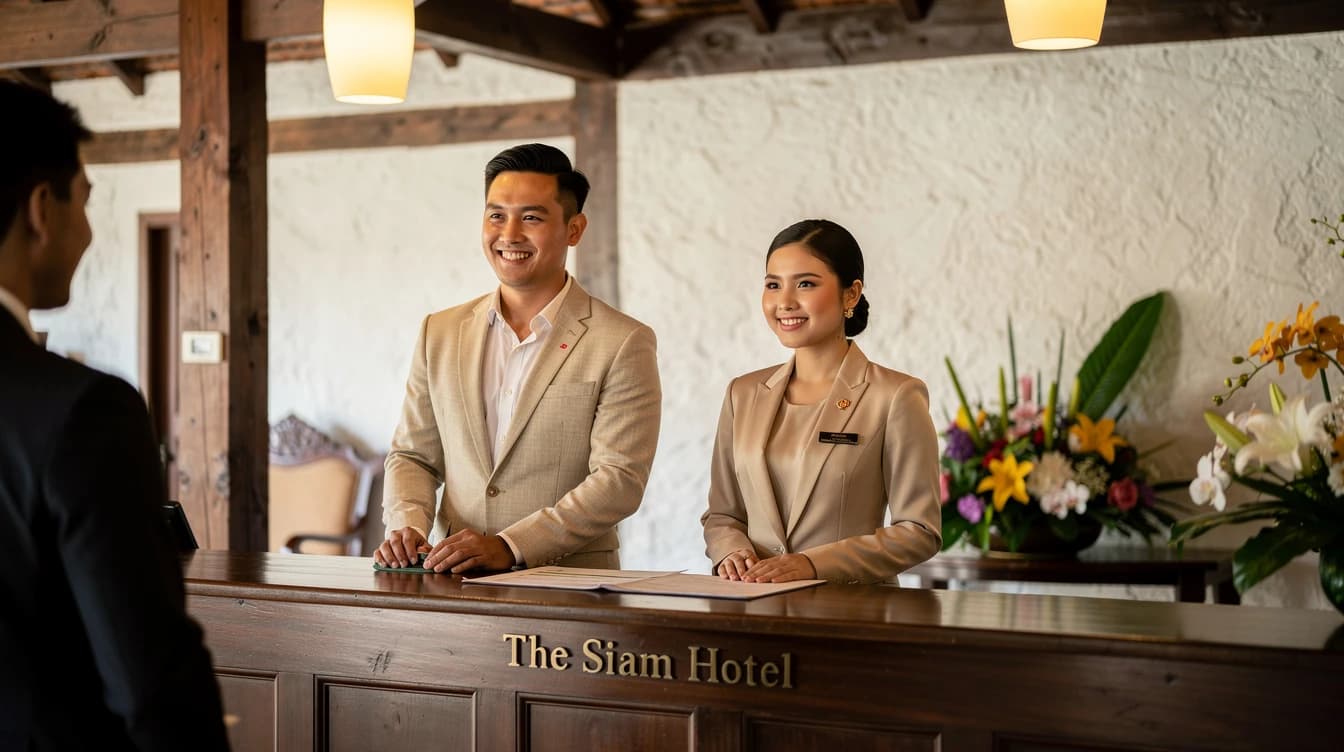
If you are planning on setting up hotel operations in Thailand, you need a hotel license. Without this license, you cannot legally collect payment from guests, list on major booking platforms, or secure hotel-specific financing or insurance. The Thai government has strictly enforced this requirement, especially for foreign-owned Airbnb condo units in Bangkok as well as guesthouses in Phuket and Pattaya.
In this guide, we will walk you through how to secure a hotel license in Thailand as a foreigner. We’ll cover the main types that are available, their key requirements, and the step-by-step application process.
What is Considered a Hotel in Thailand?
Under Section 4 of Thailand's Hotel Act, B.E. 2547 (2004) defines a hotel as any commercial property that provides temporary accommodation to travelers in exchange for payment.
If your property meets this definition, you cannot legally accept paying guests without the correct hotel license, no matter how the property is branded or marketed.
Exemption: You can register your business as a non-hotel accommodation (type 0) and be exempted from obtaining a full license. To qualify, your property should be no more than eight rooms across one or more buildings and a maximum of 30 guests.
The Four Types of Hotel Licenses in Thailand
Under the Hotels Act, there are four types of hotel licenses depending on both physical attributes and services you offer as a business. Your property should match the intended license type.
| Type | Services | Details |
|---|---|---|
| Type 1 | Accommodation only | For properties that provide rooms only (typically lower‑star guesthouses or hostels) capped at 50 rooms. |
| Type 2 | Accommodation + restaurant | Adds on-site dining/catering and allows larger room (≥8 m²) counts. |
| Type 3 | Accommodation + restaurant + seminar rooms | Includes dining or kitchen facilities. Room-size minimums typically increase (examples cite ≥14 m² for this class). Environmental Impact Assessment (EIA) and other thresholds can apply once room counts exceed certain levels (commonly ~80 rooms). |
| Type 4 | Accommodation + restaurant + seminar + entertainment | Allows entertainment venues on site and is aimed at higher-tier hotels (4‑star and above). Also includes hotels with 24‑hour service/security standards, and may trigger EIA and higher regulatory scrutiny. |
Note that hotels with fewer than 80 rooms are not permitted to include entertainment venues at all, regardless of which type they apply under. The classification you choose affects the government fees, the inspection standards, and the scope of the compliance obligations that follow.
Buying Condominium for Airbnb: Many foreign investors often think that buying a condo and listing it on Airbnb sits outside the hotel regulation. Thai courts have confirmed that renting out residential units on a daily or weekly basis falls under the Hotel Act regardless of whether the building is a hotel or a private condominium. Rentals of one month or longer generally fall outside the Hotel Act's scope.
Can Foreigners Own a Hotel Business in Thailand?
Hotel operation falls under List 3, Item 17 of Thailand's Foreign Business Act, which means a standard limited company running a hotel needs at least 51% Thai shareholding. As a foreign investor, you'd hold up to 49% and partner with a Thai shareholder for the rest. This is the most common structure for small and mid-sized hotels and guesthouses.
There are multiple pathways that allow you to own 100% of an accommodation business:
- Foreign Business License (FBL): Lets you exceed 49% ownership, but requires approval from the Department of Business Development, a minimum capital commitment, and a case made for how the project benefits the Thai economy.
- BOI promotion: The most attractive option if your project qualifies. It allows up to 100% foreign ownership plus tax incentives. Requires at least THB 100 rooms or THB 500 million in investment (or roughly THB 2 million per room), or a smaller SME track for 20–99 rooms at around THB 1 million per room.
- US-Thai Treaty of Amity: US nationals and US-majority-owned companies can hold a majority stake without the 51% Thai requirement.
- Thailand-Australia Free Trade Agreement (TAFTA): Australian investors can hold up to 60% of a luxury hotel project under specific conditions.
- Pure hotel management: If you're only managing a property rather than owning and operating the hotel business itself, this isn't subject to the foreign ownership restriction at all.
What you can’t do as a foreigner: You can't own the land directly because the Land Code Act bars foreign land ownership. This is why most projects run on a long-term leasehold instead. Nominee structures are also illegal in Thailand. Under these arrangements, a Thai shareholder holds majority shares on paper, but a foreigner is the true owner of the business or property. Thai authorities actively investigate these setups, with hotels and resorts high on their target list.
Hotel License Application Process in Thailand
To secure a hotel license in Thailand, you need to coordinate with several government departments. The processing timeline is usually around six months but can be longer depending on where your business is located and the complexity of the property.
1. Construction or Building Permit
The property needs a permit from the local district office, signed off by a licensed engineer or architect, confirming the building is legally classified for hotel use. If the property is leased and already completed, the landlord or original developer usually already holds this documentation. If the building was previously used for another purpose, such as a residential unit or shophouse, the permit needs to be amended to reflect hotel usage before you can move forward.
2. Hotel License Application
Depending on your location, the application goes to the Department of Provincial Administration (DOPA) in Bangkok or to the Provincial Governor’s Office at the Provincial Hall in other provinces.
The filing will require the following documentation:
- Company registration documents
- The construction or building permit showing approval for hotel use
- Interior layout plans and floor plans for the property
- A location map confirming the property is not situated too close to a school or temple
- Identification documents for the company director or applicant, who must be Thai if signing on behalf of a foreign-owned entity
- Details of the proposed hotel manager, submitted alongside or shortly after the main application
3. Inspection
Health, environmental, and construction authorities conduct a joint inspection to verify the premises meet safety and sanitary standards. Hotels with 80 rooms or more require a full Environmental Impact Assessment (EIA). Meanwhile, smaller hotels in high-density tourist areas such as Pattaya, Phuket, or Koh Samui may still need an Initial Environmental Examination (IEE).
Fire safety is also checked at this stage, including fire-resistant construction for buildings of three floors or more and a compliant fire escape for buildings of four floors or more.
4. Hotel Manager Registration
Every licensed hotel must designate a qualified manager, who must be registered with DOPA or the provincial office. The manager can also be the hotel operator, provided they meet the requirements under Section 33 of the Hotel Act:
- Holds a certified hotel management qualification, documented experience recognized by the Hotel Business Supervision and Promotion Committee, or completion of a Committee-certified hotel management training program
- At least 20 years of age, with a registered domicile in Thailand
- No history of bankruptcy, and not legally classified as incompetent or quasi-incompetent
- No final judgment of imprisonment, aside from offenses of negligence or minor infractions
- No final judgment connected to sexual offenses, drug offenses, or prostitution
- Not currently in the process of having a prior hotel license or manager registration revoked
The manager can be Thai or a foreign national, provided a foreign manager holds the appropriate work permit and visa.
5. License Issuance
Once inspections clear, the provincial office issues the Hotel Business License along with operating guidelines specific to the hotel's type and size.
For investors acquiring an existing hotel rather than building one, the license can be transferred rather than reapplied for from scratch, provided the new owner meets the same qualification requirements under Section 16 of the Hotel Act. There is no government fee for a straightforward transfer, though fingerprinting of the responsible individual or director is part of the process.
Acquiring an existing hotel: A hotel license can be transferred rather than reapplied,provided the new owner meets the same requirements under Section 16 of the Hotel Act. There is no government fee for a straightforward transfer, though fingerprinting of the responsible individual or director is part of the process.
Emerhub’s local team in Thailand can help you choose the right structure and manage your license application from start to finish. We can help you coordinate with provincial offices on your behalf and connect with a Thai partner if needed.
Reach out to our experts by filling out the form below and tell us about your plans to build a hotel and accommodation business.
Frequently asked questions
Do I need a Thai partner to open a hotel in Thailand?
Hotel operation is restricted under the Foreign Business Act, so a standard limited company needs at least 51% Thai ownership. You can bypass this requirement with a Foreign Business License, BOI promotion, or, if you are a US national, the Treaty of Amity.
How long does it take to get a hotel license in Thailand?
The process typically takes around six months from application to issuance. However, this depends on the province, the size of the property, and how quickly inspections are completed.
Can I rent out my condo on Airbnb instead of applying for a hotel license?
Thai courts have confirmed that daily or weekly rentals of condominium units fall under the Hotel Act. Only rentals of 30 days or longer are generally exempt from hotel licensing requirements.
What happens if my hotel has fewer than eight rooms?
Since the 2023 amendment to the hotel regulations, properties with eight rooms or fewer and a maximum of 30 guests may qualify as non-hotel accommodation, which requires registration with the local Official Registrar but not a full hotel license.
How long is a Thai hotel license valid, and can it be renewed?
The license is valid for five years from the date of issuance. Renewal is available at half the original government fee, provided the property continues to meet the applicable standards.
Is a hotel license transferable if I buy an existing property?
The license can be transferred to a new owner or operator, provided the transferee meets the qualification requirements under Section 16 of the Hotel Act. There is no government fee for the transfer itself.